Blog
Home / Blog
Blog
  • 688ZZ Deep Groove Ball Bearing: Compact Performance for Precision and Light-Duty Equipment
    688ZZ Deep Groove Ball Bearing: Compact Performance for Precision and Light-Duty Equipment

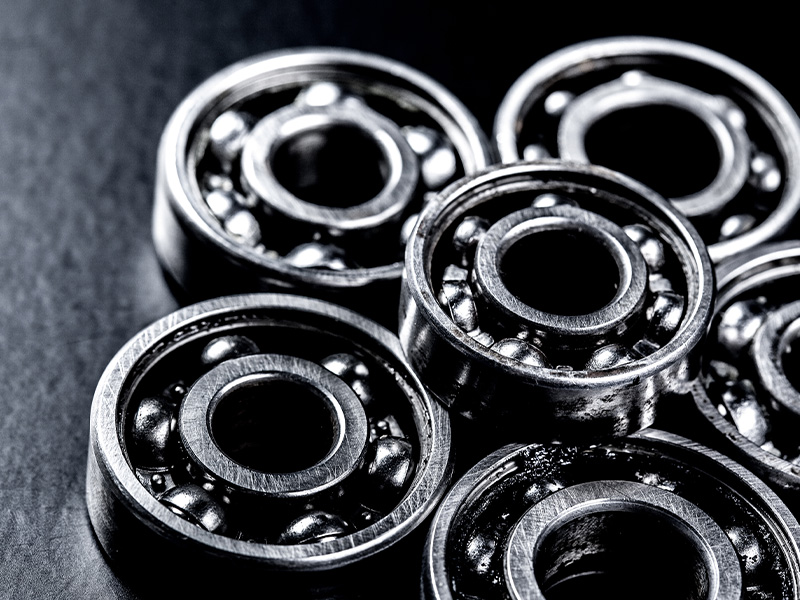
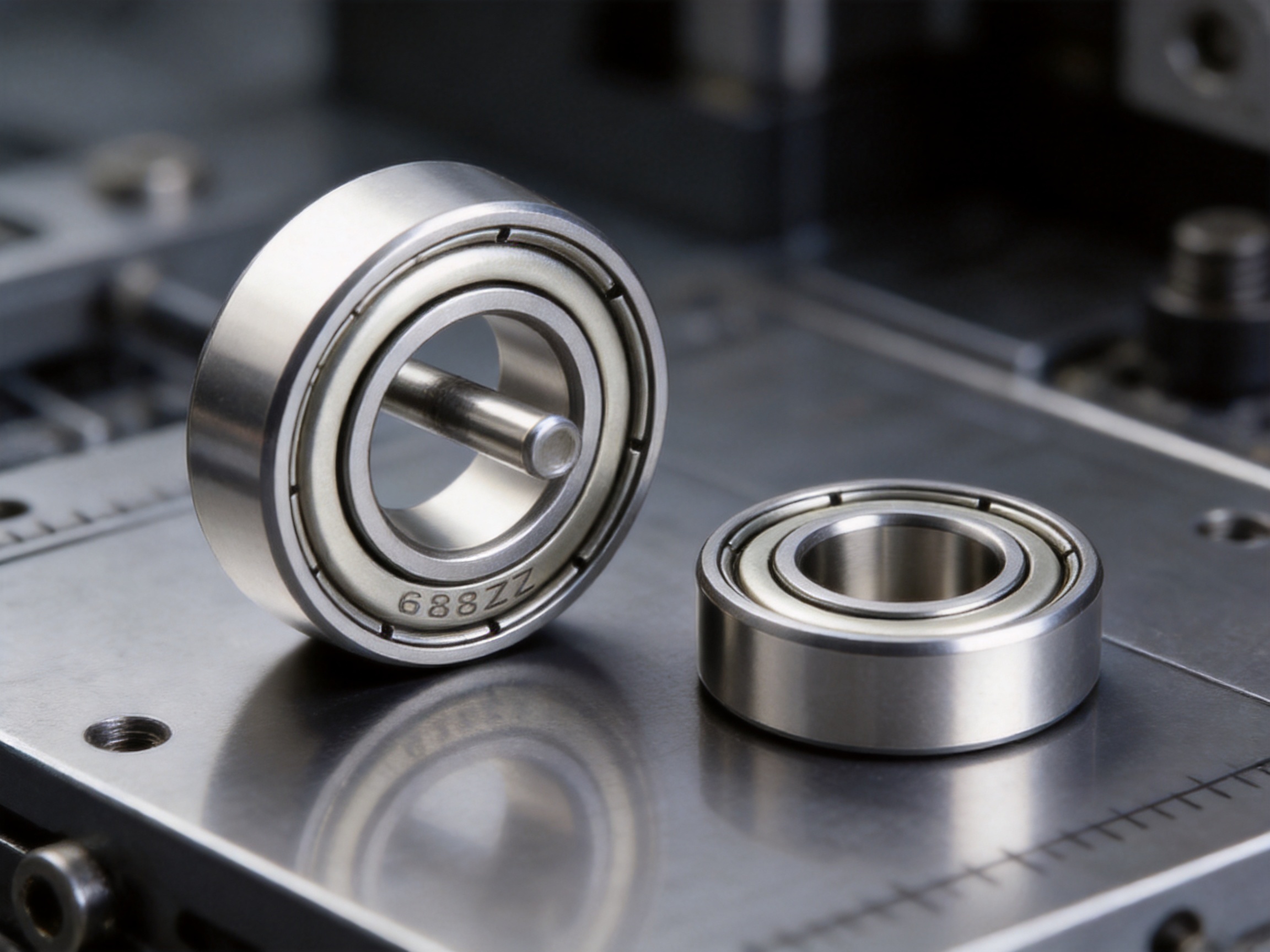
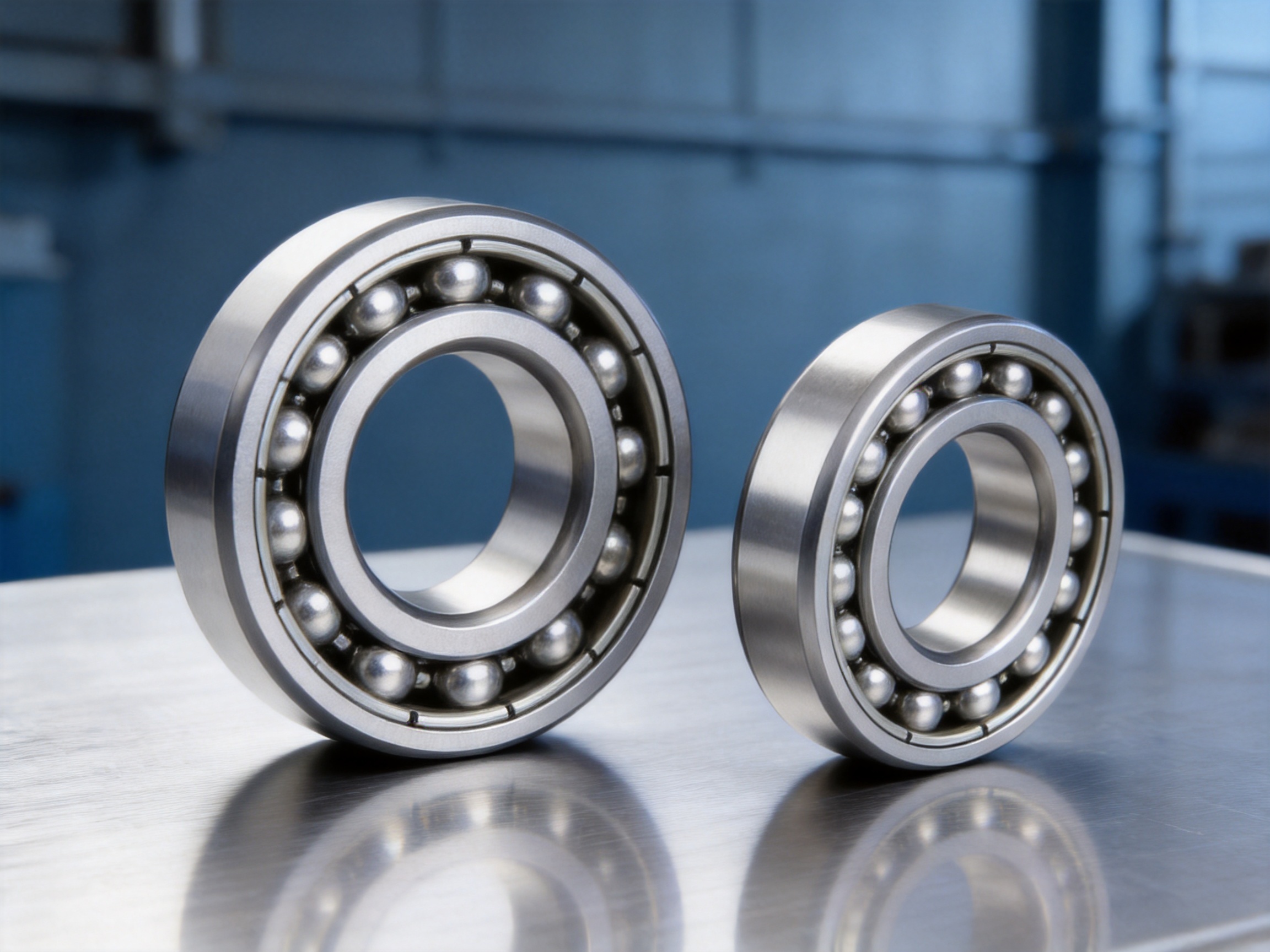
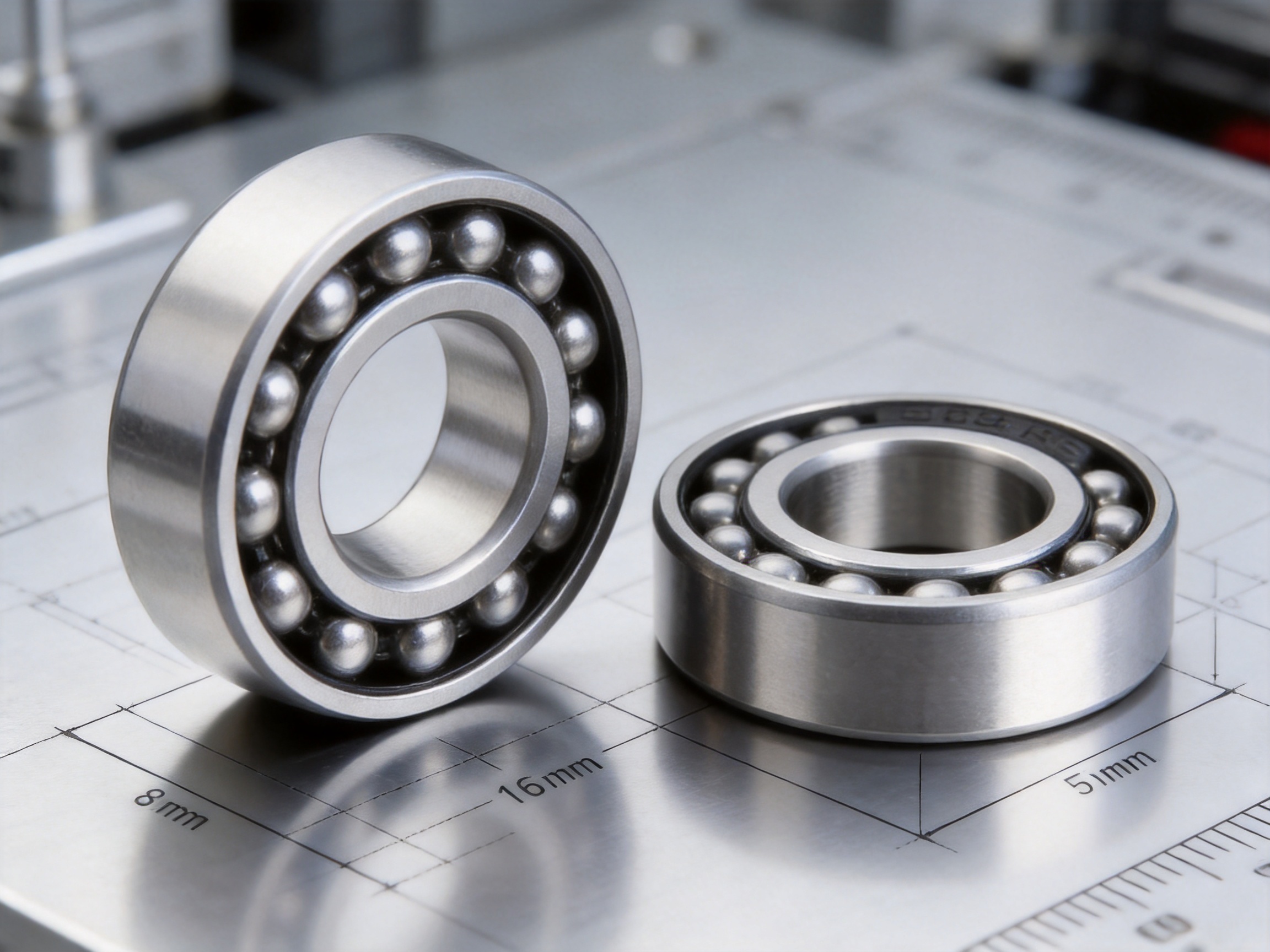
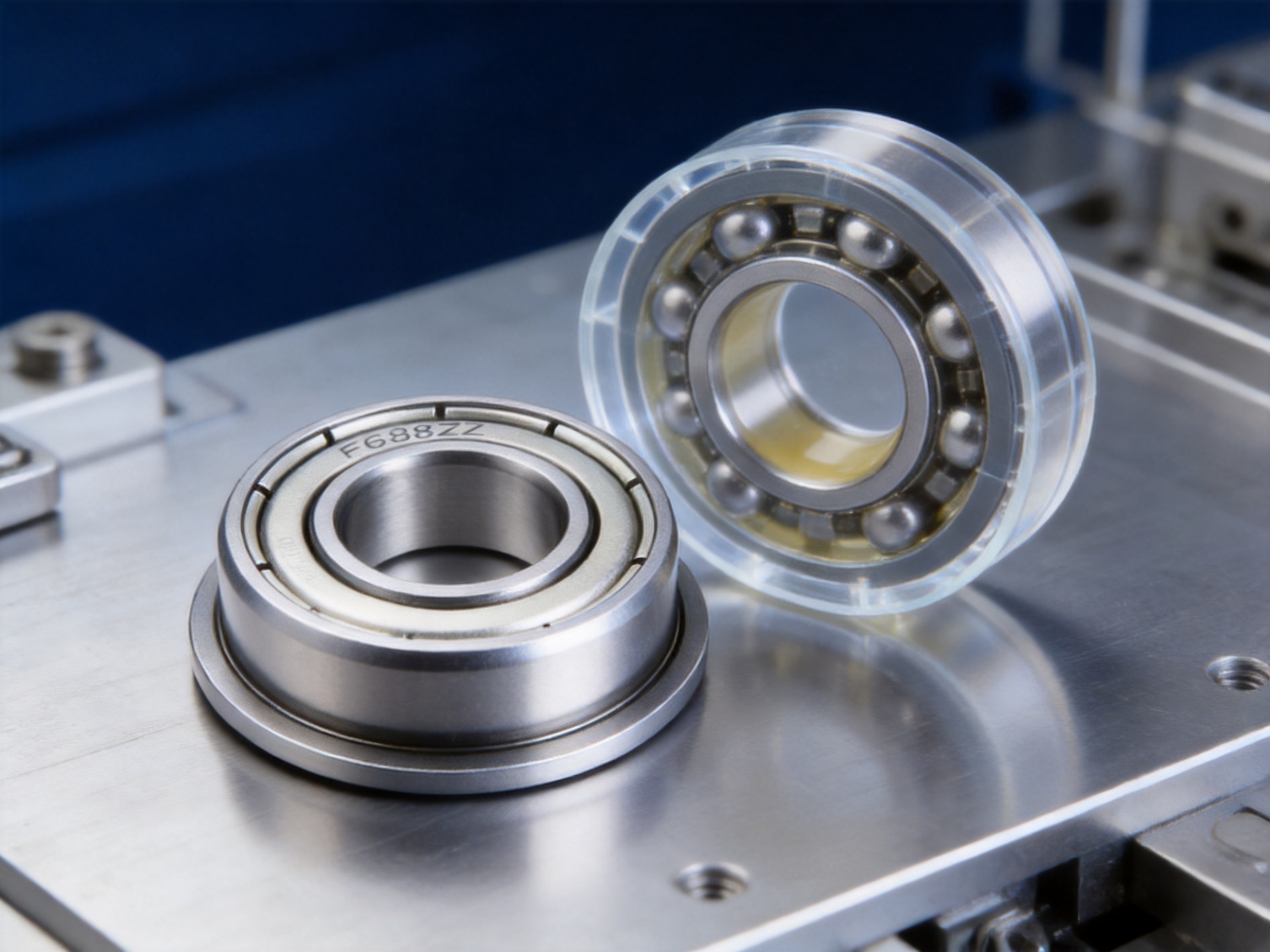
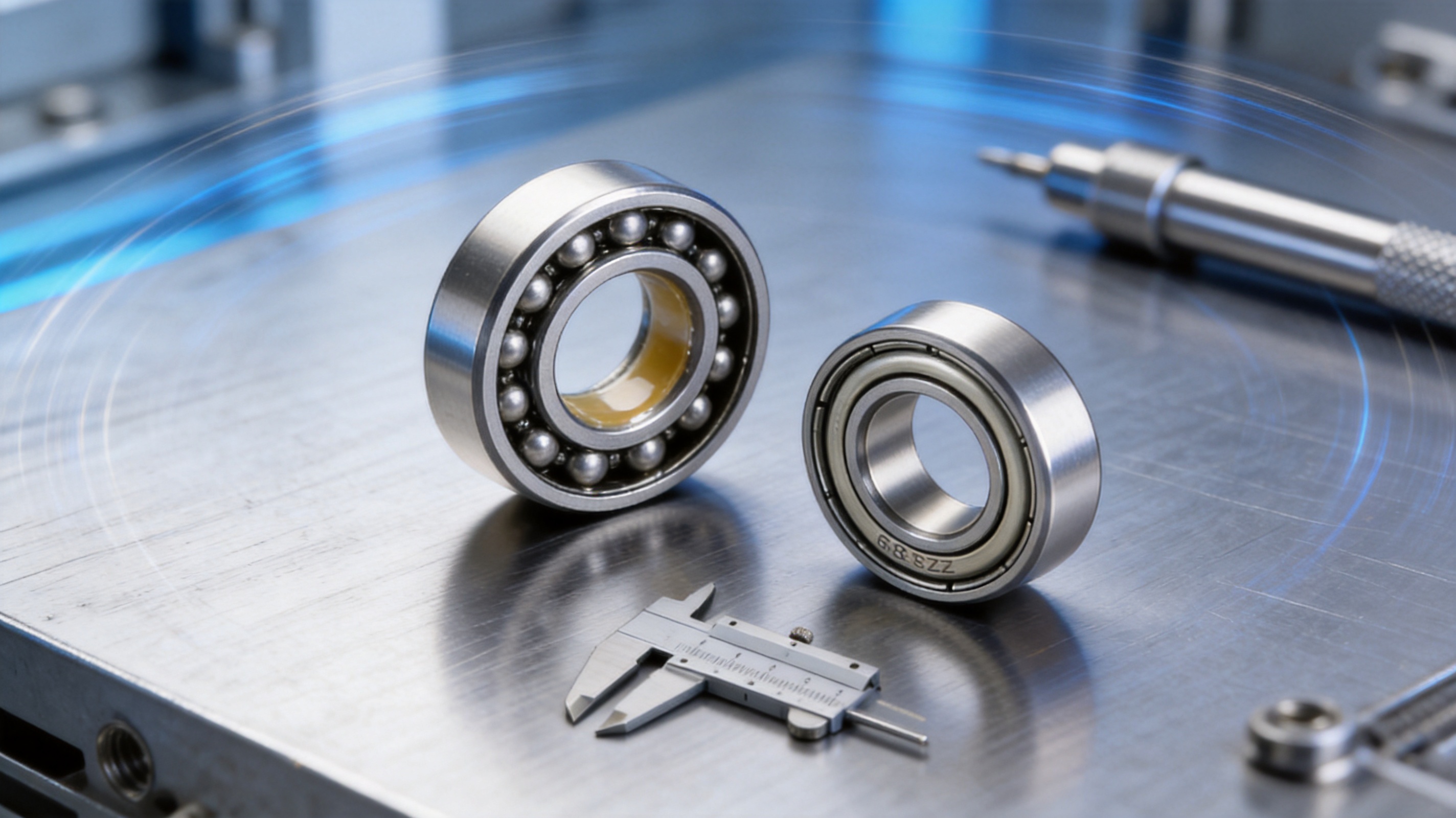
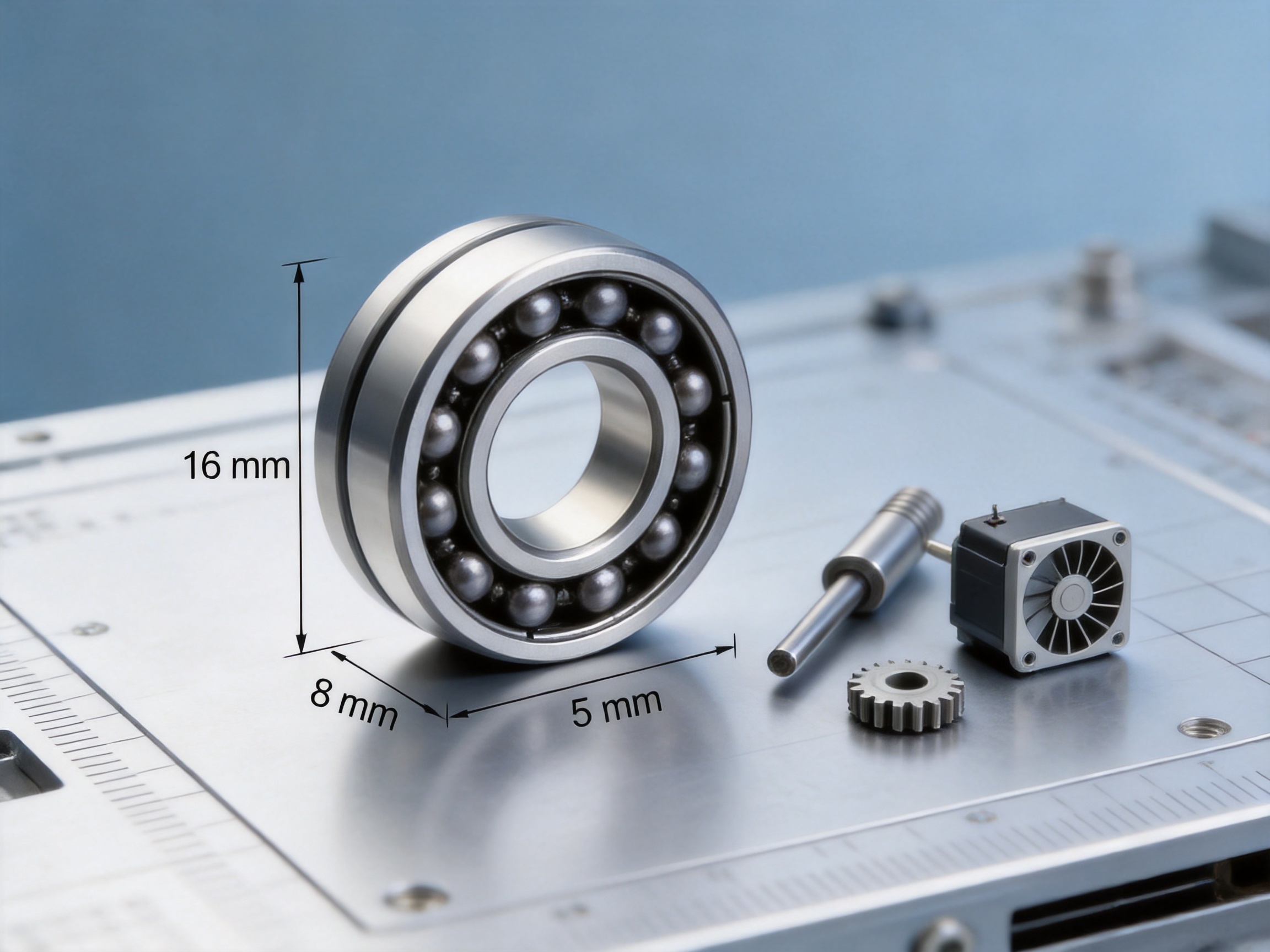
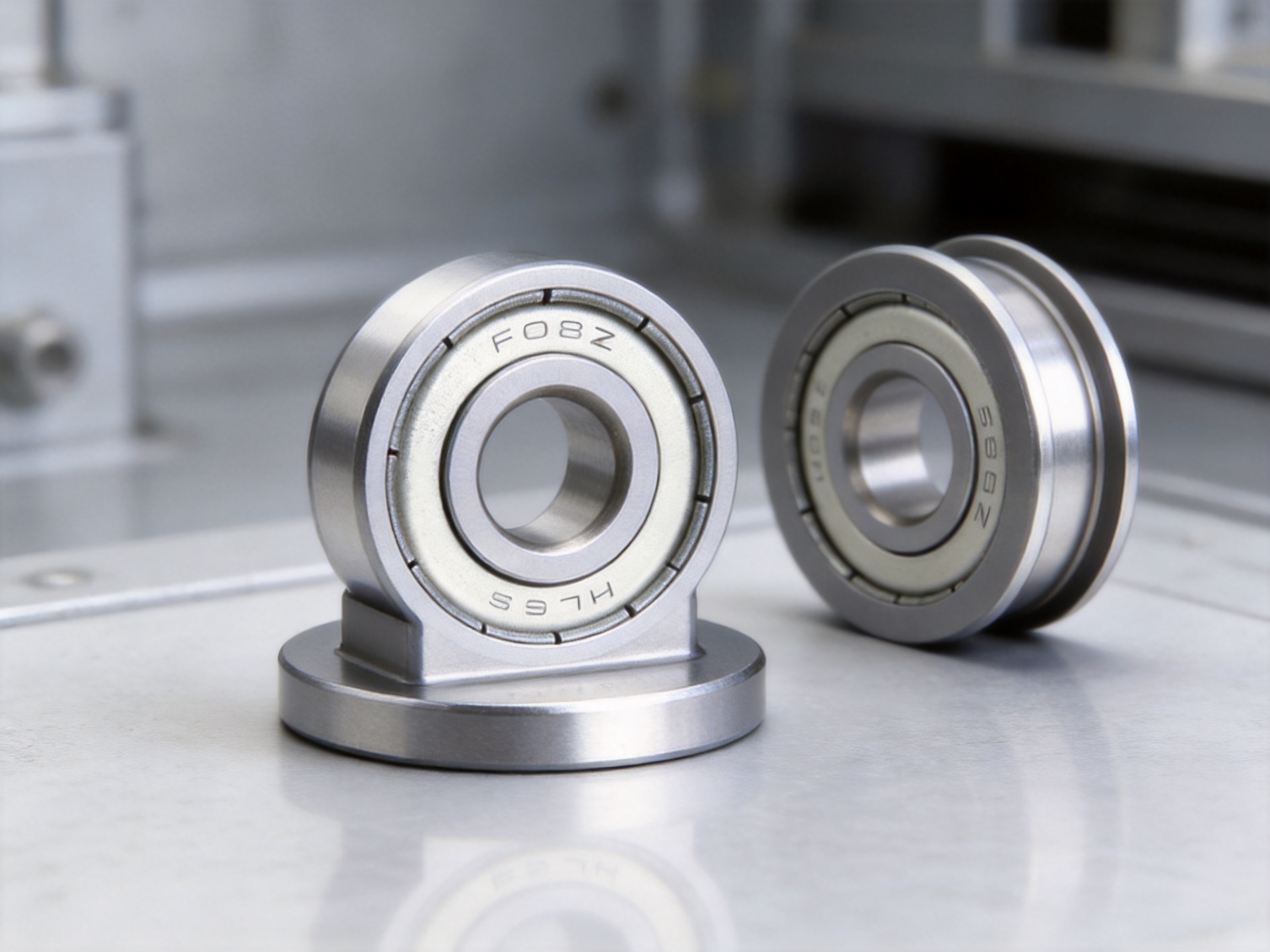
    The 688ZZ deep groove ball bearing is a miniature bearing engineered for applications where limited installation space, smooth rotation, low friction, and dependable service are essential. With an 8 mm bore, 16 mm outside diameter, and 5 mm width, this compact bearing provides a practical solution for equipment designers who need reliable radial support without adding unnecessary size or weight to an assembly. Although miniature bearings are small in physical form, their performance requirements can be demanding. A bearing installed in a miniature motor, office machine, electric toy, precision instrument, or small household appliance may rotate at high speed while operating in a confined space. It must maintain stable movement, limit frictional losses, protect its internal raceway and balls from contamination, and provide consistent service over repeated operating cycles. The 688ZZ is designed around these requirements. Its single-row deep-groove configuration supports radial loads and limited axial loads in both directions. Double metal shields, identified by the ZZ suffix, help prevent dust and other external particles from entering the bearing while helping retain the factory-applied grease. Manufactured from GCr15 bearing steel, the bearing combines a compact design with the hardness, fatigue resistance, and dimensional stability expected from a standard miniature bearing. The bearing has a grease-lubricated limiting speed of up to 36,000 revolutions per minute under suitable operating conditions. Its dynamic load rating is 1,260 N, while its static load rating is 590 N. These values make it appropriate for light-duty and moderate-duty miniature mechanisms in which smooth and efficient rotation is more important than the ability to carry extremely high loads. Product Overview The 688ZZ is a standard miniature single-row deep-groove ball bearing. Its internal arrangement consists of precision-formed raceways, rolling balls, a cage, and double metal shields. The inner ring rotates with the shaft, while the outer ring is normally fitted into a housing or support structure. As the shaft turns, the balls roll between the two raceways, reducing sliding contact and allowing smooth rotational movement. The designation “688” identifies the bearing size and basic series. The suffix “ZZ” indicates that both sides are protected by non-contact metal shields. This configuration is widely used when an application requires contamination protection and grease retention but does not require a contact seal with the additional friction that a rubber seal can introduce. Because the bearing is only 5 mm wide, it can be integrated into assemblies where standard-size bearings would be too large. Its 8 mm bore is suitable for small shafts, and the 16 mm outside diameter allows it to fit into compact bearing seats. The combination of these dimensions gives designers flexibility when developing small motors, miniature gear systems, rotating displays, small fans, electronic mechanisms, and precision devices. ParameterSpecification Bearing number688ZZ Bearing typeSingle-row deep-groove ball bearing Bore diameter8 mm Outside diameter16 mm Width5 mm Shield configurationDouble metal shields, ZZ Dynamic load rating1,260 N Static load rating590 N MaterialGCr15 bearing steel Grease-lubricated limiting speed36,000 rpm The stated ratings and speed capability should always be evaluated together with the application’s actual load, speed, temperature, lubrication, shaft fit, housing fit, alignment, and operating environment. A bearing’s performance in service depends not only on its nominal specifications but also on the quality of the surrounding design and installation process. Compact Dimensions for Space-Constrained Designs One of the clearest advantages of the 688ZZ is its compact envelope. In miniature equipment, every millimeter can influence the final product size, internal layout, weight, and manufacturing cost. A bearing with an 8 mm bore and 16 mm outside diameter can provide a stable shaft support point without requiring a large housing or a substantial structural frame. The 5 mm width is particularly useful in axial layouts where several components must be positioned close together. Designers can place gears, spacers, collars, rotors, pulleys, or small impellers near the bearing while keeping the assembly short. This can contribute to reduced equipment dimensions and may also simplify the arrangement of adjacent components. Compared with larger bearings, the 688ZZ requires less installation space and generally has lower mass. This can be beneficial in portable devices, battery-powered products, compact actuators, and miniature motors in which rotating inertia and total weight are important design considerations. The bearing’s small size also enables manufacturers to use more compact packaging, frames, and support brackets. However, compact dimensions should not be interpreted as unlimited load capacity. The 688ZZ is best suited to light-duty applications and appropriately sized mechanical systems. Designers should confirm that the bearing’s dynamic and static load ratings provide sufficient margin for the combined radial and axial forces generated during normal operation, start-up, stopping, vibration, and occasional shock. Deep-Groove Geometry and Load Support The deep-groove design is one of the most versatile bearing configurations used in rotating machinery. The raceway geometry allows the bearing to support radial loads while also accommodating limited axial loads from either direction. This makes the 688ZZ more flexible than a bearing designed only for one specific load direction. Radial loads act perpendicular to the shaft axis. In a miniature motor, for example, radial force may result from rotor imbalance, belt tension, gear engagement, fan loading, or the weight of a rotating component. The 688ZZ distributes this load through the balls and raceways, allowing the shaft to rotate with reduced friction. Axial loads act parallel to the shaft axis. In compact mechanisms, these forces may be generated by helical gears, thrust from a small impeller, assembly tolerances, or the movement of an attached component. The 688ZZ can accommodate light axial loads in both directions, although excessive axial force can shorten bearing life and increase operating temperature. The single-row arrangement provides a practical balance between compactness and load support. A multi-row bearing could provide higher capacity, but it would usually require more installation space and may be unnecessary for a light-duty mechanism. For applications that require a small, general-purpose support bearing, the single-row deep-groove configuration is an efficient choice. Double Metal Shields for Practical Protection The ZZ configuration means that the bearing is fitted with metal shields on both sides. These shields create a barrier against dust, particles, and general environmental contamination. They also help keep the factory-applied grease inside the bearing during normal service. Metal shields are non-contact components. Unlike contact seals, they normally do not rub directly against the inner ring. This contributes to low friction and supports high-speed operation. For applications in which rotational efficiency, quiet running, and speed are important, the non-contact shield design can provide a useful performance advantage over more heavily contacting sealing arrangements. The shields are not intended to make the bearing completely waterproof or suitable for severe contamination without additional protection. If the bearing is exposed to liquid, abrasive dust, chemicals, washdown procedures, or outdoor weather, the machine designer may need to use external covers, labyrinth structures, protective housings, or a different sealing configuration. Nevertheless, for clean or moderately dusty indoor equipment, the ZZ arrangement offers a practical combination of protection and low running resistance. Double-sided protection is also helpful during handling, storage, and installation. Both sides of the bearing are shielded, so the installer does not need to orient one protected side toward a particular direction. This simplifies assembly and reduces the risk of installing the bearing incorrectly. 688ZZ Deep Groove Ball Bearing Features a Compact Design Ideal for Light-Duty Applications GCr15 Bearing Steel and Material Reliability The 688ZZ is manufactured from GCr15 bearing steel. This high-carbon chromium bearing steel is widely used for rings and rolling elements because it can achieve the hardness, wear resistance, and structural consistency needed for rolling-contact applications. In a ball bearing, the rings and balls repeatedly experience concentrated contact stress. The contact area between a ball and a raceway is very small, so the local pressure can be high even when the overall bearing is carrying a relatively modest load. A suitable bearing steel helps the raceways and rolling elements resist permanent deformation, surface wear, and rolling-contact fatigue. Material selection also affects dimensional stability. Miniature bearings have small raceways and closely controlled internal geometry. Variations in hardness, cleanliness, heat treatment, or microstructure can influence noise, vibration, load capacity, and service life. The use of an established bearing material provides a consistent foundation for the manufacturing and quality-control process. GCr15 steel is not a substitute for correct application design. Excessive contamination, improper mounting, insufficient lubrication, misalignment, electrical current passage, or overloading can damage a bearing regardless of its material. The material provides the necessary performance potential, while correct design and handling are required to realize that potential in service. High-Speed Performance and Low Friction The 688ZZ has a grease-lubricated limiting speed of 36,000 rpm. This high speed capability is valuable in miniature motors, small blowers, compact fans, dental or laboratory mechanisms, office equipment, and other systems where a small shaft rotates rapidly. Several features support high-speed operation. The bearing’s small dimensions reduce the mass of the rolling elements. Its single-row construction limits internal complexity. The non-contact metal shields help control contamination without adding substantial seal friction. The deep-groove arrangement provides stable rolling contact when the bearing is properly aligned and loaded. High-speed performance is also influenced by grease selection and fill quantity. Grease must provide suitable viscosity, adhesion, temperature resistance, and mechanical stability for the intended speed. Too much grease can increase churning and heat generation, while unsuitable grease can separate, dry out, or lose its lubricating properties. The stated limiting speed should therefore be treated as a reference value rather than a universal operating speed for every installation. Low friction is important for both performance and energy consumption. In a miniature motor, unnecessary bearing resistance can reduce available output, increase power consumption, raise operating temperature, and limit battery life. In precision instruments, excessive friction can affect positioning accuracy or create unwanted variation in movement. The 688ZZ is designed to provide smooth rotation with low mechanical resistance when operating conditions are suitable. Low friction can also help reduce noise. Rolling bearings are not completely silent, and noise depends on raceway quality, ball accuracy, cage movement, lubrication, shaft geometry, mounting, and surrounding structure. However, precision manufacturing, suitable lubrication, and a non-contact shield configuration can contribute to quiet operation in appropriately designed equipment. Load Ratings and Application Evaluation The 688ZZ has a dynamic load rating of 1,260 N and a static load rating of 590 N. These values help engineers assess whether the bearing is appropriate for a particular application. The dynamic load rating is used in calculations associated with bearing life under rotating load. It does not mean that the bearing should continuously operate at that force in every situation. Bearing life is affected by the magnitude and direction of the load, rotational speed, lubrication, contamination, alignment, operating temperature, and installation quality. The static load rating relates to load conditions in which the bearing is stationary or rotating at very low speed. It helps evaluate the risk of excessive permanent deformation at the rolling contacts. Static capacity is important when the bearing experiences shock loads, vibration while stopped, heavy start-up loads, or intermittent loading. For an engineering selection, the designer should identify the radial load, axial load, speed, duty cycle, ambient temperature, required service life, and environmental conditions. The combined load should then be compared with the bearing’s capability using recognized bearing-selection methods. A suitable safety margin is recommended, particularly where shock, vibration, uncertain loading, or difficult installation conditions are present. The ratings make the 688ZZ suitable for many light-duty miniature mechanisms, but the bearing should not be selected solely because its dimensions fit. A physically compatible bearing may still be unsuitable if the load, speed, temperature, or contamination level exceeds its intended operating range. Advantages Compared with General Miniature Bearing Options The 688ZZ offers several practical advantages when compared with alternative miniature bearing configurations. The most important advantage is its balance of size, speed, protection, and general-purpose load capability. Compared with open miniature bearings, the 688ZZ provides better protection against dust and helps retain grease through its two metal shields. Open bearings may be suitable for clean, enclosed assemblies where relubrication is easy, but they are more exposed during handling and operation. The shielded design reduces the likelihood of direct contamination reaching the rolling contacts. Compared with contact-sealed bearings, the ZZ model can offer lower friction because the metal shields do not normally rub against the inner ring. This can be beneficial in high-speed applications or low-power equipment. Contact seals may provide stronger protection against moisture and contamination, but they can introduce additional rotational resistance and may generate more heat at high speed. Compared with larger bearing series, the 688ZZ requires less radial and axial space. This supports smaller product designs and can reduce the size of associated components. The compact structure is especially useful where the bearing is one of several components installed around a small shaft. Compared with specialized angular-contact or thrust bearings, the 688ZZ is a simpler and more economical choice for applications with primarily radial loading and only light axial loading. A specialized bearing may be necessary for high axial force, precision preload, or combined-load conditions, but it can also require more complex assembly and greater installation space. Compared with low-grade miniature bearings, a bearing produced from GCr15 steel under controlled manufacturing and inspection conditions can provide a more dependable basis for consistent performance. The real advantage is not simply the material name; it is the combination of suitable material, controlled geometry, accurate assembly, clean handling, lubrication, and final inspection. Manufacturing Strengths and Process Control The performance of a miniature bearing is closely connected to the manufacturing process. Small bearings have limited physical dimensions, which means that small deviations in raceway geometry, ball size, shield position, or internal clearance can have a noticeable influence on noise, vibration, friction, and service life. A professional manufacturing process begins with appropriate raw materials. GCr15 bearing steel must be selected and processed with attention to chemical composition, cleanliness, heat treatment, and mechanical properties. The rings and rolling elements require a controlled manufacturing route to achieve suitable hardness and dimensional stability. Ring production typically includes forming or machining, turning, heat treatment, grinding, and superfinishing. The raceway surface must be accurately shaped and finished because it directly contacts the rolling elements. Surface irregularities, waviness, burns, or dimensional deviations can contribute to vibration and premature fatigue. Precision grinding and finishing help establish the smooth contact required for efficient rotation. Rolling elements also require strict control. The balls must be manufactured and sorted to precise dimensional and geometric requirements. Differences in ball diameter can influence load distribution, internal clearance, and noise. Consistent ball quality helps ensure that the rolling elements share the load more evenly during operation. The cage keeps the balls separated and guides their movement around the raceways. A properly produced cage supports stable rotation and helps prevent ball-to-ball contact. Cage geometry, material, balance, and assembly accuracy become especially important at high speed because centrifugal effects and dynamic movement increase with rotational speed. Shield production and installation are also important. The metal shields must fit securely and maintain the intended protective function without interfering with the rotating components. Incorrect shield placement can create friction, noise, or insufficient grease retention. Controlled assembly helps ensure consistent shield performance across production batches. After component production, the bearing is assembled under controlled conditions. Cleanliness is critical because miniature bearing raceways are sensitive to small particles. Foreign matter can create indentation, increase noise, damage the grease, and accelerate wear. Good production practice includes organized work areas, controlled handling, suitable cleaning procedures, and protection against the introduction of contaminants during assembly. Lubrication is another controlled process. The quantity and distribution of grease influence friction, noise, temperature, and service life. An appropriate grease fill should be applied consistently, and the bearing should be protected from contamination after lubrication. Consistency is especially important for customers who use large quantities of bearings in automated production lines. Final inspection may include dimensional checks, rotational torque evaluation, noise and vibration testing, visual inspection, shield verification, and packaging review. The exact inspection plan depends on customer requirements and product standards, but the objective is the same: to confirm that the finished bearing meets the required specifications before shipment. Quality Management and Technical Experience Ningbo Zhenhai Hualei Bearing Co., Ltd. was established in 2001 and has developed experience in the manufacture of miniature deep-groove ball bearings. This long-term specialization is relevant because miniature bearings require process knowledge that extends beyond basic machining. Stable production depends on understanding materials, heat treatment, grinding, assembly, lubrication, inspection, packaging, and application requirements. The company operates under the HLGS registered trademark and provides deep-groove ball bearings for a range of industries. Its product experience includes applications in food machinery, household appliances, automotive electromechanical systems, electric tools, mechanical transmission equipment, and motors. This breadth exposes the manufacturer to different requirements for speed, load, noise, contamination protection, dimensional control, and service life. The company states that its products are strictly tested with advanced equipment and that it follows ISO 9001 and ISO/TS 16949 management systems. These systems provide a framework for documented processes, quality responsibilities, traceability, corrective action, and continuous improvement. A management system does not remove the need for product-specific inspection, but it can help organize production and quality activities consistently. For buyers, process discipline is important because a bearing is a precision component that is often installed in large quantities. A small variation repeated across thousands of units can affect assembly efficiency, equipment noise, warranty performance, and customer satisfaction. Consistent manufacturing and documented quality procedures help reduce such risks. The manufacturer also established Ningbo Hotex Mechanical & Electrical Technology Co., Ltd. in 2016 as its import and export department. This supports international customer communication, order coordination, export documentation, and professional service. For overseas customers, a capable export function can simplify procurement and improve communication regarding specifications, packaging, delivery, and technical requirements. OEM and ODM Support Different equipment manufacturers may require variations in bearing clearance, lubrication, packaging, marking, inspection, or application-specific configuration. The company provides OEM and ODM services, allowing customers to discuss requirements beyond a standard catalog order. OEM cooperation may be useful when a customer needs a bearing supplied under its own part number, packaging design, or documentation system. ODM cooperation may be appropriate when the customer needs support in developing a bearing solution for a particular machine or product family. The feasibility of any customization should be confirmed according to minimum order quantity, technical specifications, tooling, validation, and production schedule. Technical communication is especially important for miniature bearings. A customer should provide shaft dimensions, housing dimensions, operating speed, radial load, axial load, temperature, contamination conditions, required noise level, expected service life, and lubrication preferences whenever possible. Complete information allows the supplier to recommend a suitable configuration and identify potential risks before mass production. OEM and ODM support can also extend to packaging and traceability. Bearings for automated assembly may require specific tray arrangements, anti-corrosion protection, batch identification, inspection reports, or labeling. Clear packaging requirements can help reduce handling damage and improve warehouse control. Applications of the 688ZZ Miniature Motors Miniature motors are among the most common applications for the 688ZZ. The bearing can support a small rotor shaft while maintaining a compact motor envelope. Its low friction and high-speed capability are valuable in motors used in office equipment, small fans, toys, pumps, and portable devices. Motor designers should consider rotor balance, shaft fit, electrical insulation, operating temperature, and axial positioning. Excessive press fit can reduce internal clearance and increase friction, while insufficient fit can allow the ring to creep. Correct tolerances and controlled assembly are essential for realizing the bearing’s performance. Electric Toys Electric toys often include small motors, wheels, gear trains, rotating platforms, or articulated mechanisms. The 688ZZ can provide smooth support for these moving parts while keeping the assembly lightweight. Its shields help protect the grease and internal components from ordinary dust generated during handling and use. Because toys may experience impact, intermittent overload, and irregular operating conditions, the bearing should be selected with suitable load margin. The surrounding housing should also prevent direct shock from being transmitted unnecessarily to the bearing. Precision Instruments Precision instruments may require low friction, stable rotation, and limited mechanical noise. The 688ZZ can be used in adjustment mechanisms, small scanners, laboratory devices, optical equipment, and compact positioning systems when the load and accuracy requirements are appropriate. In these applications, bearing selection is only one part of the design. Shaft straightness, housing accuracy, preload, cleanliness, temperature stability, and vibration control may be equally important. A high-quality miniature bearing can support precision performance, but it cannot compensate for poor alignment or an inaccurately manufactured support structure. Office Equipment Printers, scanners, document-handling equipment, compact fans, and other office machines contain many rotating shafts and rollers. The 688ZZ may be used where a small bearing is required to guide a roller, support a gear, or reduce friction in a drive mechanism. Office equipment often operates indoors but may be used for long duty cycles. Low noise, stable grease performance, and consistent torque are therefore important. The double metal shields can help protect the bearing from ordinary airborne dust while maintaining a low-friction configuration. Small Household Appliances Small household appliances may use miniature bearings in fans, actuators, rotating controls, compact pumps, and motorized mechanisms. The bearing’s standardized dimensions make it convenient for integration into products that must remain compact and economical. Application conditions should be reviewed carefully if the appliance is exposed to water vapor, cleaning agents, high humidity, elevated temperature, or food-related contamination. Additional external protection or a more suitable sealing arrangement may be necessary in demanding environments. Electric Tools and Mechanical Transmission Devices Small electric tools and transmission mechanisms can use miniature bearings in gear supports, drive shafts, and compact motor assemblies. The 688ZZ may be suitable when the radial loads remain within its intended range and when the bearing is adequately protected from impact, abrasive particles, and excessive heat. Tools often generate vibration and intermittent shock. Engineers should evaluate the static load margin and consider the effects of tool drop, sudden stopping, gear engagement, and variable speed. Proper housing support and shaft alignment can significantly improve service performance. Installation Recommendations Correct installation is essential for any precision bearing. Before installation, the bearing, shaft, housing, tools, and work area should be clean. The bearing should remain in its original protective packaging until it is ready to be installed. Pressing force should be applied only to the ring that has the interference fit. If the inner ring is fitted tightly to the shaft, force should be transmitted through the inner ring. If the outer ring is fitted tightly into the housing, force should be transmitted through the outer ring. Applying force through the balls can create raceway damage and brinelling. Installation tools should be properly sized and aligned. Hammers, punches, or improvised tools can damage the shield, distort the ring, or introduce impact loads. A suitable press, mounting sleeve, or bearing installation tool provides more controlled force. The shaft and housing should meet the specified dimensional and geometric requirements. A shaft that is too large can reduce internal clearance and raise operating torque. A shaft that is too small can permit ring creep. Housing ovality, shoulder misalignment, excessive chamfering, or poor perpendicularity can also affect bearing life. Bearings should not be washed or relubricated unnecessarily if they are supplied pre-greased for life. Adding an incompatible grease can reduce performance or cause chemical and consistency problems. If relubrication is required, the grease type, quantity, cleanliness, and maintenance interval should be determined according to the application. After installation, the assembly should be rotated by hand where possible. Unusual tightness, roughness, noise, or resistance may indicate a fitting problem, contamination, misalignment, or damage. Early inspection can prevent the bearing from being operated under harmful conditions. Storage, Handling, and Maintenance Miniature bearings should be stored in a clean, dry environment with stable temperature and humidity. Packages should remain sealed until use. Bearings should be protected from condensation, corrosive vapors, dust, vibration, and direct contact with moisture. Handling should be done with clean hands or suitable gloves. Bearings should not be dropped, rolled across dirty surfaces, or stacked in a way that creates unnecessary impact. The shields are designed for protection during normal service, but they can be damaged by sharp tools or excessive handling force. For sealed or shielded-for-life applications, routine maintenance generally focuses on the surrounding system rather than on adding lubricant to the bearing. Inspectors should monitor noise, vibration, temperature, torque, and visible contamination. A gradual increase in noise or temperature may indicate lubrication deterioration, contamination, overload, misalignment, or a developing surface defect. Maintenance intervals should be based on operating conditions. A clean indoor motor running at moderate speed may require little direct bearing maintenance. A high-speed mechanism with vibration, dust, or elevated temperature may require more frequent inspection and earlier replacement planning. Selection Checklist for Engineers and Buyers Before ordering the 688ZZ, confirm that the 8 mm bore matches the shaft and that the 16 mm outside diameter and 5 mm width match the housing and available space. Confirm whether the required load is primarily radial and whether any axial force remains within the bearing’s suitable range. Confirm the operating speed and compare it with the grease-lubricated limiting speed. If the application operates close to 36,000 rpm, review grease type, heat generation, balance, cage behavior, and mounting conditions carefully. Continuous operation near a limiting value may require additional validation. Review the operating temperature range. Temperature affects grease viscosity, internal clearance, material expansion, shield performance, and service life. If the product operates at unusually low or high temperatures, a special configuration may be needed. Evaluate the environment. The ZZ shields are appropriate for general dust protection but are not a guarantee of water resistance or complete contamination exclusion. For washdown, outdoor, chemically aggressive, or heavily abrasive conditions, discuss alternative protection with the supplier. Determine whether standard packaging is sufficient or whether OEM packaging, labeling, batch traceability, inspection reports, or special delivery arrangements are required. Early agreement on these details can improve production efficiency and reduce procurement delays. Frequently Asked Questions What does 688ZZ mean? 688 identifies the bearing size and series, while ZZ indicates double metal shields. The bearing has an 8 mm bore, a 16 mm outside diameter, and a 5 mm width. What type of bearing is the 688ZZ? It is a single-row deep-groove ball bearing designed primarily for radial loads and light axial loads in both directions. What is the material of the bearing? The bearing is made from GCr15 bearing steel, a material commonly used for rolling-bearing rings and rolling elements because of its hardness, wear resistance, and suitability for rolling contact. What is the speed rating of the 688ZZ? The grease-lubricated limiting speed is stated as 36,000 rpm. Actual allowable speed depends on load, lubrication, temperature, mounting, alignment, and operating conditions. Are ZZ shields waterproof? No. Metal shields provide practical protection against dust and help retain grease, but they are not equivalent to contact rubber seals and should not be treated as a waterproof barrier. Can the 688ZZ support axial loads? Yes. As a deep-groove ball bearing, it can support limited axial loads in both directions. The axial load must remain appropriate for the bearing size and application conditions. What is the dynamic load rating? The dynamic load rating is 1,260 N. This value is used for bearing-life evaluation and should be considered together with speed, lubrication, contamination, alignment, and duty cycle. What is the static load rating? The static load rating is 590 N. It helps evaluate the risk of permanent deformation when the bearing is stationary, operating slowly, or exposed to shock and vibration. Where can the 688ZZ be used? Typical applications include miniature motors, electric toys, precision instruments, office equipment, small household appliances, electric tools, compact transmission systems, and other light-duty mechanisms. Is the 688ZZ suitable for high-speed miniature motors? It can be suitable when the load, temperature, grease, fit, alignment, and operating speed are appropriate. The stated limiting speed should not be applied automatically without reviewing the complete motor design. Why choose a shielded bearing instead of an open bearing? The double shields help limit the entry of dust and retain grease. This can improve convenience and protection in applications where regular relubrication is not practical. Why choose metal shields instead of contact seals? Metal shields generally create less friction because they do not normally contact the inner ring. This can be helpful in high-speed and low-power applications, although contact seals may provide stronger protection in wet or heavily contaminated environments. Does the manufacturer provide OEM and ODM services? The manufacturer provides OEM and ODM services. Customers should discuss required specifications, packaging, marking, inspection, quantity, and delivery conditions before placing a customized order. What quality systems does the company follow? The company states that it follows ISO 9001 and ISO/TS 16949 management systems and tests products using advanced equipment. Product-specific requirements should be confirmed during technical and commercial discussions. How should the bearing be installed? Use clean, properly aligned tools and apply mounting force only to the ring with the interference fit. Do not transmit installation force through the balls, and inspect the assembly for roughness or unusual resistance after installation. Conclusion The 688ZZ deep groove ball bearing provides a well-balanced solution for compact, high-speed, and light-duty equipment. Its 8 × 16 × 5 mm dimensions support space-efficient designs, while the single-row deep-groove structure provides radial capacity and limited axial support. Double metal shields help protect the internal components from ordinary dust and retain grease without the friction associated with many contact-seal designs. With a dynamic load rating of 1,260 N, a static load rating of 590 N, GCr15 bearing steel construction, and a grease-lubricated limiting speed of 36,000 rpm, the bearing is suited to a broad range of miniature mechanisms. Its advantages are most apparent in miniature motors, electric toys, precision instruments, office equipment, small household appliances, and compact transmission devices where low friction, quiet operation, and small installation space matter. The reliability of a miniature bearing depends on more than its catalog dimensions. Material quality, raceway finishing, ball accuracy, cage production, shield assembly, grease application, cleanliness, inspection, packaging, and installation all influence real-world performance. Ningbo Zhenhai Hualei Bearing Co., Ltd. combines long-term miniature bearing experience, documented quality management systems, advanced testing, and OEM and ODM support to serve customers requiring consistent bearing solutions. For the best result, the 688ZZ should be selected through a complete review of load, speed, temperature, environment, fit, alignment, and service-life requirements. When these factors are properly controlled, this compact bearing can deliver efficient and dependable rotational support in a wide variety of modern products. References 1. ISO 281, Rolling Bearings — Dynamic Load Ratings and Rating Life. 2. ISO 76, Rolling Bearings — Static Load Ratings. 3. ISO 9001, Quality Management Systems — Requirements. 4. ISO/TS 16949, Quality Management Systems for Automotive Production and Relevant Service Parts Organizations. 5. Bearing manufacturers’ technical handbooks covering miniature deep-groove ball bearings, bearing fits, lubrication, installation, and service life. 6. General engineering references on GCr15 bearing steel, rolling-contact fatigue, heat treatment, raceway finishing, and miniature bearing manufacturing. Product: 688ZZ Deep Groove Ball Bearing Features a Compact Design Ideal for Light-Duty Applications .profile-card { display: flex; align-items: flex-start; gap: 2rem; background-color: white; padding: 2rem; border-radius: 12px; box-shadow: 0 2px 10px rgba(0,0,0,0.05); } .profile-avatar { width: 120px; height: 120px; border-radius: 50%; overflow: hidden; flex-shrink: 0; } .profile-avatar img { width: 100%; height: 100%; object-fit: cover; display: block; } .profile-info { flex-grow: 1; } .profile-name { font-size:27px; font-weight: 900; margin-bottom: 1rem; color: #1a1a1a; } .profile-bio { line-height: 1.6; color: #333; } @media (max-width: 600px) { .profile-card { flex-direction: column; align-items: center; text-align: center; gap: 1.5rem; } } Amina Shen — Customer Support and Sales Specialist With eight years of experience serving mechanical transmission and automotive electromechanical customers, she oversees product selection assistance, delivery coordination, client communication, and long-term account maintenance for miniature ball bearings.

    View More
  • 6901ZZ Compact Deep Groove Ball Bearing for Fans, Motors, and Electronic Devices
    6901ZZ Compact Deep Groove Ball Bearing for Fans, Motors, and Electronic Devices

    The 6901ZZ is a compact double-shielded deep groove ball bearing developed for applications that require dependable rotation, low operating noise, and efficient use of limited installation space. With a 12 mm bore, 24 mm outside diameter, and 6 mm width, this miniature bearing provides a practical solution for compact mechanisms, small motors, household appliances, electronic devices, precision transmission systems, and light-duty power tools. Although its dimensions are small, the 6901ZZ is designed to deliver consistent performance through a carefully controlled combination of bearing steel, heat treatment, precision machining, shield construction, assembly control, and inspection. Its standard configuration supports straightforward replacement and integration into equipment designed around the 6901 bearing size. The bearing is manufactured from GCr15 bearing steel, a material widely used for rolling-element bearings because of its hardness, wear resistance, fatigue strength, and dimensional stability. The double-sided metal shield, identified by the suffix “ZZ,” helps limit the entry of dust and other contaminants while retaining lubricant inside the bearing. This makes the 6901ZZ suitable for many applications where a non-contact shield is preferred over an open bearing. For buyers, designers, maintenance engineers, and distributors, the 6901ZZ combines compact geometry with a practical load rating. Its listed dynamic load rating is 2,340 N, while its static load rating is 1,060 N. These values make the bearing suitable for light to medium operating conditions when the application is correctly designed and the bearing is properly installed. Product Overview The 6901ZZ belongs to the small-sized deep groove ball bearing family. Deep groove ball bearings are among the most widely used bearing types because they can support radial loads, accommodate limited axial loads in both directions, and operate efficiently at relatively high speeds. Their simple internal geometry also supports economical production, easy installation, and broad interchangeability. The 6901ZZ designation identifies the basic bearing series and shielding arrangement. The “6901” size designation corresponds to a bearing with a 12 mm bore, 24 mm outer diameter, and 6 mm width. The “ZZ” suffix indicates double metal shields, with one shield installed on each side of the bearing. These dimensions allow the bearing to fit into slim housings and compact shaft arrangements. It can be used where the available radial space is limited and where designers need to reduce the overall size or weight of a mechanism. The narrow width can also help reduce shaft overhang and support compact product architecture. ParameterSpecificationPractical Significance Bearing number6901ZZIdentifies the bearing size and double-shielded configuration Bore diameter12 mmFits a 12 mm nominal shaft seat when the shaft tolerance is correctly selected Outside diameter24 mmSupports installation in a compact 24 mm nominal housing seat Width6 mmSuitable for narrow axial installation spaces Seal or shield arrangementDouble metal shields, ZZHelps reduce dust entry and lubricant loss Dynamic load rating2,340 NIndicates the bearing’s reference capacity for repeated rotating load Static load rating1,060 NIndicates the reference capacity under stationary or slowly rotating load MaterialGCr15 bearing steelProvides hardness, wear resistance, and rolling-contact fatigue performance Why the 6901ZZ Is Valuable in Compact Equipment Compact equipment creates several engineering challenges. Designers must fit shafts, gears, rotors, spacers, electrical components, seals, and housings into a small volume. At the same time, the rotating assembly must remain stable, quiet, and durable. A bearing that is too large can increase the size and weight of the final product, while a bearing that is too small may not provide the required capacity or service life. The 6901ZZ occupies a useful middle position for many small rotating assemblies. Its 12 mm bore allows it to support shafts larger than those used in very small instrument bearings, while its 24 mm outside diameter and 6 mm width maintain a slim profile. This combination makes the bearing applicable to miniature motors, fans, small transmission systems, electronic equipment, household appliances, and compact tools. One important advantage is the efficient use of installation space. The narrow 6 mm width can help engineers design thinner housings and shorter bearing spans. In equipment such as small fans, compact motors, and precision mechanisms, even a few millimeters can influence the external dimensions, component arrangement, and product weight. Another advantage is the standardization of the basic dimensions. Standard bearing sizes are easier to source, replace, and integrate into new designs than highly specialized or custom-sized components. Maintenance teams can use the bearing number to identify the required replacement, while distributors can organize inventory using a recognized size designation. The double metal shields provide an additional practical benefit. They help reduce the entrance of dust particles and limit the escape of factory-applied grease. Compared with an open bearing, the ZZ arrangement normally requires less protection from the surrounding assembly. Compared with contact seals, metal shields can offer lower friction and support efficient operation where environmental contamination is moderate rather than severe. The 6901ZZ is not intended to replace every possible bearing design. Applications exposed to water, heavy dirt, corrosive chemicals, or direct washdown may require a sealed bearing, additional external protection, special grease, or a different bearing arrangement. However, for many indoor and moderately clean operating environments, the double-shielded design offers a balanced combination of protection, speed capability, and low friction. 6901ZZ Compact Ball Bearing for Fans, Motors and Electronic Devices Advantages Compared with Less Suitable Alternatives Compact Dimensions Compared with Larger Bearing Series A larger bearing may offer greater capacity, but it can also increase housing size, shaft length, rotating mass, and material consumption. In applications where loads are modest, selecting a larger bearing than necessary can create unnecessary design costs. The 6901ZZ provides a compact alternative for systems that require a 12 mm shaft interface and moderate load support. Its 24 mm outside diameter is particularly useful where the housing wall, motor frame, or supporting bracket has restricted radial space. The 6 mm width also reduces axial packaging requirements. These characteristics can help manufacturers develop lighter and more compact products without immediately moving to a less robust miniature bearing size. Metal Shields Compared with Open Bearings An open bearing has no protective shield, which can make it vulnerable to dust, fibers, and particles generated by nearby components. Open bearings may be suitable inside clean, sealed housings where lubricant circulation or easy relubrication is important. In many practical products, however, the bearing is exposed to the general internal atmosphere of the machine. The two metal shields of the 6901ZZ form a barrier around the rolling elements. They do not create the same contact sealing effect as rubber seals, but they can reduce contamination entry while maintaining a relatively low-friction configuration. This is useful in fans, small motors, electronic devices, and appliances where operating efficiency and quiet rotation are important. Low-Noise Operation Compared with Poorly Controlled Bearings Noise and vibration are influenced by many factors, including raceway accuracy, ball roundness, internal clearance, surface finish, lubrication, shield alignment, shaft fit, housing fit, and installation quality. A bearing with poor dimensional consistency can produce irregular rotation, elevated vibration, and unwanted acoustic output. The 6901ZZ is produced through controlled manufacturing and inspection procedures intended to support stable rotation. Proper heat treatment helps the rings and other bearing components maintain their mechanical properties. Precision grinding and controlled assembly help produce a more consistent rolling path. When the bearing is correctly matched to its shaft and housing, these factors contribute to smooth operation. Practical Protection Compared with Unshielded Miniature Bearings Very small unshielded bearings can be sensitive to surrounding dust and lubricant migration. In an electronic device or miniature motor, maintenance access may be limited, making early contamination difficult to correct. A double-shielded bearing can reduce the likelihood of such problems in ordinary clean or moderately dusty environments. The ZZ configuration is also useful when the customer wants a factory-lubricated bearing that can be installed without a separate relubrication procedure. This can simplify assembly and help reduce maintenance requirements. The appropriate grease type and expected service life should still be evaluated according to speed, temperature, load, and environmental conditions. Material Selection and Mechanical Reliability GCr15 bearing steel is the standard material specified for the 6901ZZ. This chromium alloy bearing steel is widely selected for rolling bearings because it can achieve high hardness after heat treatment while retaining the toughness needed for normal bearing service. Its material characteristics support resistance to rolling-contact fatigue, wear, and permanent deformation. Bearing rings are exposed to repeated stress as the balls pass over the raceways. Even when the external load is moderate, the contact pressure between a ball and a raceway is concentrated in a small area. The material must therefore withstand many repeated cycles without excessive wear or early surface damage. High-quality bearing steel also helps support dimensional consistency during grinding and finishing. If the material is unstable or contains excessive inclusions, the risk of premature fatigue, noise, and surface defects can increase. For this reason, material selection is an important foundation of bearing quality rather than a simple specification detail. The use of GCr15 does not mean that every application has identical performance. Bearing life depends on actual load, speed, lubrication, temperature, alignment, contamination, installation, and storage. Nevertheless, the material provides a well-established basis for producing a dependable standard deep groove ball bearing. Heat Treatment and Its Role in Service Life Heat treatment is one of the most important stages in bearing manufacturing. The process is used to develop the required hardness and structural properties in the bearing rings. A controlled heat-treatment cycle may include heating, holding, quenching, and tempering stages, with each stage affecting hardness, toughness, dimensional stability, and resistance to fatigue. If the material is under-treated, the raceways may experience excessive wear or indentation. If it is treated too aggressively or inadequately tempered, the components may become more vulnerable to brittleness or dimensional changes. Consistent process control is therefore essential for miniature bearings, where small geometric deviations can have a noticeable effect on running performance. For the 6901ZZ, strict heat treatment supports the long-term stability of the raceways under light to medium loads. It also helps the finished rings withstand repeated contact stress from the rolling elements. The result is a bearing designed to maintain smooth rotation over an extended service period when operating conditions remain within the intended range. Heat treatment must be followed by appropriate grinding and inspection. Even a properly hardened ring requires accurate raceway geometry and surface finishing. The interaction between material properties and machining precision determines how effectively the bearing performs in real equipment. Precision Manufacturing Process The manufacturing process for a miniature deep groove ball bearing involves multiple controlled stages. Each stage influences the final performance, and quality cannot be created through final inspection alone. A reliable production system combines suitable raw materials, stable equipment, trained operators, process documentation, measurement, cleaning, assembly control, and testing. Raw Material Preparation Production begins with bearing steel selected for chemical consistency and mechanical performance. Steel is formed into suitable ring blanks, and the blanks are prepared for turning and subsequent heat treatment. At this point, dimensional allowances are carefully considered because the components will change during hardening and later finishing operations. Material identification and batch control help manufacturers trace components through production. Traceability is valuable for quality analysis, process improvement, and customer support. It also allows production teams to compare performance across different material lots and identify the source of any abnormal result. Turning and Forming Turning operations create the basic geometry of the inner and outer rings. The bore, outside diameter, side faces, and preliminary raceway profiles are formed with controlled machining allowances. Accurate turning provides a stable foundation for heat treatment and final grinding. For a bearing as compact as the 6901ZZ, process stability is especially important. Small errors in the bore or outside diameter can affect shaft fit, housing fit, internal clearance, and rotation. Controlled tooling and regular measurement help maintain the required geometry throughout production. Heat Treatment After preliminary machining, the rings undergo heat treatment to achieve the required hardness and structural characteristics. Heating, quenching, and tempering parameters are controlled according to the material and component dimensions. The purpose is to provide a raceway capable of withstanding repeated rolling contact while limiting distortion. Post-treatment inspection can include hardness verification, dimensional checks, and examination for visible defects. The components then proceed to grinding and finishing operations, where the final dimensions and raceway quality are established. Grinding and Superfinishing Grinding is used to achieve the precise dimensions and geometry required for bearing assembly. The inner and outer ring raceways must be accurately positioned relative to the bore, outside diameter, and side faces. Errors in roundness, waviness, or alignment can increase vibration and noise. Fine finishing improves the raceway surface and supports stable contact between the balls and rings. A smooth raceway helps reduce friction, limits localized stress, and supports more consistent lubricant behavior. For small bearings used in motors and electronic devices, these details can have a direct effect on acoustic performance. Ball Selection and Component Matching The balls must be selected and matched according to size, roundness, surface quality, and grade requirements. Consistency among the balls helps distribute load evenly and reduces irregular motion. The number and arrangement of balls are determined by the bearing design and required performance characteristics. Component matching is important because the inner ring, outer ring, balls, cage, shields, and lubricant must work together as one assembly. The goal is not simply to produce individual parts within broad dimensional limits, but to create a bearing with controlled internal behavior and repeatable rotation. Cage Installation and Lubrication The cage separates the balls and guides them around the raceways. Correct cage assembly helps maintain ball spacing, reduce sliding contact, and support smooth operation. Lubricant is then applied in a controlled quantity suitable for the intended bearing configuration. Too little lubricant may lead to increased friction, heat, and wear. Too much lubricant can increase churning resistance and operating temperature, particularly at higher speeds. Controlled filling helps provide a consistent balance between protection and efficiency. Metal Shield Installation The two metal shields are installed on opposite sides of the bearing. Their position and clearance must be controlled so that the shields protect the internal components without contacting the rotating ring. Incorrect shield installation can create friction, noise, or damage during operation. The ZZ design is a non-contact shielding arrangement. This configuration helps limit contamination entry while allowing the bearing to rotate with relatively low resistance. It is an appropriate choice for many clean and moderately dusty environments, although it should not be treated as a complete barrier against water or severe contamination. Final Cleaning and Inspection After assembly, bearings are cleaned and inspected. Inspection may involve dimensional measurement, visual examination, rotational testing, noise and vibration evaluation, and verification of shield installation. Advanced equipment can identify abnormal sound, excessive vibration, inconsistent torque, or other indicators of assembly or component problems. Strict final testing is particularly important for miniature bearings because the products are often installed in equipment where replacement is time-consuming or costly. A consistent bearing reduces the risk of unexpected noise, unstable rotation, and premature maintenance. Performance Characteristics of the 6901ZZ Load Capacity The listed dynamic load rating of the 6901ZZ is 2,340 N. Dynamic load rating is used as a reference for the bearing’s ability to withstand repeated rotating loads. It is not a universal operating limit and should not be interpreted as the maximum permissible load for every application. Actual bearing life is influenced by the magnitude and direction of the load, rotational speed, lubrication, contamination, shaft and housing accuracy, temperature, and alignment. Engineers should calculate the expected load and life using recognized bearing-selection methods rather than selecting a bearing based only on its basic rating. The static load rating is listed as 1,060 N. Static capacity is important when the bearing is stationary, starts and stops frequently, experiences shock loads, or operates at very low speed. Excessive static load can create permanent dents in the raceways, which may later produce noise and vibration during rotation. Low Noise and Smooth Rotation Small motors, fans, electronic devices, and household appliances often operate close to users. In these products, bearing noise can become a significant part of the overall acoustic output. The 6901ZZ is designed for stable rotation through controlled raceway geometry, consistent rolling elements, suitable lubrication, and careful assembly. Noise performance also depends on the surrounding product. A rigid or poorly aligned housing can transfer vibration into the frame. An oversized interference fit can reduce internal clearance, while excessive looseness can permit shaft movement. Electrical imbalance, fan blade imbalance, gear mesh, and resonance may also create noise that is not caused by the bearing itself. For this reason, the bearing should be evaluated as part of the complete assembly. Proper shaft and housing tolerances, accurate alignment, balanced rotating parts, and correct installation are essential to achieving the quiet performance expected from a precision miniature bearing. Friction and Rotational Efficiency The compact deep groove design and non-contact metal shields support efficient rotation in applications where low friction is important. This is useful for small fans, miniature motors, electronic mechanisms, and portable equipment that may have limited power available. Friction is affected by radial load, axial load, lubricant quantity, rotational speed, temperature, internal clearance, shield clearance, and mounting conditions. The bearing should therefore be operated within the conditions established during equipment design and testing. Service Life The service life of a 6901ZZ bearing depends on the complete operating environment. A clean, correctly aligned, properly lubricated bearing carrying a moderate load can provide long service. By contrast, contamination, excessive preload, shaft misalignment, impact loading, high temperature, insufficient lubrication, or incorrect storage can shorten life. The bearing’s double metal shields help preserve the internal lubricant and reduce the entry of ordinary airborne dust. This can lower maintenance requirements in equipment where bearing access is limited. However, shielded bearings should still be protected from direct water, corrosive vapors, and heavy particle contamination through suitable equipment design. Applications Fans and Ventilation Devices The 6901ZZ is suitable for many compact fans and ventilation assemblies using a 12 mm shaft arrangement. Its narrow width supports slim fan structures, while the shielded configuration helps protect the lubricant from ordinary dust inside the equipment. Fan applications require attention to balance and alignment. Even a high-quality bearing cannot compensate for an unbalanced impeller or a bent shaft. The housing should be rigid, the shaft seat should be clean and accurately finished, and the bearing should be installed without impact damage. Miniature Motors Small motors used in appliances, instruments, office equipment, and automation systems often require bearings that combine low friction with stable rotation. The 6901ZZ can support rotor shafts in compact motor designs where the expected load is within the bearing’s capacity. Motor designers should consider radial magnetic forces, belt or gear loads, axial forces, rotor weight, speed, temperature, and electrical operating conditions. Bearing selection should also account for current passage and electrical erosion risks in applications involving variable-frequency drives or unusual electrical environments. Household Appliances Household appliances commonly contain small motors, fans, pumps, actuators, and transmission mechanisms. The 6901ZZ can be used in suitable internal assemblies where the operating temperature, load, speed, and contamination level are compatible with a double-shielded bearing. Its standardized size can simplify service replacement and help appliance manufacturers maintain a consistent bill of materials. The bearing’s compact design also supports efforts to reduce appliance size and weight without abandoning a robust rolling-bearing arrangement. Small Power Tools Compact power tools may include rotating spindles, cooling fans, gear trains, and auxiliary mechanisms. The 6901ZZ can be considered for light to medium load positions, especially where a narrow bearing envelope is valuable. Power-tool designers must evaluate vibration, intermittent shock, high acceleration, dust exposure, and operating temperature. Tools that generate large amounts of abrasive dust may require external seals or additional protective structures. The bearing should be selected only after the complete duty cycle has been reviewed. Electronic Devices and Precision Equipment Electronic equipment often has strict requirements for size, noise, energy consumption, and reliability. The 6901ZZ can support compact rotating components in devices where a 12 mm shaft interface is appropriate. Examples may include small cooling systems, compact drive mechanisms, positioning devices, instrument assemblies, and precision transmission systems. The low-profile geometry allows designers to preserve internal space for circuit boards, wiring, sensors, and other components. Mechanical Transmission Systems Small gears, rollers, pulleys, and shafts can use deep groove ball bearings to reduce friction and maintain alignment. The 6901ZZ can be used in transmission mechanisms where the radial and axial loads remain within suitable limits. When gears or pulleys are used, the resulting radial load should be calculated carefully. Belt tension, gear force, overhung load, and shock during starting or stopping can produce loads greater than the nominal equipment rating. Correct bearing spacing and shaft support are also important for avoiding excessive bending. Installation Recommendations Correct installation is essential to realizing the advantages of a precision bearing. Before installation, verify the bearing number, dimensions, shield configuration, and application requirements. The shaft and housing should be clean, free from burrs, and checked for damage or distortion. The bearing should be pressed through the ring that receives the installation force. If the bearing is being fitted onto a shaft, force should be applied to the inner ring. If it is being fitted into a housing, force should be applied to the outer ring. Applying force through the balls can damage the raceways and create early noise or fatigue. Impact tools, hammers, and improvised installation methods should be avoided unless an appropriate bearing installation tool is used. Even small impact marks can create permanent indentations in the raceways. Such damage may not be visible during assembly but can lead to vibration and shortened service life. Excessive interference can reduce internal clearance and increase operating temperature. Insufficient interference can allow creep between the bearing ring and mating component. Shaft and housing tolerances should therefore be selected according to load direction, speed, temperature, material, and mounting arrangement. Alignment should be checked after assembly. Misalignment can increase contact stress and produce uneven loading across the raceways. In paired-bearing arrangements, the spacing and relative position of the bearings should be designed to support the shaft without creating unnecessary preload. After installation, the assembly should be rotated by hand when possible. Abnormal roughness, binding, scraping, or excessive looseness may indicate contamination, incorrect fit, shield interference, damaged components, or misalignment. Early inspection can prevent the bearing from being placed into service under abnormal conditions. Lubrication and Environmental Considerations The 6901ZZ is normally supplied with factory-applied grease suitable for its intended general operating conditions. The grease reduces rolling and sliding friction, protects surfaces, and helps limit wear. The correct lubricant quantity is important because both under-lubrication and over-lubrication can create problems. Under-lubrication may produce metal-to-metal contact, elevated temperature, and accelerated wear. Over-lubrication may increase churning, torque, and heat generation. For many sealed or shielded miniature bearings, relubrication is not practical, so product selection should consider the expected service life from the beginning. Temperature has a direct effect on grease performance, material stability, and internal clearance. Applications with elevated temperatures should be reviewed carefully. A standard bearing may not be suitable for continuous high-temperature operation without a special lubricant, heat-resistant cage, or modified internal design. The metal shields provide useful protection against ordinary dust but are not equivalent to rubber contact seals. For applications exposed to water spray, condensation, mud, abrasive powder, or chemical contamination, additional external shielding or a different bearing configuration may be necessary. Storage conditions also affect bearing quality. Bearings should remain in their original packaging until use and should be kept in a clean, dry environment with stable temperature and humidity. Prolonged exposure to moisture can cause corrosion, while careless handling can damage the shields or contaminate the lubricant. Quality Management and Manufacturing Strengths Ningbo Zhenhai Hualei Bearing Co., Ltd. was established in 2001 and specializes in miniature deep groove ball bearings. Its long-term focus on this product category supports accumulated experience in material selection, bearing production, quality control, application understanding, and customer service. The company manufactures a broad range of deep groove ball bearings under the HLGS registered trademark. Its products are used in food machinery, household appliances, automotive electromechanical systems, electric tools, mechanical transmission devices, motors, and other equipment. For the 6901ZZ, this manufacturing specialization is valuable because miniature bearings require close attention to dimensional accuracy, surface quality, cleanliness, internal clearance, shield installation, lubrication, noise, and vibration. A manufacturer with experience in small bearings can build process controls around these specific requirements rather than treating miniature products as merely reduced versions of larger bearings. The company follows ISO 9001 and ISO/TS 16949 management systems. These management frameworks support documented procedures, process monitoring, corrective action, traceability, customer-oriented quality control, and continual improvement. Certification alone does not determine the performance of an individual bearing, but a structured quality system provides an important foundation for repeatable manufacturing. Advanced testing equipment is used to inspect products before delivery. Testing can support evaluation of dimensions, rotation, noise, vibration, hardness, and other quality characteristics. Consistent inspection helps identify process deviations and reduces the risk of nonconforming products entering customer production lines. The company also established Ningbo Hotex Mechanical & Electrical Technology Co., Ltd. in 2016 as its import and export department. This structure supports international communication, order coordination, technical discussions, and logistics services for customers in different markets. OEM and ODM services provide additional flexibility for customers with application-specific needs. While the 6901ZZ is based on a standard size and configuration, professional support may be useful when customers need packaging customization, private labeling, special order quantities, documentation, or evaluation of alternative bearing configurations. Benefits for Distributors and Industrial Buyers The standard 6901ZZ designation simplifies product identification. Buyers can specify the bearing number together with the required quantity, packaging, quality documentation, and application conditions. This improves communication between manufacturers, distributors, maintenance teams, and equipment builders. For distributors, the product’s compact size and broad application range can make it a practical inventory item. One bearing type may serve several equipment categories, including small motors, fans, appliances, tools, and electronic mechanisms. This can reduce the number of different items required for routine replacement programs. For OEM customers, stable production and technical communication are important. A bearing supplier should be able to discuss load, speed, temperature, installation, lubrication, noise, and environmental factors instead of focusing only on nominal dimensions. This application-based approach helps reduce the risk of selecting a bearing that fits physically but fails to meet performance requirements. For maintenance customers, dependable packaging, clear bearing identification, and repeatable quality are equally important. A replacement bearing that matches the original dimensions and configuration can reduce downtime and simplify repair procedures. Nevertheless, maintenance teams should investigate the cause of the original bearing failure before installing a replacement. How to Select the Correct 6901ZZ Bearing Begin by confirming the shaft diameter, housing diameter, and available axial width. The 6901ZZ has a 12 mm bore, 24 mm outside diameter, and 6 mm width. These dimensions must match the mating components and should not be assumed from appearance alone. Next, determine the load type. Deep groove ball bearings primarily support radial loads but can also accommodate axial loads in both directions within appropriate limits. If the application has a large axial load, heavy shock, severe misalignment, or high moment load, another bearing type or arrangement may be more appropriate. Rotational speed must also be evaluated. Speed limits depend on lubrication, internal clearance, cage design, load, heat dissipation, shield arrangement, and mounting conditions. The bearing should be tested in the actual assembly when acoustic output, temperature, or energy efficiency is critical. Environmental conditions should be reviewed in detail. Consider dust, moisture, water spray, chemicals, abrasive particles, vacuum, temperature variation, and cleaning procedures. The ZZ shield is suited to many ordinary indoor conditions but may not provide sufficient protection in harsh environments. Finally, review installation and maintenance requirements. If the bearing will be difficult to access after assembly, factory lubrication and double shielding may be especially beneficial. If frequent relubrication is required, an open or specially serviceable bearing may be preferable. Failure Prevention Premature bearing failure often results from causes outside the bearing’s basic manufacturing quality. Contamination is one of the most common causes. Dust, metal particles, fibers, and moisture can enter during storage, installation, or operation. Clean work areas and protective equipment design are therefore essential. Improper mounting is another major cause. Pressing on the wrong ring, using excessive force, striking the bearing, or misaligning the shaft can damage the raceways and balls. Installation tools should be selected for the specific fit and bearing size. Overloading can lead to fatigue, deformation, and excessive heat. Loads from belts, gears, fans, couplings, and external structures should be calculated rather than estimated casually. Shock loads during starting, stopping, impact, or tool use should also be considered. Insufficient or unsuitable lubrication may cause wear, discoloration, noise, and seizure. Conversely, excessive lubricant can create heat and drag. The specified lubricant should not be mixed with an incompatible grease without technical evaluation. Misalignment and housing distortion can create uneven raceway loading. This may cause localized wear and vibration even when the nominal radial load is low. Shaft shoulders, housing seats, spacers, and retaining features should be designed to support the bearing without twisting or distorting the rings. Electrical current can also damage bearings in certain motor applications. If current passes through the rolling contacts, electrical discharge may create fluting or pitting on the raceways. The equipment designer should evaluate grounding, insulation, drive systems, and any need for electrically insulated bearing solutions. Inspection and Maintenance During routine maintenance, listen for abnormal noise and check for changes in vibration, temperature, or rotational resistance. A gradual increase in noise may indicate contamination, lubricant deterioration, raceway damage, or alignment problems. Visual inspection can identify damaged shields, corrosion, grease leakage, or evidence of overheating. A damaged metal shield should not be ignored because it may allow contamination to enter the bearing or cause interference with the rotating ring. When replacing a bearing, clean the surrounding shaft and housing before installation. Inspect the mating surfaces for fretting, wear, burrs, looseness, and distortion. If the shaft or housing is damaged, installing a new bearing alone may not resolve the problem. Record operating conditions and failure symptoms whenever possible. Information about speed, load, temperature, installation method, service duration, and contamination can help identify the root cause and improve future bearing selection. Technical Positioning of the 6901ZZ The 6901ZZ is best understood as a compact, general-purpose, double-shielded deep groove ball bearing for light to medium duty. Its strengths are its small envelope, recognized dimensions, practical load ratings, low-maintenance shield arrangement, and suitability for stable rotation in many compact devices. It offers a balanced alternative to open bearings when basic dust protection is required, and it offers a more space-efficient option than larger bearing series when the load does not justify a larger envelope. Its GCr15 steel construction and controlled heat treatment support dependable rolling-contact performance. The bearing is particularly attractive when equipment designers need a combination of compactness, low noise, standard replacement availability, and efficient operation. It is not a universal solution for heavy loads, extreme temperatures, severe contamination, or significant misalignment. Correct application engineering remains essential. Frequently Asked Questions What do the numbers in 6901ZZ mean? The “6901” identifies the bearing size series, which corresponds to a 12 mm bore, 24 mm outside diameter, and 6 mm width. The “ZZ” suffix indicates double metal shields, with one shield on each side of the bearing. Is the 6901ZZ a sealed bearing? The 6901ZZ is a double-shielded bearing rather than a contact-sealed bearing. Its metal shields help reduce dust entry and retain lubricant, but they do not provide the same level of water and contamination protection as rubber contact seals. What material is used for the 6901ZZ? The specified material is GCr15 bearing steel. This material is widely used for bearing rings and rolling components because it can provide high hardness, wear resistance, and resistance to repeated rolling-contact fatigue after suitable heat treatment. What are the load ratings? The listed dynamic load rating is 2,340 N, and the listed static load rating is 1,060 N. These are reference ratings used in bearing calculations. Actual operating capacity and service life depend on load direction, speed, lubrication, temperature, alignment, contamination, and installation. Can the 6901ZZ be used in a small electric motor? Yes, it can be used in suitable small electric motors when the shaft size, load, speed, temperature, electrical conditions, and environmental protection requirements are compatible with the bearing. Motor designers should evaluate rotor loads, vibration, heat generation, and any risk of electrical current passing through the bearing. Can it be used in a fan? The bearing is suitable for many compact fan designs using a 12 mm shaft arrangement. Fan balance, shaft straightness, housing accuracy, and correct installation are important because imbalance or misalignment can create noise and reduce bearing life. Does the 6901ZZ require relubrication? In many general applications, the bearing is supplied with factory-applied grease and is intended to operate without routine relubrication. The need for relubrication depends on speed, temperature, load, contamination, and equipment design. Relubrication should not be performed without confirming lubricant compatibility and the bearing’s service requirements. How should the bearing be installed? Apply installation force only to the ring that receives the fit. Use force on the inner ring when mounting onto a shaft and on the outer ring when mounting into a housing. Avoid impact through the balls, contamination, shield damage, and excessive force. What environments are suitable for a ZZ-shielded bearing? The 6901ZZ is suitable for many clean or moderately dusty indoor environments, including motors, fans, appliances, electronic devices, and compact mechanisms. Applications involving direct water, heavy abrasive dust, corrosive chemicals, or severe contamination may require additional protection or a different sealing arrangement. What makes this bearing suitable for limited installation space? Its 6 mm width and 24 mm outside diameter provide a compact radial and axial envelope, while the 12 mm bore supports a practical small-shaft arrangement. This combination helps designers reduce housing size and fit the bearing into slim mechanisms. Why is quality inspection important for miniature bearings? Small dimensional errors can significantly affect internal clearance, fit, noise, vibration, and service life. Inspection of dimensions, hardness, rotation, noise, vibration, shields, and assembly quality helps support consistent performance from batch to batch. Can the 6901ZZ be used as a replacement for another bearing? It can replace another bearing only when the dimensions, shield arrangement, load ratings, speed, lubrication, and application requirements are compatible. The original bearing number and equipment documentation should be checked before replacement. Conclusion The 6901ZZ is a compact double-shielded deep groove ball bearing designed for reliable rotation in applications where space, noise, and maintenance requirements are important. Its 12×24×6 mm dimensions make it suitable for slim assemblies, while its GCr15 bearing steel construction, controlled heat treatment, precision finishing, and inspection support stable performance. The bearing’s double metal shields help reduce dust entry and retain lubricant, making it a practical choice for many small motors, fans, household appliances, electronic devices, precision mechanisms, power tools, and transmission systems. Its 2,340 N dynamic load rating and 1,060 N static load rating provide useful capacity for light to medium operating conditions when the bearing is correctly selected. Its strongest advantages are compact packaging, standard dimensions, low-maintenance protection, efficient rotation, and broad application flexibility. These benefits are supported by the manufacturer’s long experience in miniature deep groove ball bearings, structured quality management, advanced testing, and OEM and ODM capabilities. For the best results, users should evaluate the complete application rather than selecting a bearing based only on size. Load, speed, temperature, lubrication, contamination, alignment, shaft and housing fits, installation method, and maintenance access all influence bearing performance. When these factors are properly controlled, the 6901ZZ can provide a dependable and economical solution for compact rotating equipment. References ISO 15, Rolling Bearings—Radial Bearings—Boundary Dimensions, International Organization for Standardization. ISO 281, Rolling Bearings—Dynamic Load Ratings and Rating Life, International Organization for Standardization. ISO 76, Rolling Bearings—Static Load Ratings, International Organization for Standardization. ISO 9001, Quality Management Systems—Requirements, International Organization for Standardization. ISO/TS 16949, Quality Management Systems for Automotive Production and Relevant Service Part Organizations, International automotive quality management standard. SKF Rolling Bearings Catalogue, principles of bearing selection, lubrication, mounting, and maintenance. NSK Rolling Bearings Technical Information, deep groove ball bearing design and application guidance. Product technical information for the 6901ZZ compact deep groove ball bearing, including dimensions, material, shielding arrangement, and load ratings. Product: 6901ZZ Compact Ball Bearing for Fans, Motors and Electronic Devices .profile-card { display: flex; align-items: flex-start; gap: 2rem; background-color: white; padding: 2rem; border-radius: 12px; box-shadow: 0 2px 10px rgba(0,0,0,0.05); } .profile-avatar { width: 120px; height: 120px; border-radius: 50%; overflow: hidden; flex-shrink: 0; } .profile-avatar img { width: 100%; height: 100%; object-fit: cover; display: block; } .profile-info { flex-grow: 1; } .profile-name { font-size:27px; font-weight: 900; margin-bottom: 1rem; color: #1a1a1a; } .profile-bio { line-height: 1.6; color: #333; } @media (max-width: 600px) { .profile-card { flex-direction: column; align-items: center; text-align: center; gap: 1.5rem; } } Mireille Qiao — International Sales Executive With seven years of experience in industrial component sales, she is responsible for developing overseas customers, preparing quotations, coordinating OEM and ODM projects, and supporting distributors of HLGS deep groove ball bearings.

    View More
  • S688-2RS Ultra-Slim Stainless Steel Deep Groove Ball Bearing: Compact Performance for Precision Equipment
    S688-2RS Ultra-Slim Stainless Steel Deep Groove Ball Bearing: Compact Performance for Precision Equipment

    The S688-2RS is a miniature stainless steel deep groove ball bearing developed for applications where installation space is limited, operating smoothness is important, and dependable long-term rotation is required. With an 8 mm bore, 16 mm outside diameter, and 5 mm width, this ultra-slim bearing provides a practical combination of compact dimensions, corrosion resistance, low operating noise, and stable performance under light-load working conditions. Miniature bearings are not simply reduced-size versions of larger bearings. Their small dimensions make manufacturing accuracy, surface quality, sealing, material selection, assembly control, and inspection especially important. A minor dimensional deviation, contamination particle, or raceway defect can have a noticeable effect on friction, noise, service life, and rotational precision. For this reason, the S688-2RS is designed for users who need more than a basic small bearing: they need a compact component manufactured with disciplined processes and supported by an experienced miniature-bearing supplier. This article examines the S688-2RS in detail, including its construction, dimensional advantages, stainless steel material, sealing considerations, load ratings, application suitability, manufacturing strengths, quality controls, and selection guidelines. It also explains why the bearing is suitable for precision instruments, micro motors, consumer electronics, small household appliances, office equipment, medical devices, and other miniature mechanical systems. 1. Product Overview The S688-2RS belongs to the family of miniature deep groove ball bearings. Its basic design includes an inner ring, an outer ring, precision balls, a cage, lubricant, and protective closures. The deep groove raceway geometry allows the bearing to support radial loads while also accommodating limited axial loads in both directions. This makes it more versatile than a bearing designed only for one specific loading direction. ParameterSpecification Bearing numberS688-2RS Product typeMiniature stainless steel deep groove ball bearing Bore diameter8 mm Outside diameter16 mm Width5 mm Closure configurationDouble-sided protective closure; confirm 2RS or ZZ configuration when ordering MaterialStainless steel, including 440C or AISI 304 options according to application and configuration Dynamic load rating830 N Static load rating400 N Approximate weight0.003 kg The designation S688 generally identifies a thin-section miniature bearing with a nominal 8 mm bore, 16 mm outside diameter, and 5 mm width. The “2RS” suffix is commonly associated with rubber or elastomer contact seals on both sides, while “ZZ” is commonly used for non-contact metal shields on both sides. The supplied product information describes the bearing as S688-2RS but also lists double metal shields identified as ZZ. Because closure design affects friction, sealing, speed, and lubrication retention, purchasers should confirm the exact closure configuration before production release. This specification point does not reduce the value of the product. Instead, it highlights the importance of accurate technical communication when selecting miniature bearings. A professional manufacturer or supplier should be able to confirm the closure type, material grade, internal clearance, lubrication, tolerance class, and other details required by the customer’s equipment design. 2. Why the Ultra-Slim Design Matters The most immediate advantage of the S688-2RS is its compact envelope. The 5 mm width allows designers to reduce the axial length of a rotating assembly, while the 16 mm outside diameter helps preserve space around the bearing seat. In small mechanisms, these few millimeters can influence the total size of the housing, the placement of gears, the length of a shaft, the position of a sensor, or the overall appearance of the finished product. Equipment designers increasingly seek smaller and lighter products. Handheld electronics, compact actuators, medical instruments, laboratory devices, office equipment, and miniature automation assemblies often have very little room for conventional bearing arrangements. A full-size bearing may provide more capacity than necessary while consuming valuable space. The S688-2RS offers a more proportional solution for light-load rotating components. A slim bearing can also simplify mechanical integration. When the bearing width matches the available housing shoulder, designers may reduce the number of spacers, washers, or additional positioning components. Fewer components can mean fewer assembly operations, lower part count, reduced weight, and less opportunity for alignment errors. However, the housing and shaft must still be designed with appropriate fits and shoulders so that the bearing is not subjected to excessive mounting stress. The compact geometry is particularly useful in paired or multiple-bearing arrangements. Two miniature bearings can be installed at selected positions along a shaft without requiring a large bearing block. This may improve shaft support and reduce deflection in small mechanisms. Designers should evaluate the distance between bearings, shaft rigidity, load direction, speed, and alignment rather than assuming that simply adding more bearings will automatically improve performance. Compared with generic miniature bearings made for general-purpose use, a carefully produced ultra-slim bearing can offer better dimensional consistency and more predictable installation. This is important because miniature assemblies frequently use precision-molded housings, thin-wall components, or small shafts that cannot tolerate large variations in fit. Stable dimensions help manufacturers maintain repeatable assembly quality. S688-2RS Ultra-Slim Deep Groove Ball Bearing Features a Thin Profile and Is Space-Saving 3. Stainless Steel Construction and Corrosion Resistance Stainless steel is one of the defining characteristics of the S688-2RS. Compared with standard bearing steel, stainless steel provides improved resistance to moisture, oxidation, and many mildly corrosive environments. This makes it useful in equipment exposed to humid air, occasional condensation, cleaning agents, handling, or atmospheric contaminants. The supplied information identifies stainless steel grades including 440C and AISI 304. These materials have different properties and should not be treated as interchangeable in every application. 440C is a hardened martensitic stainless steel commonly selected for bearing rings and rolling elements because it can provide high hardness, wear resistance, and suitable corrosion resistance after heat treatment. AISI 304 is an austenitic stainless steel known for strong general corrosion resistance and good cleanliness characteristics, although its hardness and load-carrying behavior differ from hardened bearing-grade materials. For this reason, the exact material arrangement should be confirmed according to the bearing configuration. Rings and balls, for example, may require different material characteristics from seals, shields, or cages. Application conditions also matter. A bearing operating in a dry indoor office device may have different material priorities from one exposed to humidity, cleaning cycles, or light chemical contact. Stainless steel does not mean that a bearing is immune to every corrosive substance. Strong acids, aggressive alkaline solutions, saltwater exposure, high temperatures, poor cleaning practices, and galvanic contact with dissimilar metals can still affect bearing performance. Correct material selection should consider the full environment, including temperature, humidity, liquid exposure, contaminants, cleaning chemicals, and expected service life. When compared with ordinary carbon-chromium bearing steel, stainless steel can provide a meaningful advantage in applications where corrosion marks or discoloration would be unacceptable. Corrosion on a raceway can increase vibration, generate noise, damage rolling elements, and accelerate lubricant degradation. Preventing or reducing corrosion helps preserve smooth rotation and dimensional integrity. 4. Smooth Rotation and Low Operating Noise Miniature bearings are often installed in products used close to people, such as office machines, medical devices, small appliances, consumer electronics, and precision instruments. In these products, noise and vibration may be more noticeable than in large industrial machinery. A bearing that operates with low friction and consistent rolling behavior can contribute to a quieter and more refined user experience. The S688-2RS is described as providing exceptionally smooth and stable rotation, low operating noise, and consistent performance under light-load conditions. These properties depend on several factors working together. Raceway geometry must be accurately formed and finished. Rolling elements must have controlled size and roundness. The cage must maintain correct ball spacing. Seals or shields must be properly installed. Lubricant must be clean and appropriate for the intended speed and temperature. Surface finish is especially significant in a miniature bearing. Rough or irregular raceways can increase rolling resistance and create vibration. Even when the bearing is able to rotate, uneven contact can produce acoustic peaks, torque variation, or premature wear. Fine finishing and controlled inspection help reduce these effects. Low noise should always be evaluated in the complete assembly. Shaft imbalance, gear mesh, motor electromagnetic noise, housing resonance, incorrect fits, contamination, and misalignment may all produce sound that is incorrectly attributed to the bearing. The best results are achieved when the bearing, shaft, housing, lubricant, and operating conditions are designed as one system. Light-load applications can present their own challenges. If the load is too low, the rolling elements may not maintain ideal contact under vibration or acceleration. This can lead to sliding, skidding, or unstable friction. A bearing should therefore be selected according to actual radial and axial loads, rotational speed, acceleration, mounting orientation, and vibration conditions rather than load capacity alone. 5. Load Capacity for Miniature Applications The S688-2RS has a listed dynamic load rating of 830 N and a static load rating of 400 N. These values are important reference points for preliminary design, but they should not be interpreted as a guaranteed working load in every application. Bearing ratings are used in calculations involving fatigue life, static safety, load direction, speed, lubrication, alignment, and operating environment. The dynamic load rating is generally associated with the load a bearing can carry over a defined rating life under standardized conditions. It is used in bearing-life calculations when the bearing is rotating. The actual service life may be affected by contamination, inadequate lubrication, excessive preload, mounting damage, electrical current, vibration, temperature, or improper shaft and housing fits. The static load rating relates to permanent deformation risk when the bearing is stationary or subjected to slow oscillation. A static safety factor should be considered when the bearing experiences shock loads, sudden stops, clamping forces, transportation vibration, or heavy stationary loads. Even a brief impact can damage a miniature raceway if the contact stress is sufficiently high. Because the S688-2RS has an ultra-slim section, it is most appropriate for light-load and moderate-load miniature mechanisms rather than heavily loaded industrial shafts. Its strength lies in compactness, corrosion resistance, smooth rotation, and integration efficiency. Selecting a much larger bearing solely for greater capacity may unnecessarily increase product size, weight, friction, and cost. For a reliable design, engineers should identify the radial load, axial load, combined load, rotating speed, duty cycle, acceleration, temperature, and expected life. They should also consider whether the load is constant, intermittent, reversing, or shock-related. A bearing supplier can assist with selection when the operating data and environmental requirements are clearly provided. 6. Sealing, Shielding, and Lubricant Retention Protective closures help keep lubricant inside the bearing and reduce the entry of dust, fibers, moisture, and other contaminants. This is particularly important in miniature products because contamination particles can be relatively large compared with the clearance and contact dimensions inside the bearing. Two common closure categories are rubber contact seals and metal shields. Contact seals normally provide stronger protection against contamination and lubricant leakage, but they may create more friction and heat. Metal shields generally offer lower friction and may support higher speed, but they are not equivalent to a fully contacting seal in environments with liquid, dust, or fine particles. The product is identified as S688-2RS, while the supplied technical table refers to double metal shields and the code ZZ. This specification should be confirmed before ordering. The appropriate choice depends on the equipment’s priorities: RequirementPotentially suitable closure priorityDesign consideration Very low friction and high rotational efficiencyNon-contact metal shieldsMay provide less protection against liquid and fine contaminants Improved protection against dust and lubricant escapeContact sealsMay increase starting torque and operating friction Humid or contamination-prone environmentEnhanced sealing configurationConfirm seal material, temperature range, and chemical compatibility High-speed miniature motorLow-friction closure and suitable greaseVerify speed, heat generation, and lubricant life Lubricant selection is equally important. A miniature bearing may be supplied with grease selected for low noise, long life, high speed, low temperature, or general-purpose service. Grease quantity must be controlled because overfilling can increase friction and heat, while insufficient lubrication can accelerate wear. Customers with specialized requirements should specify speed, temperature, noise limits, duty cycle, and chemical exposure when requesting a quotation. 7. Manufacturing Strengths and Process Discipline The performance of a miniature bearing depends heavily on manufacturing discipline. A bearing measuring only a few millimeters wide requires control at every stage, from raw material preparation to final packaging. Small components leave little margin for burrs, raceway waviness, dimensional variation, or assembly damage. Ningbo Zhenhai Hualei Bearing Co., Ltd. was established in 2001 and is identified as a professional manufacturer of miniature deep groove ball bearings. Its product range includes deep groove ball bearings under the HLGS trademark. The company serves applications including food machinery, household appliances, automotive electromechanical systems, electric tools, mechanical transmission equipment, and motors. Years of specialization in miniature deep groove bearings can provide practical advantages in process knowledge. These advantages may include a better understanding of miniature raceway production, small-ball handling, cage installation, seal or shield fitting, lubrication control, noise inspection, and packaging requirements. Experience is valuable because many bearing problems are not caused by a single major defect but by a combination of small process variations. The company states that its products are strictly tested with advanced equipment and that it follows ISO 9001 and ISO/TS 16949 management systems. ISO 9001 supports structured quality management, documented processes, corrective action, traceability, and continual improvement. ISO/TS 16949 was developed for automotive quality management and emphasizes process control, defect prevention, variation reduction, and customer-specific requirements. Although certification or management-system compliance does not by itself guarantee that every bearing suits every application, it provides a framework for repeatable manufacturing and quality assurance. A disciplined miniature-bearing process typically includes the following stages: 7.1 Material preparation Suitable stainless steel material is selected according to the required hardness, corrosion resistance, dimensional stability, and load performance. Material certificates and incoming inspection can help verify chemical composition and mechanical properties. Proper storage also reduces the risk of corrosion, contamination, and material mix-ups. 7.2 Ring manufacturing Inner and outer rings are formed, machined, heat-treated where required, ground, and finished. Raceway geometry must be controlled carefully because the raceway determines contact with the balls. The bore, outside diameter, width, shoulder geometry, and chamfers must also meet the required dimensional tolerances. 7.3 Rolling-element preparation Balls must have controlled diameter, roundness, surface finish, and grade. In a miniature bearing, the difference between rolling elements can influence internal load distribution and rotational smoothness. Clean handling is important because small surface particles can damage the raceways during assembly or operation. 7.4 Cage and closure assembly The cage maintains spacing between the balls and supports stable rolling motion. Seals or shields are installed with controlled positioning so that they do not rub incorrectly, become distorted, or leave an excessive opening. The configuration must match the customer’s order and technical requirements. 7.5 Lubrication Lubricant is applied in a controlled quantity and under clean conditions. For low-noise applications, grease cleanliness and consistency are important. For high-speed applications, viscosity, churning, heat generation, and compatibility with seals must be considered. 7.6 Inspection and testing Inspection may include dimensional measurement, visual examination, rotational torque evaluation, noise and vibration testing, closure verification, material traceability, and sampling-based life or performance tests. The appropriate inspection plan depends on the product design, customer specification, and application risk. 7.7 Packaging and shipment Packaging protects the bearing from moisture, dust, impact, and mixed identification during storage and transportation. Correct labeling is especially important when similar miniature bearing numbers differ only by a suffix, closure type, clearance, material, or lubrication specification. 8. Advantages Over Generic Competitor Products The S688-2RS can compete effectively with generic miniature bearings when customers value a combination of compact size, stainless steel construction, application support, and manufacturing consistency. Price is only one part of bearing value. A low-cost bearing that produces excessive noise, fails early, or causes assembly problems can generate higher total costs through rework, warranty claims, downtime, and redesign. One advantage is the thin 5 mm width. Many competing products may use a wider section even when the bore and outside diameter are similar. A wider bearing can require a longer housing, reduce available space for adjacent components, or increase total assembly weight. The ultra-slim profile of the S688-2RS helps designers maintain a compact architecture. A second advantage is stainless steel construction. In humid or corrosion-sensitive applications, stainless steel may provide a longer useful service period and more stable appearance than standard bearing steel. It can also reduce the risk that surface corrosion will produce noise, vibration, or contamination inside the product. A third advantage is suitability for precision miniature equipment. The product description emphasizes smooth rotation, low noise, wear resistance, and stable light-load performance. These qualities are relevant to equipment in which the bearing is part of the user-facing performance, such as small motors, office devices, medical instruments, and consumer products. A fourth advantage is the supplier’s manufacturing specialization. A manufacturer with long-term experience in miniature deep groove bearings may provide more consistent support for OEM and ODM programs than a general industrial distributor. Product customization can include packaging, lubrication, closure selection, material confirmation, tolerance requirements, and production documentation, subject to technical review. A fifth advantage is quality-system orientation. The stated ISO 9001 and ISO/TS 16949 management systems indicate an emphasis on documented procedures, process control, and continual improvement. For customers building repeat-production equipment, this can be more valuable than an isolated sample that performs well but cannot be reproduced consistently in future batches. These advantages should be evaluated against the customer’s exact requirements. A stainless steel miniature bearing may not be the best option for a heavily loaded shaft, a very high-temperature environment, or an application requiring special electrical insulation. Competitive selection should therefore compare load, speed, life, sealing, material, noise, fit, cost, delivery, and documentation rather than relying on a single feature. 9. Application Areas 9.1 Precision instruments Precision instruments often require small rotating knobs, rollers, positioning mechanisms, fans, or actuator components. The S688-2RS can help reduce assembly size while supporting smooth movement. Stainless steel is useful where clean appearance, corrosion resistance, and stable operation are important. 9.2 Micro motors Micro motors used in instruments, fans, pumps, office equipment, toys, and compact automation products frequently require miniature bearings. The S688-2RS can support rotor shafts when the load, speed, temperature, and electrical conditions are within the bearing’s design limits. Motor designers should check starting torque, running torque, grease compatibility, rotor balance, and shaft fit. 9.3 Consumer electronics Compact electronics may contain cooling fans, rotating adjustment mechanisms, small actuators, optical modules, or moving interfaces. Low noise and small size are particularly important in these products. The bearing should be protected from assembly contamination and selected with a lubricant compatible with the product’s operating temperature. 9.4 Small household appliances Small household appliances may experience humidity, intermittent operation, vibration, and repeated start-stop cycles. Stainless steel can help in environments where ordinary steel may be more vulnerable to oxidation. The designer must still consider cleaning agents, water exposure, shock loads, and the quality of surrounding seals. 9.5 Office equipment Printers, scanners, document-handling systems, compact fans, and other office devices often rely on smooth and quiet rotary motion. A miniature bearing can reduce assembly size and support reliable movement in rollers, gears, and small motors. Stable manufacturing is important because office equipment is often produced in large volumes and requires repeatable performance. 9.6 Medical devices Medical and laboratory equipment may require compact components with clean operation and corrosion resistance. Before using the bearing in a regulated device, the customer must evaluate material documentation, lubricants, cleaning procedures, sterilization conditions, biocompatibility requirements, traceability, and applicable regulatory standards. The product should be approved only after the complete device validation process. 9.7 High-precision miniature machinery Miniature automation, optical equipment, measuring instruments, and compact transmission systems can benefit from the bearing’s small envelope and smooth rotation. Correct alignment and installation are essential because precision mechanisms may be sensitive to even small mounting errors. 10. Installation and Design Recommendations Correct installation is necessary to obtain the intended performance of any miniature bearing. The bearing should remain in its original protective packaging until it is ready for assembly. Work surfaces, tools, shafts, and housings should be clean. Small particles that may seem harmless can cause measurable damage inside a miniature bearing. The mounting force should be applied only to the ring being fitted. If the inner ring is being pressed onto a shaft, force should be applied to the inner ring. If the outer ring is being installed into a housing, force should be applied to the outer ring. Applying force through the rolling elements can create raceway indentations and premature noise. Shaft and housing fits must be selected according to the rotating ring, load direction, temperature, material expansion, and required precision. An excessively tight fit can reduce internal clearance and increase friction. An excessively loose fit can permit creep, fretting, or unstable positioning. Thin housing walls may deform during installation, so the housing should have adequate rigidity and support. Shoulders, spacers, and retaining features should be designed to contact the appropriate bearing ring without interfering with seals or shields. The bearing should not be clamped beyond the manufacturer’s recommended limits. If axial preload is required, it should be calculated and controlled carefully because miniature bearings can be sensitive to even small changes in axial force. When a bearing is installed near magnets, electrical motors, or high-frequency equipment, designers should consider electrical current and stray voltage. Electrical discharge through a bearing can cause fluting, pitting, and premature failure. If the application creates a risk of bearing current, electrical insulation or another suitable bearing solution may be necessary. 11. Operating Conditions and Service Life The expected service life of the S688-2RS depends on more than the listed load ratings. Rotation speed, load spectrum, lubrication, contamination, temperature, installation quality, misalignment, and vibration all affect the result. A bearing operating at low speed in a clean environment may perform very differently from the same bearing operating continuously at high speed in a hot or contaminated environment. Temperature affects both materials and lubricant. At elevated temperatures, grease can soften, oxidize, or lose its useful properties. At low temperatures, grease may become more viscous and increase starting torque. Stainless steel, seals, cages, and lubricant should be reviewed together for the full operating temperature range. Contamination is one of the most common causes of miniature bearing damage. Dust, metal particles, fibers, water, and cleaning residues can enter through openings or be introduced during installation. Protective closures reduce this risk but do not eliminate it in every environment. Housing seals and equipment-level protection should be used when the application is exposed to significant contaminants. Vibration and shock can be especially harmful when the bearing is stationary or lightly loaded. Repeated oscillation can produce false brinelling or fretting marks. If the equipment is transported with strong vibration, the shaft may require temporary restraint or additional packaging protection. Maintenance requirements depend on the closure and lubricant configuration. Many miniature sealed or shielded bearings are intended to be replaced rather than relubricated. Attempting to remove closures or add unsuitable grease can introduce contamination or damage the closure. A planned replacement interval may be more practical than field relubrication in compact consumer or medical equipment. 12. OEM and ODM Cooperation Ningbo Zhenhai Hualei Bearing Co., Ltd. established Ningbo Hotex Mechanical & Electrical Technology Co., Ltd. in 2016 as its import and export department. The company provides OEM and ODM services and seeks cooperation with customers worldwide. This structure can support international customers that require communication, product coordination, export documentation, and project follow-up. OEM cooperation is useful when a customer needs a bearing produced according to an established drawing or specification. ODM cooperation may be appropriate when the customer needs technical assistance in selecting a bearing configuration for a new product. In either case, the most effective project begins with complete operating information. Customers should provide the required bore, outside diameter, width, load, speed, temperature, environment, closure preference, material requirement, lubricant, noise target, internal clearance, tolerance class, packaging quantity, and expected annual demand. Samples, drawings, test reports, and inspection standards should be agreed before mass production. For automotive or safety-related applications, customers may also require lot traceability, process approval, control plans, measurement records, change notification, and special characteristic management. The stated automotive-oriented quality management experience can be relevant to these expectations, but all customer-specific requirements must be reviewed and confirmed individually. 13. Quality Assurance for Consistent Supply Quality assurance is most effective when it covers both product characteristics and process behavior. Final inspection is important, but it cannot replace controlled production. A reliable supply program should monitor incoming materials, machining processes, heat treatment, grinding, assembly, lubrication, packaging, and shipment identification. For the S688-2RS, critical characteristics may include bore diameter, outside diameter, width, raceway quality, radial internal clearance, ball grade, closure position, rotational torque, noise, vibration, corrosion condition, and packaging integrity. The appropriate inspection frequency may vary according to production volume, customer requirements, and process capability. Batch consistency is particularly important for miniature bearings used in motors and high-volume equipment. Small changes in friction or noise can affect the acoustic output and power consumption of the final product. Statistical process monitoring and documented corrective action can help identify trends before they become large-scale problems. Traceability also supports efficient problem solving. If a customer reports unusual noise or premature wear, the manufacturer should be able to review the relevant production batch, material records, inspection data, assembly conditions, and shipment information. This structured approach can reduce investigation time and support continuous improvement. 14. Purchasing Checklist Before placing an order for the S688-2RS, buyers should verify the basic dimensions and bearing number. The 8 mm bore, 16 mm outside diameter, and 5 mm width must match the shaft and housing design. The customer should also confirm whether the required closure is 2RS contact-sealed or ZZ shielded, because the supplied product information contains both descriptions. The material specification should be clearly written. If the application requires 440C, AISI 304, or another stainless steel arrangement, the customer should request confirmation of which components use each material. Hardness, corrosion resistance, load performance, and temperature requirements should be considered together. Buyers should confirm the dynamic and static load ratings, internal clearance, tolerance class, rotational speed, grease type, temperature range, and expected service life. If low noise is critical, the customer should define the test method, operating speed, load, and acceptable noise or vibration level. Packaging requirements should also be discussed. High-volume customers may need individual packaging, tube packaging, tray packaging, batch labels, barcodes, desiccant, rust prevention, or special carton configurations. Clear packaging can reduce mix-ups between similar bearing sizes and suffixes. Finally, buyers should request technical documentation appropriate to the application. This may include product drawings, material certificates, inspection reports, quality-system information, sample approval records, and change-control procedures. Good documentation is an important part of professional bearing procurement. 15. Comparison with Alternative Bearing Materials Standard chrome steel bearings are widely used because they offer strong load capacity, good hardness, and competitive cost. For clean, dry, indoor applications, they may be entirely suitable. However, they can be more vulnerable to corrosion if exposed to moisture or poor storage conditions. Stainless steel becomes more attractive when environmental resistance and appearance are important. Ceramic or hybrid bearings may provide advantages in very high-speed, electrically sensitive, or specialized applications. Their cost and design requirements are usually higher, and they may not be necessary for ordinary light-load equipment. The S688-2RS offers a more economical stainless steel solution for many compact mechanisms that do not require ceramic rolling elements. Polymer bearings can operate without conventional lubrication and may resist certain chemicals. However, they may have different load, speed, stiffness, dimensional stability, and temperature characteristics. A stainless steel deep groove ball bearing can provide lower rolling friction and greater dimensional rigidity when those properties are needed. Plain bushings are another alternative. They may be simpler and less expensive in slow oscillating mechanisms, but they can produce more sliding friction and may require different lubrication or wear allowances. The S688-2RS is generally preferable where continuous rotation, low friction, compact size, and controlled running noise are priorities. 16. Practical Engineering Evaluation A prototype evaluation should measure the bearing in the actual assembly rather than relying only on catalog data. Relevant tests may include starting torque, running torque, temperature rise, rotational noise, vibration, speed stability, axial movement, and endurance. The test should use the intended shaft, housing, lubricant, load, and operating cycle. For corrosion-sensitive applications, testing may include humidity exposure, condensation cycles, cleaning-agent compatibility, or salt-related environmental evaluation as appropriate. The exact test method should reflect the real environment and should not be assumed from the general term “stainless steel.” For micro motor applications, the bearing should be evaluated with the motor’s rotor, winding, magnetic system, and housing. Bearing noise may interact with motor noise and housing resonance. Testing the bearing alone can identify basic defects, but complete motor testing is necessary for final acoustic validation. For medical or laboratory equipment, additional validation may be needed for cleaning, disinfection, sterilization, particle generation, lubricant compatibility, and traceability. A bearing supplier can provide product information, but the equipment manufacturer remains responsible for validating the finished device. 17. Frequently Asked Questions What type of bearing is the S688-2RS? The S688-2RS is a miniature stainless steel deep groove ball bearing with an 8 mm bore, 16 mm outside diameter, and 5 mm width. It is designed for compact rotating mechanisms and light-load applications. What does the S688 size mean? The S688 designation generally refers to a miniature thin-section bearing with an 8 mm bore, 16 mm outside diameter, and 5 mm width. The exact closure, material, clearance, and lubrication should be confirmed from the supplier’s technical specification. Is the bearing sealed or shielded? The product name identifies it as S688-2RS, which commonly indicates two rubber contact seals. However, the supplied information also lists double metal shields with the code ZZ. Customers should confirm whether the required version is 2RS or ZZ before ordering. What materials are available? The product information identifies stainless steel materials including 440C and AISI 304. The appropriate grade depends on the required hardness, corrosion resistance, load, temperature, and component arrangement. The exact material specification should be confirmed for each order. What are the load ratings? The listed dynamic load rating is 830 N, and the listed static load rating is 400 N. These values are reference ratings, not universal working-load limits. Actual bearing selection should consider load type, speed, life, shock, lubrication, alignment, and operating environment. Which applications are suitable for this bearing? Typical applications include precision instruments, micro motors, consumer electronics, small household appliances, office equipment, medical devices, and high-precision miniature machinery. The bearing is especially suitable where space is limited and smooth, quiet, corrosion-resistant rotation is required. Can it be used in wet environments? Stainless steel and an appropriate closure can improve resistance to humidity and light moisture exposure, but the bearing is not automatically suitable for immersion, strong chemicals, or continuous water contact. The seal, material grade, lubricant, housing protection, and actual environmental conditions must be evaluated. Is this bearing suitable for high-speed operation? Suitability for high speed depends on the closure type, lubricant, internal clearance, temperature, load, and mounting arrangement. A shielded version may have lower friction than a contact-sealed version, but the supplier should confirm the allowable speed for the exact configuration. Can the bearing be customized? OEM and ODM services are available according to the provided company information. Potential customization areas may include material, closure, lubrication, packaging, tolerances, and customer-specific documentation, subject to technical review and production feasibility. How should the bearing be installed? Keep the bearing clean, align the shaft and housing carefully, and apply mounting force only to the ring being fitted. Do not transmit pressing force through the rolling elements. Avoid excessive interference, impact, contamination, and seal damage during installation. Does stainless steel guarantee unlimited corrosion resistance? No. Stainless steel improves corrosion resistance but does not resist every chemical or environmental condition. Strong chemicals, saltwater, high humidity, poor cleaning, high temperature, and galvanic contact can still cause damage. Application-specific material and sealing evaluation is necessary. What information should be included in an inquiry? An inquiry should include quantity, dimensions, bearing number, closure type, material, load, speed, temperature, operating environment, lubricant requirements, noise expectations, packaging, delivery schedule, and any OEM or ODM documentation requirements. 18. Conclusion The S688-2RS is a compact stainless steel deep groove ball bearing designed to meet the needs of modern miniature equipment. Its 8×16×5 mm size helps save space, reduce assembly length, and support lightweight product architectures. Stainless steel construction provides an advantage in humid or corrosion-sensitive environments, while the deep groove design supports versatile radial and limited axial loading. Its stated benefits include smooth rotation, low operating noise, wear resistance, and stable performance under light-load conditions. These qualities make it suitable for precision instruments, micro motors, consumer electronics, household appliances, office equipment, medical devices, and miniature mechanical systems. The product’s value is strengthened by the manufacturer’s long experience in miniature deep groove ball bearings, its broad application background, its OEM and ODM capabilities, and its stated ISO 9001 and ISO/TS 16949 quality-management systems. Advanced equipment, structured inspection, process control, material traceability, and careful assembly are all important for achieving consistent miniature-bearing performance. Before final selection, customers should confirm the closure designation because the supplied information refers both to S688-2RS and to double metal shields identified as ZZ. They should also verify material grade, load, speed, lubricant, clearance, temperature, and environmental requirements. With those details properly matched to the application, the S688-2RS can provide an efficient, space-saving, and dependable bearing solution for precision rotating equipment. References 1. ISO 9001, Quality Management Systems — Requirements. 2. ISO/TS 16949, Quality Management Systems for Automotive Production and Relevant Service-Part Organizations. 3. ISO 281, Rolling Bearings — Dynamic Load Ratings and Rating Life. 4. ISO 76, Rolling Bearings — Static Load Ratings. 5. ISO 492, Rolling Bearings — Radial Bearings — Geometrical Product Specifications and Tolerance Values. 6. General engineering principles for miniature deep groove ball bearing selection, installation, lubrication, and maintenance. 7. Product specification materials supplied for the S688-2RS stainless steel miniature deep groove ball bearing. Product: S688-2RS Ultra-Slim Deep Groove Ball Bearing Features a Thin Profile and Is Space-Saving .profile-card { display: flex; align-items: flex-start; gap: 2rem; background-color: white; padding: 2rem; border-radius: 12px; box-shadow: 0 2px 10px rgba(0,0,0,0.05); } .profile-avatar { width: 120px; height: 120px; border-radius: 50%; overflow: hidden; flex-shrink: 0; } .profile-avatar img { width: 100%; height: 100%; object-fit: cover; display: block; } .profile-info { flex-grow: 1; } .profile-name { font-size:27px; font-weight: 900; margin-bottom: 1rem; color: #1a1a1a; } .profile-bio { line-height: 1.6; color: #333; } @media (max-width: 600px) { .profile-card { flex-direction: column; align-items: center; text-align: center; gap: 1.5rem; } } Amina Shen — Customer Support and Sales Specialist With eight years of experience serving mechanical transmission and automotive electromechanical customers, she oversees product selection assistance, delivery coordination, client communication, and long-term account maintenance for miniature ball bearings.

    View More
  • F688ZZ Flanged Miniature Bearing: Space-Saving Performance for Precision Devices
    F688ZZ Flanged Miniature Bearing: Space-Saving Performance for Precision Devices

    The F688ZZ flanged miniature deep groove ball bearing is designed for applications that require reliable rotational support in a very limited installation space. With an 8 mm bore, 16 mm outside diameter, 5 mm width, and 17.5 mm flange diameter, this compact bearing combines the basic versatility of a deep groove ball bearing with the positioning convenience of an integrated flange. Small bearings are often used in products where every millimeter matters. Precision instruments, compact motors, office equipment, household appliances, consumer electronics, and miniature mechanisms all depend on bearings that can operate smoothly without adding unnecessary weight or occupying excessive space. In these environments, a bearing must do more than simply rotate. It must support alignment, reduce friction, resist contamination, operate quietly, and maintain dependable performance over repeated cycles. The F688ZZ addresses these requirements through a compact flanged structure, double metal shields, bearing-grade materials, and a configuration suitable for light-duty continuous operation. Its design makes installation easier while helping prevent axial movement in applications where a conventional unflanged miniature bearing may require additional locating components. Manufactured by Ningbo Zhenhai Hualei Bearing Co., Ltd., the bearing benefits from the company’s long-term specialization in miniature deep groove ball bearings, structured quality management, advanced testing equipment, and OEM and ODM capabilities. These strengths support consistent production for customers who need dependable miniature bearings in standard or customized quantities. F688ZZ Flanged Mini Bearing Features a Space-Saving Design Ideal for Small Devices What Is the F688ZZ Flanged Miniature Bearing? The F688ZZ is a flanged version of the 688-series miniature deep groove ball bearing. The “F” designation commonly identifies the external flange, while “ZZ” indicates double metal shields. The bearing’s internal rolling elements are arranged to support radial loads and moderate axial loads in both directions, making the design useful for a broad range of compact rotating assemblies. The external flange extends beyond the standard outer ring. During installation, this flange can act as an integrated shoulder or locating feature. Instead of relying entirely on a separate spacer, retaining ring, stepped housing, or additional axial positioning component, the user can use the flange to help locate the bearing in a suitable housing or panel. This feature is especially valuable in thin plates, compact frames, small brackets, and molded components where a simple press-fit installation is preferred. The flange can help establish a repeatable seating position and improve installation stability when the surrounding design is correctly matched to the bearing dimensions. The F688ZZ is not intended to replace larger bearings in heavy industrial equipment. Its principal value lies in compact precision applications where low friction, low noise, limited radial envelope, and straightforward mounting are more important than very high load capacity. F688ZZ Key Specifications Parameter Specification Practical Significance Bearing number F688ZZ Identifies the flanged miniature deep groove ball bearing configuration Bore diameter 8 mm Fits an 8 mm shaft when the shaft and bearing tolerance requirements are correctly matched Outside diameter 16 mm Provides a compact radial envelope for small assemblies Width 5 mm Supports slim installation in space-limited mechanisms Flange diameter 17.5 mm Provides an integrated locating surface larger than the bearing outside diameter Shield configuration Double metal shields, ZZ Helps retain lubricant and reduce entry of larger dust particles Dynamic load rating, Cr 1260 N Reference value for bearing life calculations under dynamic loading Static load rating, Cor 590 N Reference value for evaluating stationary or shock-related loading conditions Material GCr15 / stainless steel Supports durability and allows material selection according to application requirements Dimensions and ratings should always be reviewed together with operating speed, temperature, lubrication, shaft and housing fits, mounting orientation, contamination level, and expected duty cycle. Load ratings are reference values rather than guarantees of service life under every operating condition. Compact Dimensions for Efficient Product Design The most visible advantage of the F688ZZ is its small envelope. With a 16 mm outside diameter and a 5 mm width, it can fit into mechanisms where a larger bearing would force the designer to enlarge the housing, increase the frame thickness, or redesign the drive system. Miniaturization is important in many modern products. Portable equipment, compact actuators, small fans, handheld tools, laboratory instruments, automated office devices, and consumer products often need moving components that occupy as little space as possible. A smaller bearing can provide more freedom for wiring, sensors, gears, belts, shafts, and protective covers. The 8 mm bore is also useful for small shafts and axles. When the shaft diameter is already established, selecting a bearing with a matching bore allows the designer to avoid unnecessary sleeves or adapters. Fewer additional parts can reduce assembly time and simplify inventory management. The 5 mm width contributes to a slim axial arrangement. In a compact mechanism, excessive bearing width can create interference with gears, pulleys, couplings, or adjacent structural members. The F688ZZ helps designers maintain a short shaft span while still obtaining rolling support. Although the bearing is small, dimensional compactness does not mean that the component is limited to one type of product. The same basic size can be incorporated into different assemblies, provided that the load, speed, temperature, and environmental requirements remain within suitable limits. Integrated Flange for Easier Positioning A standard miniature bearing normally depends on the housing and shaft shoulders to control its position. The F688ZZ adds a flange to the outer ring, creating an additional locating surface. This integrated feature can simplify housing design and reduce the need for separate retention components. In a thin housing or panel, the flanged outer ring can seat against a prepared surface. When the fit is correctly designed, the flange helps establish the bearing’s axial location during installation. It may also make the bearing easier to handle and align before final assembly. The flange can be particularly useful when the housing is manufactured from sheet metal, molded polymer, or a compact machined support. Instead of creating a deep stepped bore, the designer may use a simpler through-hole with a suitable seating face. This approach can reduce structural complexity and provide a more repeatable installation process. The flange is not a substitute for correct interference, clearance, or retention design. The housing must support the bearing evenly, and installation force should be applied to the appropriate ring. If the outer ring is being fitted into a housing, force should be directed through the outer ring rather than through the shields or rolling elements. When the bearing is exposed to axial forces, the flange can assist with positioning, but the application should still be evaluated for thrust direction and magnitude. It is important to distinguish between a locating feature and a component specifically designed for heavy axial load. The F688ZZ is primarily a miniature deep groove ball bearing for compact, light-duty precision mechanisms. Double Metal Shields for Practical Protection The “ZZ” designation identifies double metal shields installed on both sides of the bearing. These shields help retain the factory-applied lubricant and reduce the entry of larger particles from the surrounding environment. They also maintain a compact bearing profile without the additional contact friction associated with many rubber sealing arrangements. Metal shields are suitable for applications that require low rotational resistance and clean, relatively controlled operating conditions. They are commonly used in small motors, office equipment, instruments, household appliances, and other mechanisms where the bearing is not directly exposed to heavy water spray, abrasive slurry, or large volumes of fine contamination. Because the shields are non-contact or have limited contact depending on the specific design, they can support smooth rotation and low noise. This is valuable in products where audible bearing noise may affect user perception or interfere with precision operation. However, users should select the shield type according to the environment. A ZZ-shielded bearing is not automatically waterproof or hermetically sealed. If the application involves washing, high humidity, chemical exposure, or direct contamination, the complete bearing design should be reviewed with the manufacturer. In some cases, a contact-sealed configuration, external cover, special grease, or additional environmental protection may be more appropriate. Low Friction and Smooth Rotation Rolling bearings reduce sliding friction by using balls between the inner and outer rings. In a miniature bearing, the rolling elements, raceways, cage, lubricant, shields, and dimensional accuracy must work together to produce stable rotation. A defect in any one of these areas can cause vibration, noise, heat generation, or premature wear. The F688ZZ is designed for low-friction operation in light-duty rotating assemblies. Its compact deep groove configuration supports continuous movement while limiting energy loss. This characteristic is useful in small motors and precision mechanisms where the available drive power may be limited. Low friction can also help reduce heat generation. Excessive heat in a compact assembly may be difficult to dissipate because the housing has limited surface area and airflow. By reducing unnecessary resistance, the bearing can contribute to more efficient operation and improved thermal control. Actual friction depends on several factors. Speed, lubricant quantity, shaft alignment, preload, fit, temperature, contamination, and external sealing all affect torque. The bearing should therefore be evaluated as part of the complete mechanism rather than considered in isolation. Proper shaft and housing tolerances are particularly important. An overly tight fit can increase internal stress and running torque, while an overly loose fit may allow ring creep, vibration, or positional instability. A well-designed assembly allows the bearing to rotate freely while maintaining the required location and load distribution. Low Noise for Precision and Consumer Applications Noise performance is a major consideration in small devices. Users often notice sound from fans, office machines, compact motors, household appliances, and electronic products because these products may operate near people. A bearing with inconsistent raceways, poor cleanliness, inadequate lubrication, or incorrect installation can produce tonal noise and vibration. The F688ZZ is intended to provide smooth, quiet operation when used under suitable conditions. Precision manufacturing and controlled inspection help support consistent raceway geometry, rolling contact, and running behavior. The double metal shields also help protect the internal lubricant and reduce the risk of larger external particles entering the rolling path. Quiet operation depends on more than the bearing itself. Motor balance, shaft straightness, gear mesh, housing rigidity, electrical commutation, fan blade balance, and assembly alignment can all influence the final acoustic result. For this reason, product testing should evaluate the complete assembly at the actual operating speed and load. For sensitive applications, customers can work with the manufacturer to define requirements such as noise level, vibration level, rotational torque, lubrication type, and inspection method. OEM and ODM support can be valuable when the standard product must be integrated into a new mechanism or manufactured for a specific operating profile. Material Options and Durability The listed material for the F688ZZ is GCr15 or stainless steel. GCr15 is a widely used bearing steel known for hardness, wear resistance, and suitability for precision rolling contact. It is commonly selected for general-purpose bearing applications where load capacity and durability are important. Stainless steel can be considered when corrosion resistance is a greater priority. The exact stainless-steel grade, heat treatment, lubricant, and manufacturing configuration should be confirmed for the intended application. Stainless construction may be beneficial in humid environments or equipment where corrosion control is important, although corrosion resistance does not eliminate the need for appropriate sealing and maintenance. Material selection should reflect the full operating environment. Factors include atmospheric humidity, exposure to water or cleaning agents, operating temperature, load, speed, electrical conditions, and required service life. A bearing that performs well in a dry indoor instrument may require a different material or protection system in food-processing equipment or outdoor machinery. The use of bearing-grade materials supports stable raceway surfaces and durable rolling contact. These features are essential for maintaining smooth operation during repeated rotation. When paired with suitable lubrication and correct assembly, they can help the bearing withstand the recurring light-duty loads found in compact mechanisms. Dynamic and Static Load Considerations The F688ZZ has a listed dynamic load rating of 1260 N and a static load rating of 590 N. These values help engineers compare bearing capacity and estimate performance under defined loading conditions. They should not be interpreted as the exact permissible load for every application. The dynamic load rating is used in bearing life calculations when the bearing rotates under load. A simplified basic rating life relationship for ball bearings is commonly expressed as: L10 = (C/P)3 In this relationship, L10 represents the basic rating life in millions of revolutions, C is the dynamic load rating, and P is the equivalent dynamic bearing load. The calculation is a starting point and does not account for every real-world influence, including contamination, lubrication quality, mounting errors, vibration, material fatigue, and extreme temperatures. The static load rating is used when the bearing is stationary or exposed to slow movement, shock, or intermittent loading. Excessive static load can create permanent indentation in the raceways or rolling elements. In a precision instrument, even a small permanent deformation may increase noise or reduce rotational accuracy. Engineers should calculate radial and axial loads together when the application includes thrust. The equivalent load depends on the internal geometry and load ratio. If the product experiences sudden impacts, belt tension, gear forces, or misalignment, these effects should be included in the evaluation. The compact size of the F688ZZ makes it ideal for light-duty mechanisms, but compactness should not be confused with unlimited capacity. Correct bearing selection requires a balance between load, speed, life, stiffness, and installation space. Applications for the F688ZZ Precision Instruments Precision instruments frequently use miniature bearings in adjustment mechanisms, rotary controls, optical systems, measuring devices, and compact actuators. The F688ZZ can be useful where a small shaft must rotate smoothly and the supporting structure has limited room. The flange can simplify installation in a panel or thin support plate. Low friction can improve the feel of manual adjustment mechanisms, while low noise helps maintain a refined operating experience. For sensitive instruments, the manufacturer and customer should confirm runout, torque, vibration, and cleanliness requirements. Small Motors Small electric motors use bearings to support rotor shafts and maintain the air gap between the rotor and stator. The F688ZZ’s 8 mm bore and compact outer diameter can suit miniature motor designs, provided the shaft load, operating speed, and temperature are appropriate. Motor applications often require careful attention to grease selection, electrical current passage, rotor balance, shaft fit, and axial positioning. The integrated flange can help locate the bearing in a motor end shield or compact mounting plate, while the ZZ shields help retain lubricant during ordinary indoor operation. Consumer Electronics Compact electronics and electromechanical products may contain fans, rotary controls, small gear trains, scanning assemblies, or positioning mechanisms. In these products, the bearing must occupy little space and operate with limited vibration and sound. The F688ZZ can be integrated into a housing where the flange provides a simple locating surface. Its standard miniature dimensions also make it easier to plan around established shaft and bore sizes during product development. Home Appliances Small household appliances often include motors, rotating knobs, rollers, pumps, and compact transmission systems. The bearing may be exposed to changes in temperature and occasional household dust. In such applications, product designers should verify the suitability of the shield arrangement and lubricant. Where moisture, detergent, steam, or direct washing is expected, additional protection may be required. The standard F688ZZ is best evaluated for the actual environment rather than assumed to be suitable for all appliance conditions. Office Equipment Printers, scanners, copiers, document feeders, label equipment, and other office machines depend on accurate and repeatable motion. Bearings in these products may support rollers, guide shafts, small motors, and positioning mechanisms. The low-friction design can help reduce drive resistance, while the flanged structure may simplify installation in compact frames. Consistent bearing quality is important because vibration or variable torque can affect paper handling, scanning accuracy, and operating noise. Compact Precision Mechanisms Robotics modules, miniature linear systems, laboratory devices, educational equipment, and small automation assemblies may use flanged bearings as simple rotational supports. The F688ZZ is particularly attractive when the mechanism requires a standard 8 mm shaft and a slim bearing seat. Designers can combine the bearing with pulleys, gears, rollers, linkages, and small couplings. The correct combination depends on the radial and axial load paths, shaft stiffness, housing construction, and expected operating cycle. Manufacturing Strengths and Quality Management Ningbo Zhenhai Hualei Bearing Co., Ltd. was established in 2001 and specializes in miniature deep groove ball bearings. Long-term specialization in this product category provides an important foundation for understanding miniature bearing dimensions, raceway quality, shield assembly, lubrication, packaging, and customer-specific requirements. The company reports that its products are strictly tested with advanced equipment. For miniature bearings, inspection and testing are essential because small dimensional deviations can influence noise, torque, vibration, fit, and service life. Effective quality control must cover materials, heat treatment, ring dimensions, raceway condition, rolling elements, cage assembly, shields, lubricant, and final rotation performance. The company follows ISO 9001 and ISO/TS 16949 management systems. These systems provide a structured framework for documentation, process control, traceability, corrective action, supplier management, and continual improvement. For customers in automotive electromechanical systems, motors, power tools, and industrial equipment, a formal quality management approach can support purchasing confidence and production consistency. A controlled manufacturing process typically begins with qualified raw materials. Bearing steel must meet required chemical and metallurgical conditions before it enters forming and machining operations. Ring production then requires accurate shaping, heat treatment, grinding, and finishing. The raceways must achieve the required geometry and surface quality so that rolling contact remains stable. Rolling elements also require close dimensional control. Ball diameter variation, roundness, surface finish, and sorting influence load distribution and noise. The cage must hold the balls in their correct positions while allowing smooth movement. Shield installation must provide consistent coverage without damaging the ring or creating excessive rotational resistance. Although the supplied company information does not specify every machine, tolerance grade, or inspection value used for the F688ZZ, the reported use of advanced testing equipment indicates an organized approach to product verification. Customers requiring detailed process capability data, inspection plans, material certificates, or special acceptance criteria should request the relevant documentation before placing an order. Process Control for Miniature Bearing Production Raw Material Control Material quality affects the long-term performance of a bearing. The steel must have the necessary cleanliness, hardness potential, toughness, and dimensional stability. Incoming inspection and supplier control help reduce variation before production begins. Ring Forming and Machining The inner and outer rings must be formed and machined accurately to establish the bearing’s basic geometry. For a flanged bearing, the flange requires additional dimensional and positional control because it serves as a locating feature during installation. Heat Treatment Heat treatment develops the hardness and microstructure required for rolling contact. Inconsistent heat treatment can reduce wear resistance or create dimensional instability. Controlled processing and inspection help maintain suitable properties across production batches. Grinding and Superfinishing Grinding and finishing influence raceway geometry, surface roughness, roundness, and runout. These characteristics affect friction, vibration, noise, and fatigue life. Precision finishing is especially important in miniature bearings because the rolling contacts are small and sensitive to surface defects. Assembly and Lubrication Assembly brings together the rings, balls, cage, shields, and lubricant. Cleanliness is critical because small particles can create noise or damage the raceways. The lubricant quantity must be controlled to balance protection, friction, temperature rise, and service life. Final Inspection Final inspection may include dimensional checks, rotational torque testing, vibration or noise evaluation, visual inspection, shield verification, and sampling-based performance checks. The specific inspection program should reflect the customer’s application and quality requirements. Advantages Compared with Conventional Unflanged Miniature Bearings The F688ZZ’s primary advantage over a comparable unflanged bearing is its integrated locating flange. A standard bearing may require a stepped housing or an additional retaining component to establish axial position. The flanged version can simplify this part of the design. This simplified arrangement may reduce the total number of components. Fewer parts can mean fewer assembly operations, less inventory, and fewer opportunities for incorrect installation. In high-volume production, even a modest reduction in assembly time can produce meaningful cost and productivity benefits. The flange can also assist with repeatable seating. When the housing has a correctly designed shoulder or mounting surface, the bearing can be installed to a predictable position. This is useful in mechanisms where the bearing must align with a gear, pulley, roller, or optical component. Compared with larger bearings, the F688ZZ offers a smaller radial and axial footprint. This can support lighter product structures and more compact packaging. Compared with plain bushings, the rolling design can offer lower friction and more consistent rotation in suitable applications. The F688ZZ also provides a practical balance between protection and low resistance. Double metal shields help retain lubrication and reduce larger particle entry while maintaining a compact configuration. In clean or moderately controlled environments, this can be more suitable than a larger, heavily sealed bearing. These advantages do not mean that the F688ZZ is superior for every application. A larger bearing may be better for high loads, a fully sealed bearing may be better for wet contamination, and a plain bushing may be preferable in certain oscillating or low-speed designs. The competitive advantage of the F688ZZ is its combination of flange-based positioning, miniature dimensions, low-friction rotation, and practical shield protection. Installation Recommendations Correct installation is essential to achieving the expected performance of any miniature bearing. Before assembly, inspect the shaft, housing, flange seat, and surrounding components. Surfaces should be clean, free from burrs, and within the specified dimensional tolerances. The shaft should enter the 8 mm bore without excessive force or angular misalignment. If the fit is tight, use an appropriate press or installation tool. Do not strike the shields, cage, or rolling elements. When pressing the inner ring onto a shaft, apply force to the inner ring. When pressing the outer ring into a housing, apply force to the outer ring. The flange should seat evenly against the intended locating surface. An uneven or damaged shoulder can tilt the bearing and cause shaft misalignment. The housing should not apply uncontrolled force to the flange, and the flange should not be used as a pressing surface unless the installation tool is designed for that purpose. After installation, rotate the shaft by hand if possible. Check for abnormal resistance, grinding, sticking, or uneven motion. In motor applications, verify that the rotor remains correctly centered and that the bearing is not subject to excessive preload. Do not wash a pre-lubricated ZZ bearing with solvents unless the bearing is intended to be cleaned and relubricated. Solvents can remove or damage the factory lubricant. If the application requires special grease, high-temperature lubrication, vacuum compatibility, or low-outgassing performance, confirm the specification with the supplier. Design Factors for Service Life Bearing life depends on the relationship between load and dynamic capacity, but other operating factors can have an equally important effect. Contamination, lubricant degradation, moisture, misalignment, electrical damage, vibration, and improper fitting may shorten service life even when the calculated load is low. Speed should be checked against the application’s operating temperature and lubrication condition. Higher speed increases frictional heat and may alter lubricant behavior. Small bearings have limited heat dissipation, so the housing design and surrounding airflow can be important. Alignment is another critical factor. A miniature bearing can tolerate only limited angular error before the load becomes unevenly distributed. Shaft deflection, housing distortion, and inaccurate mounting surfaces may create edge loading and vibration. Preload should be controlled carefully. Excessive preload increases friction and heat, while insufficient control may allow vibration or axial movement. The correct arrangement depends on the shaft, housing, axial load direction, and mechanism architecture. Environmental cleanliness should be considered from the beginning of product development. If the bearing is installed inside a sealed enclosure, the enclosure design, assembly cleanliness, and internal lubricant compatibility all matter. If it is exposed to dust or moisture, the shield configuration and external protection should be reviewed. OEM and ODM Support Ningbo Zhenhai Hualei Bearing Co., Ltd. established Ningbo Hotex Mechanical & Electrical Technology Co., Ltd. in 2016 as its import and export department. According to the supplied company information, this structure supports international business, OEM and ODM services, and cooperation with customers worldwide. OEM support can help customers source a standard F688ZZ bearing for integration into an existing product. ODM support may be useful when a customer needs assistance with a modified configuration, packaging program, marking requirement, material option, lubrication specification, or application-specific inspection plan. When requesting a quotation or technical review, customers should provide as much application information as possible. Useful details include shaft size, housing dimensions, radial and axial loads, operating speed, temperature range, contamination level, duty cycle, required noise level, expected service life, packaging requirements, and annual demand. Clear technical communication helps the supplier determine whether the standard F688ZZ is suitable or whether an alternative should be considered. It also allows quality requirements to be documented before production, reducing ambiguity during sampling and mass delivery. Purchasing and Quality Verification Before purchasing, confirm that the bearing number, dimensions, flange diameter, shield arrangement, material, and load ratings correspond to the application. Product drawings and formal technical data should be reviewed when the bearing is used in a safety-critical or high-precision assembly. For incoming inspection, customers may check packaging condition, visible surface quality, basic dimensions, flange integrity, rotation smoothness, and bearing identification. More advanced checks may include radial clearance, torque, vibration, noise, material verification, and sampling-based dimensional analysis. Packaging should protect miniature bearings from impact, dust, moisture, and uncontrolled handling. The bearing should remain in its original protective packaging until assembly whenever possible. Opened packages should be resealed or stored in a clean, dry area. Traceability is valuable for production control. Batch identification, inspection records, material information, and shipment documentation can help customers investigate any variation and maintain consistent manufacturing records. Why Choose a Specialized Miniature Bearing Manufacturer? A supplier that focuses on miniature deep groove ball bearings is more likely to understand the practical issues associated with small components. These issues include low-torque control, noise reduction, shield assembly, miniature raceway finishing, precise flange dimensions, packaging, and high-volume consistency. Specialization also supports better communication during product development. A manufacturer familiar with miniature bearing applications can help identify possible conflicts between shaft fit, housing fit, speed, lubrication, and load. This technical dialogue can prevent costly redesigns after the product has entered testing. Hualei’s history since 2001, its emphasis on miniature deep groove ball bearings, structured quality systems, and stated use of advanced testing equipment provide a foundation for supplying the F688ZZ to industrial and commercial customers. Its product range and OEM and ODM capabilities can also support customers who need more than a single standard bearing. The company’s experience across food machinery, household appliances, automotive electromechanical systems, electric tools, mechanical transmission devices, and motors indicates familiarity with varied operating requirements. Each industry demands different combinations of durability, cleanliness, noise control, corrosion resistance, and production reliability. Application Selection Checklist Before selecting the F688ZZ, verify that the shaft diameter is compatible with the 8 mm bore and that the 16 mm outside diameter fits the housing. Confirm that the 5 mm width and 17.5 mm flange diameter are compatible with neighboring parts and the available locating surface. Estimate the radial and axial loads, including shock and belt or gear forces. Compare the calculated equivalent load with the dynamic and static ratings. If the application involves severe impacts, frequent starts and stops, or high vibration, ask for a detailed technical review. Confirm the operating speed and temperature. Review whether the standard lubricant and ZZ shields are suitable. For high humidity, liquid exposure, aggressive chemicals, or heavy dust, discuss alternative sealing or material requirements. Evaluate noise and vibration expectations at the complete product level. If the bearing is used in a quiet consumer device or precision instrument, specify measurable acceptance criteria during the quotation and sample stages. Finally, consider the expected quantity, packaging, labeling, delivery schedule, inspection documentation, and long-term supply requirements. These commercial and quality factors are as important as the initial dimensional selection for a successful production program. Frequently Asked Questions What does F688ZZ mean? F688ZZ identifies a flanged miniature deep groove ball bearing in the 688 size family. The “F” refers to the integrated flange on the outer ring, while “ZZ” indicates double metal shields. What are the dimensions of the F688ZZ? The bearing has an 8 mm bore, a 16 mm outside diameter, and a 5 mm width. Its flange diameter is 17.5 mm. What is the main advantage of the flange? The flange provides an integrated locating feature that can simplify axial positioning and installation in a suitable housing or panel. It may reduce the need for a separate retaining ring or stepped housing design. Is the F688ZZ suitable for high loads? The F688ZZ is intended primarily for compact, light-duty precision mechanisms. Its listed dynamic load rating is 1260 N and its static load rating is 590 N, but actual suitability depends on load direction, speed, shock, lubrication, fit, and service-life requirements. Are ZZ shields waterproof? No. Double metal shields help retain lubricant and reduce the entry of larger particles, but they should not automatically be treated as waterproof seals. Applications involving water, washing, or heavy contamination may require another protection arrangement. What materials are available? The supplied specification lists GCr15 or stainless steel. The appropriate choice depends on load, corrosion exposure, temperature, speed, and customer requirements. The exact material grade should be confirmed before ordering. Where can the F688ZZ be used? Typical applications include precision instruments, small motors, consumer electronics, home appliances, office equipment, and compact precision mechanisms. It may also be used in small automation and transmission assemblies when the operating conditions are suitable. How should the bearing be installed? Keep the bearing and mating components clean, remove burrs, and use suitable tools. Apply force only to the ring being fitted. Do not press through the shields, cage, or rolling elements, and ensure that the flange seats evenly against its locating surface. Can the bearing be customized? Customers can discuss OEM and ODM requirements with the manufacturer. Possible topics may include material, lubrication, packaging, marking, inspection criteria, and other application-specific specifications, subject to technical and production review. How should the bearing be stored? Store it in its original packaging in a clean, dry environment away from corrosive materials, excessive humidity, vibration, and uncontrolled temperature changes. Opened packaging should be protected from dust and moisture until assembly. Conclusion The F688ZZ flanged miniature bearing offers a practical combination of compact dimensions, integrated positioning, low-friction rotation, double metal shielding, and dependable bearing-grade construction. Its 8×16×5 mm body fits space-limited designs, while the 17.5 mm flange can simplify housing arrangements and improve installation stability. The bearing is well suited to small motors, precision instruments, consumer electronics, office equipment, home appliances, and other compact mechanisms that require smooth and repeatable rotation. Its listed load ratings provide a useful starting point for engineering calculations, while the final selection should account for speed, temperature, contamination, lubrication, fit, alignment, and service life. Supported by specialization in miniature deep groove ball bearings, advanced testing equipment, ISO 9001 and ISO/TS 16949 management systems, and OEM and ODM capabilities, Ningbo Zhenhai Hualei Bearing Co., Ltd. can provide a technical and manufacturing base for customers seeking consistent miniature bearing supply. When the application is matched correctly and installation is carefully controlled, the F688ZZ can contribute to compact product design, simplified assembly, reduced friction, and reliable light-duty performance. References 1. ISO 9001, Quality Management Systems—Requirements. 2. IATF 16949, Quality Management System Requirements for Automotive Production and Relevant Service Parts Organizations. 3. ISO 281, Rolling Bearings—Dynamic Load Ratings and Rating Life. 4. ISO 76, Rolling Bearings—Static Load Ratings. 5. General engineering principles for miniature deep groove ball bearing selection, installation, lubrication, and maintenance. 6. Manufacturer-supplied F688ZZ product specifications and company information. Product: F688ZZ Flanged Mini Bearing Features a Space-Saving Design Ideal for Small Devices .profile-card { display: flex; align-items: flex-start; gap: 2rem; background-color: white; padding: 2rem; border-radius: 12px; box-shadow: 0 2px 10px rgba(0,0,0,0.05); } .profile-avatar { width: 120px; height: 120px; border-radius: 50%; overflow: hidden; flex-shrink: 0; } .profile-avatar img { width: 100%; height: 100%; object-fit: cover; display: block; } .profile-info { flex-grow: 1; } .profile-name { font-size:27px; font-weight: 900; margin-bottom: 1rem; color: #1a1a1a; } .profile-bio { line-height: 1.6; color: #333; } @media (max-width: 600px) { .profile-card { flex-direction: column; align-items: center; text-align: center; gap: 1.5rem; } } Lin Yutong — After-Sales Service Manager With nine years of experience in bearing customer support, she manages technical inquiries, warranty cases, product feedback, and after-sales coordination for miniature deep groove ball bearings across domestic and international markets.

    View More
  • 688ZZ Deep Groove Ball Bearing: Compact, High-Speed Performance for Precision Applications
    688ZZ Deep Groove Ball Bearing: Compact, High-Speed Performance for Precision Applications

    The 688ZZ deep groove ball bearing is a miniature bearing designed for equipment that requires dependable rotation, low friction, compact dimensions, and protection against ordinary dust and handling contaminants. With an 8 mm bore, 16 mm outside diameter, and 5 mm width, this double-shielded bearing provides a practical combination of small size and reliable load capacity for light-duty mechanical systems. Although miniature bearings occupy very little space, their influence on equipment performance can be significant. A suitable bearing helps reduce friction, maintain shaft alignment, limit vibration, support smooth rotation, and extend the service life of surrounding components. The 688ZZ is engineered for these requirements in applications such as miniature motors, electric toys, precision instruments, office equipment, small household appliances, and compact mechanical transmission systems. Manufactured from GCr15 bearing steel, the 688ZZ offers a carefully balanced specification for general industrial and commercial use. Its double metal shields help retain factory-applied grease while reducing the entry of dust and other common contaminants. Its single-row deep-groove structure supports radial loads and limited axial loads in both directions, making it more versatile than a bearing intended only for one specific loading condition. For equipment designers, maintenance departments, distributors, and original equipment manufacturers, the value of the 688ZZ lies in more than its dimensions. It is a standardized, easily integrated bearing that combines compact construction, high rotational capability, straightforward installation, and dependable manufacturing control. Product Overview The 688ZZ is a miniature single-row deep-groove ball bearing. The “688” designation identifies the basic bearing series and size, while the “ZZ” suffix indicates two non-contact metal shields, one on each side of the bearing. These shields help protect the internal raceways and rolling elements from ordinary dust and help preserve the grease inside the bearing during operation. The bearing has a nominal bore diameter of 8 mm. This bore is suitable for compact shafts used in small motors, rollers, pulleys, instruments, and light mechanical assemblies. The 16 mm outside diameter allows the bearing to fit into relatively small housings, while the 5 mm width minimizes the axial space required for installation. Its dimensions are particularly useful when a design requires a bearing that is smaller than standard light-series bearings but stronger and more stable than many very low-capacity miniature alternatives. The 688ZZ therefore occupies an important position between extremely delicate instrument bearings and larger bearings intended for heavier loads. Parameter Specification Bearing number 688ZZ Type Single-row deep-groove ball bearing Bore diameter 8 mm Outside diameter 16 mm Width 5 mm Shield configuration Double metal shields, ZZ Dynamic load rating 1,260 N Static load rating 590 N Material GCr15 bearing steel Grease-lubricated limiting speed 36,000 rpm The stated performance values should always be considered together with the actual operating conditions. Shaft fit, housing fit, lubrication, temperature, contamination, vibration, installation accuracy, and load direction all influence practical bearing life. Nevertheless, the specification demonstrates that the 688ZZ is suitable for demanding high-speed, light-load applications where space is limited. Deep-Groove Design and Operating Principle A deep-groove ball bearing uses balls running in deep, continuous grooves formed in the inner and outer rings. This geometry allows the bearing to accommodate radial forces while also supporting limited axial forces. Because the raceway profile surrounds a substantial portion of each ball, the structure provides stable contact and smooth movement during rotation. The single-row arrangement keeps the bearing narrow and efficient. Compared with multi-row designs, a single-row miniature bearing requires less installation space and generally produces less internal resistance when used within its intended load range. This makes the 688ZZ suitable for compact shafts where a larger or wider bearing would be impractical. The deep-groove configuration also simplifies product selection. In many light-duty mechanisms, the bearing does not need a specialized angular-contact, thrust, needle, or self-aligning design. A standard deep-groove bearing can provide an economical and versatile solution for supporting a rotating shaft, guiding a small roller, or reducing friction between moving components. Axial load capability is an important benefit in real equipment. Even when the primary force is radial, small axial forces may occur because of belt tension, gear engagement, assembly tolerances, rotor movement, or external operating forces. The 688ZZ can accommodate light axial loads in either direction, helping it perform reliably in mechanisms where the force pattern is not perfectly radial. The bearing is not intended to replace a dedicated thrust or angular-contact bearing in applications involving substantial axial force, high preload, or demanding combined-load conditions. Correct application selection remains essential. Within light-duty and moderate-load conditions, however, its deep-groove form offers a practical balance of performance, simplicity, and cost. Compact Dimensions for Space-Constrained Equipment The compact 8 × 16 × 5 mm envelope is one of the most important advantages of the 688ZZ. Modern products increasingly require smaller motors, lighter mechanisms, reduced noise, and more efficient use of internal space. A bearing with a small outer diameter can help engineers reduce housing size, while a narrow width can simplify axial stack-up and leave room for other components. The 8 mm bore is large enough to provide a useful shaft interface while remaining compact for miniature machinery. The 16 mm outside diameter provides a practical housing fit for small assemblies. The 5 mm width reduces the need for deep bearing seats and can help shorten the overall shaft-support structure. Compact dimensions can also support product miniaturization. In small electric motors, for example, bearing envelope size affects rotor diameter, end-shield design, winding arrangement, and total motor length. In office equipment and compact appliances, the bearing may be installed near gears, rollers, fans, or actuator components where every millimeter matters. Compared with larger bearings selected merely because they are readily available, the 688ZZ can help prevent unnecessary oversizing. An oversized bearing may increase housing dimensions, weight, rotating inertia, and material usage. When the application requires only light-duty capacity, a correctly sized miniature bearing can provide a more efficient design solution. At the same time, the bearing should not be undersized. Designers should compare the dynamic and static load ratings with the actual forces, expected operating hours, speed, shock, and service environment. The benefit of compactness is greatest when the bearing is matched carefully to the application rather than chosen solely on physical dimensions. 688ZZ Deep Groove Ball Bearing Features a Compact Design Ideal for Light-Duty Applications GCr15 Bearing Steel Construction The 688ZZ is made from GCr15 bearing steel, a material widely used for rolling bearings because of its hardness, wear resistance, fatigue performance, and suitability for precision heat treatment. Bearing rings and rolling elements must withstand repeated contact stress during rotation. The material must therefore offer a controlled combination of strength, hardness, toughness, and dimensional stability. GCr15 is a high-carbon chromium bearing steel commonly associated with reliable rolling-contact performance. When processed correctly, it can produce raceways and balls capable of supporting repeated rolling cycles with controlled wear. The material is suitable for miniature bearing components where raceway quality and dimensional precision are especially important. Material selection alone does not determine bearing quality. The final result depends on the complete production chain, including steel quality, forging or forming, heat treatment, grinding, superfinishing, cleaning, assembly, lubrication, inspection, and packaging. Consistency at each stage is necessary to achieve stable running behavior and predictable service performance. For customers, the use of GCr15 provides a familiar and widely recognized material basis for general-purpose bearing applications. It also supports compatibility with common shafts, housings, lubricants, and maintenance practices used in miniature machinery. Double Metal Shields for Practical Protection The ZZ designation means that the bearing has two metal shields. These shields are fitted on both sides of the bearing and create a protective barrier around the internal rolling elements. Their primary functions are to help reduce the entry of ordinary dust and to help retain the internal grease. Metal shields are especially useful in applications where the bearing is exposed to dry dust, airborne particles, assembly debris, or general workshop conditions. They are also valuable when a customer wants a pre-lubricated bearing that does not require frequent relubrication during normal service. Because the shields are non-contact or low-clearance metal components rather than rubbing rubber seals, they generally contribute to low friction and support high-speed operation. This is an important distinction when comparing shielded miniature bearings with sealed designs intended for stronger contamination protection. A rubber-sealed bearing may provide greater resistance to liquid or heavy contamination, but it can also create more seal friction and heat. The 688ZZ is therefore a strong choice for clean or moderately dusty environments where high rotational speed and low resistance are important. It is not a waterproof bearing, and the metal shields should not be treated as a substitute for full-contact seals in wet, corrosive, or heavily contaminated conditions. Correct installation and storage are also important. Shields should not be pried out, pierced, or exposed to tools that could deform them. The bearing should remain in its original protective packaging until installation, especially in humid or chemically aggressive environments. High-Speed Performance The grease-lubricated limiting speed of the 688ZZ is stated as 36,000 rpm. This high-speed capability makes the bearing suitable for many miniature motors, compact fans, precision rotating devices, and other mechanisms where rapid shaft rotation is required. High-speed bearing performance depends on several factors. The bearing must have accurate raceways, properly finished surfaces, correctly sized rolling elements, suitable internal clearance, balanced lubrication, and effective control of manufacturing tolerances. Even a bearing with a high published speed rating may perform poorly if it is installed with excessive interference, exposed to misalignment, overloaded, or filled with an unsuitable lubricant. The double metal-shield design supports high-speed operation by limiting the friction associated with contacting seals. The compact structure also reduces the mass and rotational inertia of the bearing compared with larger bearing types. These characteristics can help small motors start efficiently and operate with lower mechanical resistance. In practice, the limiting speed should be treated as a reference value rather than an automatic operating target. Continuous operation near the maximum value requires careful attention to temperature, shaft and housing tolerances, lubrication condition, vibration, and load. Applications involving acceleration, frequent starts and stops, or high ambient temperatures may require a lower working speed. For most product designs, it is beneficial to establish a safety margin below the limiting speed. Testing under actual operating conditions can confirm bearing temperature, noise, vibration, and service life. This approach helps ensure that the bearing is not merely capable of rotating at a specified speed but is also suitable for long-term operation in the finished machine. Low Friction and Quiet Operation Low friction is a central performance requirement for miniature bearings. Excessive resistance can reduce motor efficiency, increase energy consumption, raise operating temperature, and interfere with the movement of precision mechanisms. The 688ZZ is designed to provide smooth rolling contact with low friction when used under appropriate loads and lubrication conditions. Its single-row deep-groove structure, metal shields, precision-finished raceways, and grease lubrication work together to support efficient rotation. Low friction is especially valuable in small motors because the bearing can represent a meaningful portion of total mechanical resistance. Reducing bearing drag can improve starting performance and help maintain stable rotational speed. Quiet operation is equally important in office equipment, household appliances, miniature fans, toys, precision instruments, and consumer products. Bearing noise may result from raceway roughness, ball-size variation, contamination, inadequate lubrication, excessive clearance, misalignment, or damage during installation. Consistent manufacturing and clean assembly are therefore necessary to achieve smooth acoustic performance. A quiet bearing does not mean that the bearing is completely silent under every condition. The final noise level also depends on shaft balance, motor electromagnetic noise, housing resonance, gear engagement, fan blades, mounting rigidity, and the surrounding structure. Nevertheless, a precision miniature bearing provides an important foundation for controlling mechanical noise. Customers selecting bearings for quiet products should evaluate the complete assembly. Bearing quality, correct fit, clean installation, appropriate grease, and accurate shaft alignment should be considered together. When these factors are controlled, the 688ZZ can contribute to a smoother and quieter operating system. Load Ratings and Application Capability The 688ZZ has a dynamic load rating of 1,260 N and a static load rating of 590 N. The dynamic load rating relates to the bearing’s ability to withstand repeated rolling loads during rotation and is used in bearing-life calculations. The static load rating relates to the load that can be applied when the bearing is stationary or moving very slowly without producing unacceptable permanent deformation under standard calculation methods. These ratings demonstrate that the bearing is designed for more than purely decorative or exceptionally delicate mechanisms. It can support useful radial loads in miniature equipment, provided that the shaft, housing, lubrication, speed, temperature, and operating cycle remain within suitable limits. In a typical radial application, the load is applied perpendicular to the shaft. Examples include a small motor rotor, a roller, or a pulley. The deep-groove design also allows limited axial load in either direction, which can be useful where minor thrust forces occur during operation. Load ratings should not be interpreted as direct operating loads for every situation. Shock loads, vibration, impact, shaft misalignment, contamination, and poor fits can reduce practical life. A bearing subject to repeated starting torque, sudden acceleration, or belt tension may experience loads that differ considerably from a simple static calculation. For reliable selection, engineers should determine the equivalent dynamic bearing load, equivalent static bearing load, required life, rotational speed, and operating temperature. If the application includes substantial axial force, severe impact, high preload, or very high reliability requirements, a more specialized bearing design may be appropriate. Application factor Why it matters Radial load Determines the primary rolling-contact load and influences fatigue life. Axial load Must be checked when thrust forces occur in either direction. Speed Influences heat generation, lubrication behavior, and vibration. Temperature Can change grease viscosity, clearances, and material stability. Contamination Dust, moisture, and particles can accelerate wear and noise. Fit and alignment Incorrect fits can create excessive preload, looseness, or raceway stress. Shock and vibration May produce momentary loads greater than the calculated average load. Advantages Compared with Generic Miniature Bearing Options The 688ZZ offers several practical advantages over generic miniature bearings that may have less clearly defined specifications or inconsistent production controls. Its standardized dimensions simplify replacement and integration. Customers can design around a recognized 8 × 16 × 5 mm envelope and maintain consistent interchangeability across production batches when quality controls are properly applied. The stated GCr15 material provides a clear basis for evaluating the bearing’s expected wear and fatigue characteristics. In contrast, an unspecified miniature bearing may not provide sufficient information about ring material, rolling-element material, heat treatment, or quality standards. Material transparency helps engineers make better decisions about service conditions and maintenance planning. The double metal shields provide a useful balance between protection and low friction. Compared with open bearings, the 688ZZ is better protected from ordinary dust and is less likely to lose grease during handling and operation. Compared with heavily contacting sealed designs, the shielded configuration can offer lower resistance and stronger high-speed suitability in clean environments. The 36,000 rpm grease-lubricated limiting speed is another important advantage for compact high-speed equipment. Not every miniature bearing is optimized for rapid rotation. A bearing selected for high-speed service must be manufactured with suitable precision and used with appropriate lubrication. The 688ZZ is positioned for applications where small size and high rotational capability are both required. The bearing also offers a useful load rating for its compact envelope. With a dynamic load rating of 1,260 N and a static load rating of 590 N, it can serve in many light-duty mechanisms without the space penalty of a larger bearing. This combination can help equipment manufacturers reduce size while retaining dependable shaft support. Another advantage is application flexibility. The same basic bearing can be used in miniature motors, toys, instruments, office equipment, appliances, and mechanical transmission devices. This versatility can simplify purchasing, inventory management, and replacement planning for customers who use multiple compact products. Advanced Manufacturing Process Reliable miniature bearing production requires more than basic turning and assembly. The small dimensions of the 688ZZ demand accurate control of ring geometry, raceway profile, ball diameter, internal clearance, shield position, grease quantity, and surface finish. Small deviations can affect noise, vibration, speed capability, temperature, and service life. A professional manufacturing process begins with controlled raw materials. Bearing steel must meet appropriate chemical and cleanliness requirements before it enters forming and machining operations. Consistent steel quality helps reduce the risk of inclusions or material variation that could affect rolling-contact fatigue. Ring production generally involves forming, machining, heat treatment, grinding, and finishing. The inner and outer rings must achieve accurate dimensions and raceway geometry. Heat treatment develops the required hardness and structural properties, while grinding and superfinishing improve surface quality and dimensional accuracy. The rolling elements must also be manufactured and sorted carefully. Ball diameter variation, roundness, surface finish, and material quality influence load distribution and running noise. A precision miniature bearing requires balls that work together as a matched set rather than random components with uncontrolled variation. After component processing, the bearing is cleaned before assembly. Cleanliness is essential because small particles can generate noise, mark raceways, increase wear, and shorten service life. Assembly includes placing the rolling elements and cage, checking internal clearance, installing the metal shields, and applying the specified grease quantity. Grease filling must be controlled carefully. Too little grease may reduce protection and lubrication life, while too much grease can raise starting torque and operating temperature, particularly at high speed. Consistent grease quantity supports repeatable performance from bearing to bearing. Final inspection may include dimensional measurement, rotational inspection, noise and vibration testing, appearance checks, shield verification, and packaging inspection. These controls help identify defects before shipment and support stable performance in customer equipment. Quality Management and Production Strengths The manufacturer has operated since 2001 and specializes in miniature deep-groove ball bearings. This long-term focus provides valuable experience in the design, production, inspection, packaging, and application support of small bearing products. The company follows ISO 9001 and ISO/TS 16949 management systems. These systems support structured quality procedures, process documentation, traceability, corrective action, and continual improvement. ISO-based management is especially important for customers that require repeatable supply, controlled production records, and dependable communication across international orders. ISO/TS 16949 experience is particularly relevant to automotive and automotive-related electromechanical applications, where quality planning, process discipline, risk control, and defect prevention are essential. Even when a 688ZZ bearing is used outside the automotive sector, these management principles can contribute to improved production consistency. Advanced testing equipment is used to inspect products before delivery. Testing and inspection help verify that the manufactured bearing corresponds to the required size, material, shield configuration, and performance expectations. For miniature bearings, inspection is critical because defects that appear small visually can create significant effects at high rotational speeds. The company supplies a broad range of deep-groove ball bearings under the HLGS trademark. Its product experience covers applications including food machinery, household appliances, automotive electromechanical systems, electric tools, mechanical transmission devices, and motors. This broad application base can help the manufacturer understand different customer requirements concerning speed, noise, load, packaging, and delivery. In addition to standard products, the company provides OEM and ODM services through its import and export department, established in 2016. OEM and ODM capability can benefit customers that need customized packaging, product identification, production coordination, application support, or a bearing specification adapted to a particular assembly. A strong manufacturing partner should offer more than a catalog dimension. It should be able to discuss operating conditions, identify potential installation risks, support quality documentation, and coordinate production requirements. The company’s experience in miniature bearings and international cooperation provides a foundation for this type of service. Applications of the 688ZZ Miniature Motors Miniature motors are among the most common applications for the 688ZZ. The bearing’s 8 mm bore can support a compact rotor shaft, while the 16 mm outside diameter fits many small motor end shields and housings. Its low friction and high-speed capability are useful in motors for fans, actuators, toys, office machines, and compact appliances. Motor designers should consider rotor balance, shaft tolerance, bearing preload, electrical operating temperature, and axial movement. A bearing that is correctly selected but poorly mounted may experience excessive noise or premature wear. Press-fitting forces should be applied only to the ring being fitted, and impact should never be transferred through the rolling elements. Electric Toys Electric toys often contain small motors, gear trains, wheels, rollers, or rotating decorative elements. The 688ZZ can help these mechanisms operate smoothly while occupying little internal space. Its shields provide practical protection against ordinary dry dust, and its pre-lubricated design can simplify assembly. Toy manufacturers may also value standardized dimensions because the same bearing can be used across several product models. However, toys may experience shock, rough handling, frequent starts and stops, and intermittent overload. The bearing should therefore be applied with suitable mechanical protection and not exposed to loads beyond its intended capacity. Precision Instruments Precision instruments require smooth, stable, and low-noise motion. The 688ZZ can be used in small rotary stages, adjustment mechanisms, compact scanners, measuring devices, and other equipment where shaft guidance is required in a limited space. Instrument designers should pay close attention to runout, clearance, mounting accuracy, lubricant compatibility, and environmental cleanliness. In highly sensitive systems, the bearing may need to be evaluated as part of the complete instrument rather than as an isolated component. Office Equipment Printers, scanners, document-handling machines, copiers, and other office equipment often use small rollers and drive systems. Smooth rotation helps maintain paper movement, reduce operating noise, and prevent unnecessary motor load. The compact dimensions of the 688ZZ make it suitable for assemblies where rollers and shafts are installed close together. Office equipment may operate for long periods and may be installed in relatively clean indoor environments. These conditions are generally favorable for a double-shielded miniature bearing, provided that paper dust, toner, and other particles are controlled through suitable equipment design. Small Household Appliances Small household appliances may contain compact fans, rotating shafts, gear assemblies, and motorized actuators. The 688ZZ can support these functions where loads are moderate and space is restricted. Its low friction can help maintain efficient motor operation, while the metal shields offer protection from ordinary household dust. Applications involving steam, water spray, cleaning chemicals, or high humidity require additional evaluation. Metal shields do not provide complete waterproof protection. In these environments, a sealed bearing, protective housing, corrosion-resistant material, or specially selected lubricant may be necessary. Electric Tools and Mechanical Transmission Devices Some compact electric tools and mechanical transmission systems use miniature bearings to support gears, spindles, rollers, or auxiliary shafts. The 688ZZ may be suitable when the load and speed fall within its capability and when shock loads are controlled. Electric tools can produce significant vibration and impact. Engineers should carefully evaluate tool duty cycles, spindle loads, gear forces, temperature, and contamination. A bearing intended for continuous smooth rotation may require a different selection when the equipment experiences repeated impacts or sudden load changes. Installation Recommendations Correct installation is essential to achieving the expected performance of a precision miniature bearing. Before installation, inspect the shaft and housing for burrs, corrosion, dirt, and dimensional damage. The mating surfaces should be clean and free from particles that could distort the bearing or affect alignment. Confirm the bearing number, dimensions, shield condition, and packaging before use. Do not install a bearing if the shield is bent, the rings are visibly damaged, or contamination is present inside the package. Bearings should be handled with clean tools and hands or suitable gloves to prevent corrosion caused by moisture and fingerprints. The fit between the inner ring and shaft should be selected according to the rotating-load condition and the expected temperature range. Similarly, the housing fit should prevent unwanted movement without producing excessive interference. An overly tight fit can reduce internal clearance and increase operating temperature, while an excessively loose fit can cause creep, vibration, and fretting. When installing the bearing onto a shaft, apply force to the inner ring if the inner ring is the fitted component. When installing the bearing into a housing, apply force to the outer ring. If both rings are being fitted simultaneously, use a tool that applies force evenly to both rings. Never transmit installation force through the balls from one ring to the other. Pressing is preferable to hammering. If a press is unavailable, a clean installation sleeve may be used carefully. Direct impact on the shields can deform them and may damage the internal components. After installation, rotate the shaft by hand to check for abnormal resistance, roughness, or noise before operating the equipment at full speed. Alignment should also be verified. Angular misalignment can create uneven load distribution and may increase vibration or noise. The shaft, housing, spacers, and end covers should be designed so that the bearing is not forced into a skewed position during tightening. Lubrication and Maintenance The 688ZZ is supplied as a grease-lubricated bearing. The internal grease supports rolling contact and helps reduce friction during normal service. In many applications, the original factory grease is sufficient for the intended operating life, especially when the bearing is shielded and the environment is clean. Additional grease should not be added automatically. Overfilling can create churning, increase torque, raise temperature, and reduce high-speed performance. If relubrication is required, the replacement grease must be compatible with the original lubricant and suitable for the operating speed, temperature, load, and materials. Lubricant selection should consider base oil viscosity, thickener type, temperature range, oxidation resistance, water resistance, and compatibility with seals or shields. A grease that performs well in a slow, heavily loaded bearing may not be appropriate for a small bearing operating at tens of thousands of revolutions per minute. Maintenance personnel should monitor operating temperature, noise, vibration, and rotational resistance. A gradual increase in noise or temperature may indicate lubricant deterioration, contamination, incorrect fit, misalignment, or developing raceway damage. Early investigation can prevent secondary damage to shafts, housings, gears, and motors. Bearings stored for extended periods should remain sealed in their original packaging. Storage areas should be clean, dry, temperature-stable, and free from corrosive vapors. Avoid placing heavy objects on bearing packages, and rotate stock according to a controlled inventory system. How to Select the Correct Bearing for a New Design The first step is to confirm the required envelope dimensions. The shaft must accommodate the 8 mm bore, the housing must accept the 16 mm outside diameter, and the available axial space must allow the 5 mm width. Designers should also verify shoulder dimensions, fillet radii, retaining methods, and access for installation tools. The next step is to identify the load direction and magnitude. Determine the radial load, axial load, combined load, shock load, and duty cycle. Compare these values with the dynamic and static load ratings. If the bearing will remain stationary under a heavy load or experience repeated impacts, the static rating deserves particular attention. Speed and temperature should then be reviewed. The stated grease-lubricated limiting speed is 36,000 rpm, but the practical operating speed may be lower depending on load, mounting, lubrication, ambient temperature, and acceleration. Heat generated by the bearing must be able to dissipate through the shaft, housing, and surrounding structure. Environmental conditions are equally important. The ZZ metal shields are appropriate for ordinary dry contamination protection, but they are not designed to provide complete protection from water, aggressive chemicals, fine liquid spray, or heavy abrasive particles. If the environment is severe, consider additional external shielding or another sealing and material configuration. Noise and vibration requirements should be defined early. Equipment manufacturers should test bearings in the actual shaft and housing arrangement because system resonance and assembly conditions can influence sound levels. A bearing that performs quietly in a test fixture may behave differently in a flexible housing or a mechanism with gear excitation. Finally, consider supply requirements. Standardized 688ZZ dimensions can simplify replacement and inventory planning. For large-volume programs, customers may also evaluate packaging, batch consistency, inspection records, OEM labeling, delivery schedules, and technical communication. Inspection and Performance Verification Incoming inspection can confirm that delivered bearings match the requested specification. Basic checks may include bearing number, bore diameter, outside diameter, width, shield condition, visible cleanliness, and packaging identification. For critical applications, customers may also conduct rotational torque, noise, vibration, radial clearance, and temperature tests. Dimensional inspection should use calibrated equipment and appropriate measuring methods. Miniature bearings are sensitive to measurement force and temperature, so procedures should be consistent. Measurements taken without proper fixturing can produce misleading results. Application testing should reproduce the actual operating cycle as closely as possible. Include the intended speed, radial and axial loads, temperature, mounting fits, lubrication condition, acceleration, and duty pattern. Monitor temperature and vibration throughout the test rather than relying only on a short initial run. Failure analysis should examine both the bearing and the surrounding components. Raceway marks, ball damage, discoloration, shield deformation, grease condition, and mounting marks can help identify the cause of a problem. Many apparent bearing failures originate from misalignment, electrical current, contamination, improper fits, or installation damage. OEM and ODM Support Manufacturers of equipment may require more than standard catalog supply. OEM and ODM services can support customer-specific packaging, product identification, labeling, production quantities, inspection arrangements, and application coordination. These services are particularly useful when a miniature bearing is part of a long-term product program. During technical discussions, customers should provide shaft dimensions, housing dimensions, load information, speed, temperature, environment, operating cycle, expected life, and noise requirements. The more complete the information, the more effectively the supplier can evaluate suitability and identify potential risks. For international customers, a dedicated import and export function can simplify communication, documentation, order management, and shipping coordination. Stable communication is important when customers require repeat orders across multiple production locations or product generations. Customized service should not eliminate the need for technical verification. Any modification to material, clearance, grease, shields, packaging, or inspection criteria should be documented and validated before mass production. A controlled change process helps ensure that a lower-cost or customized option does not unintentionally alter performance. Why Manufacturing Experience Matters Miniature bearings may appear simple, but producing them consistently requires specialized knowledge. The smaller the bearing, the more influential small dimensional variations can become. A minor change in raceway geometry or internal clearance may affect torque, noise, heat generation, or load distribution. Long-term experience enables manufacturers to refine machining parameters, heat-treatment practices, grinding processes, assembly methods, inspection standards, and packaging procedures. It also helps production teams understand how different applications place different demands on the same bearing size. Experience across food machinery, household appliances, motors, electric tools, automotive electromechanical systems, and mechanical transmission equipment provides a broad technical perspective. The same 688ZZ bearing may require different design considerations depending on whether it is installed in a quiet office machine, a high-speed motor, or a compact actuator. Quality management systems add structure to this experience. Documented processes, trained personnel, equipment maintenance, inspection plans, traceability, and corrective actions help convert individual expertise into repeatable manufacturing performance. Competitive Value for Distributors and Buyers For distributors, the 688ZZ is an attractive product because it addresses several common market requirements in one standard bearing. It is compact, double-shielded, grease lubricated, suitable for high-speed applications, and useful across many industries. These features make it relevant to both replacement markets and original equipment projects. Standard dimensions also support broad compatibility. A distributor can serve customers using miniature motors, office equipment, toys, appliances, and small machinery without maintaining an unusually specialized product. Clear specifications make it easier for sales and engineering teams to recommend the bearing accurately. For purchasing departments, supplier reliability is as important as unit price. Stable quality, repeatable dimensions, responsive communication, documented inspection, and predictable delivery can reduce total procurement risk. A bearing that is inexpensive but inconsistent may create greater costs through assembly problems, returns, downtime, or field failures. The combination of manufacturing experience, quality-system support, OEM and ODM capability, and international service can provide value beyond the individual bearing. Customers can work toward a long-term supply relationship rather than treating each order as an isolated transaction. Limitations and Responsible Application A technically responsible product evaluation should recognize the limits of the 688ZZ. It is a miniature bearing for light-duty and moderate-load applications. It should not be selected automatically for heavy industrial loads, severe shock, substantial thrust, high contamination, underwater use, or applications requiring complete fluid exclusion. The ZZ shields protect against ordinary dust but are not equivalent to full-contact rubber seals. Exposure to water, washdown, corrosive chemicals, or fine liquid contaminants may require another bearing configuration or additional external protection. The published 36,000 rpm limiting speed is not a guarantee of continuous operation at that speed in every assembly. Actual speed capability depends on load, lubrication, temperature, fits, alignment, balance, and operating cycle. Engineering validation remains essential for high-speed applications. Similarly, load ratings do not mean that the bearing should be operated continuously at those values without a life calculation. Shock, vibration, misalignment, and contamination may reduce practical performance. Correct selection and installation are necessary to obtain the benefits of the product. Q&A What does 688ZZ mean? 688 identifies the miniature deep-groove bearing size series, while ZZ indicates double metal shields. The bearing has an 8 mm bore, a 16 mm outside diameter, and a 5 mm width. What are the main advantages of the 688ZZ? Its main advantages are compact dimensions, double metal-shield protection, GCr15 bearing steel construction, low friction, quiet operation, a high grease-lubricated limiting speed, and the ability to support radial and light axial loads. What is the limiting speed of the 688ZZ? The stated grease-lubricated limiting speed is 36,000 rpm. The actual allowable operating speed should be confirmed according to load, temperature, lubrication, fit, alignment, and equipment design. Is the 688ZZ suitable for wet environments? The double metal shields help protect against ordinary dry dust, but they do not provide complete waterproof protection. Wet, humid, chemically aggressive, or washdown environments may require a sealed, corrosion-resistant, or specially protected bearing. What material is used for the bearing? The bearing is made from GCr15 bearing steel, a commonly used material for rolling-bearing rings and rolling elements because of its hardness, wear resistance, and rolling-contact fatigue performance. What loads can the bearing support? The 688ZZ is primarily intended for radial loads and can also accommodate light axial loads in both directions. Its dynamic load rating is 1,260 N, and its static load rating is 590 N. Actual operating loads must be evaluated with speed, shock, temperature, and duty cycle included. Can the 688ZZ be used in miniature motors? Yes. Its 8 mm bore, compact envelope, low friction, and high-speed capability make it suitable for many miniature motors. Motor designers should still check shaft fit, rotor balance, axial movement, operating temperature, and expected service life. Does the 688ZZ require additional grease? It is supplied as a grease-lubricated bearing, and additional grease is not normally required at installation. If relubrication is necessary, the grease type, quantity, compatibility, speed, and temperature range should be evaluated carefully. How should the bearing be installed? Use clean tools and apply installation force only to the ring being fitted. Pressing is preferred to hammering. Avoid transferring force through the balls and avoid deforming the metal shields. Shaft and housing alignment should be checked after installation. What quality systems support production? The manufacturer follows ISO 9001 and ISO/TS 16949 management systems and uses advanced testing equipment to inspect products. These systems support documented processes, quality control, traceability, and continual improvement. Are OEM and ODM services available? OEM and ODM services are available for customers that require coordinated production, customized packaging, product identification, or other project-specific support. Technical requirements should be confirmed before production begins. What industries use this type of bearing? Typical industries include miniature motors, electric toys, precision instruments, office equipment, household appliances, electric tools, food machinery, automotive electromechanical systems, mechanical transmission devices, and other compact machines. Conclusion The 688ZZ deep-groove ball bearing is a practical solution for compact mechanisms requiring smooth, quiet, and high-speed rotation. Its 8 × 16 × 5 mm dimensions support space-efficient design, while the single-row deep-groove structure provides radial support and limited axial-load capability. Double metal shields help retain grease and protect against ordinary dust, and GCr15 bearing steel provides a reliable material foundation for rolling-contact performance. With a dynamic load rating of 1,260 N, a static load rating of 590 N, and a grease-lubricated limiting speed of 36,000 rpm, the bearing offers a strong balance of capacity and speed for light-duty applications. Compared with unspecified or poorly controlled miniature alternatives, its defined material, dimensions, shielding, and performance data make engineering evaluation and procurement more straightforward. The product’s performance also depends on manufacturing discipline. Controlled material selection, heat treatment, precision grinding, surface finishing, ball sorting, cleaning, assembly, grease filling, shield installation, and final inspection all contribute to dependable bearing quality. Supported by experience since 2001, ISO 9001 and ISO/TS 16949 management systems, advanced testing, and OEM and ODM capabilities, the manufacturer is positioned to serve both standard replacement demand and customized equipment programs. When correctly selected, installed, lubricated, and protected, the 688ZZ can help equipment manufacturers achieve smaller designs, lower mechanical resistance, reduced operating noise, and dependable service in a wide range of miniature machines. References 1. International Organization for Standardization, ISO 9001, Quality Management Systems—Requirements. 2. International Organization for Standardization and International Automotive Task Force, ISO/TS 16949, Quality Management Systems for Automotive Production and Relevant Service Parts Organizations. 3. International Organization for Standardization, ISO 281, Rolling Bearings—Dynamic Load Ratings and Rating Life. 4. International Organization for Standardization, ISO 76, Rolling Bearings—Static Load Ratings. 5. General technical principles for miniature single-row deep-groove ball bearings, including bearing designation, dimensional selection, load rating, lubrication, installation, and maintenance practices. 6. Product specification data for the 688ZZ miniature deep-groove ball bearing, including dimensions, shield configuration, material, load ratings, and grease-lubricated speed information. Product: 688ZZ Deep Groove Ball Bearing Features a Compact Design Ideal for Light-Duty Applications .profile-card { display: flex; align-items: flex-start; gap: 2rem; background-color: white; padding: 2rem; border-radius: 12px; box-shadow: 0 2px 10px rgba(0,0,0,0.05); } .profile-avatar { width: 120px; height: 120px; border-radius: 50%; overflow: hidden; flex-shrink: 0; } .profile-avatar img { width: 100%; height: 100%; object-fit: cover; display: block; } .profile-info { flex-grow: 1; } .profile-name { font-size:27px; font-weight: 900; margin-bottom: 1rem; color: #1a1a1a; } .profile-bio { line-height: 1.6; color: #333; } @media (max-width: 600px) { .profile-card { flex-direction: column; align-items: center; text-align: center; gap: 1.5rem; } } Zhao Xinyue — Product Sales Consultant With six years of experience in bearing product sales, she handles customer consultations, application recommendations, order follow-up, and customized solutions for food machinery, household appliances, motors, and electric tools.

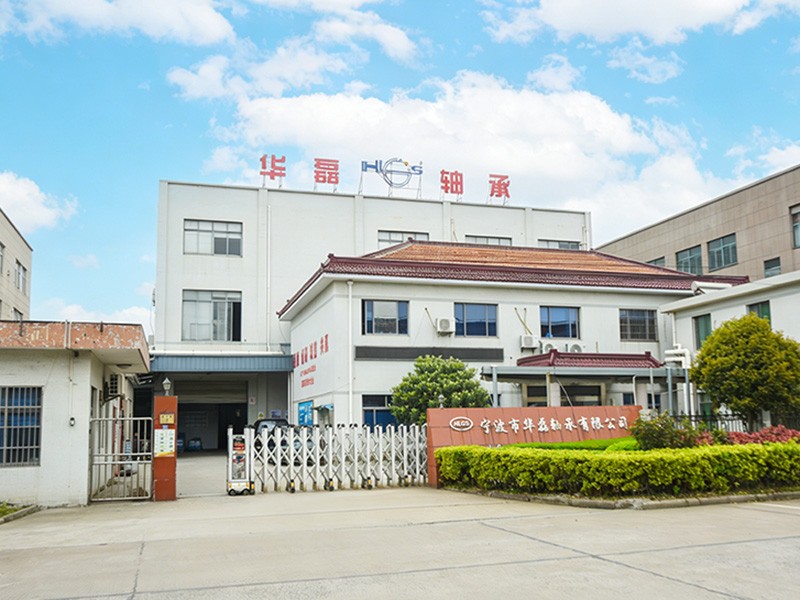
    View More
  • 6200ZZNR Deep Groove Ball Bearing for Compact Motors and Power Tools
    6200ZZNR Deep Groove Ball Bearing for Compact Motors and Power Tools

    The 6200ZZNR industrial bearing is a compact, practical, and versatile single-row deep groove ball bearing developed for applications that require dependable rotation, efficient space utilization, and straightforward installation. With a 10 mm bore, 30 mm outside diameter, and 9 mm width, this bearing fits a broad range of small motors, fans, power tools, household appliances, and light-duty mechanical transmission systems. Its designation describes several important design features. The basic 6200 bearing configuration is a single-row deep groove ball bearing. The “ZZ” suffix indicates double metal shields, while “NR” identifies the retaining groove and snap ring on the outer ring. Together, these features create a bearing that combines the operating advantages of a shielded bearing with the positioning convenience of an integrated snap ring. For equipment designers, maintenance technicians, and industrial buyers, the 6200ZZNR offers more than a standard bearing dimension. It provides a ready-to-install solution for applications where axial positioning, contamination resistance, low friction, and consistent service are important. The bearing is manufactured from high-carbon chromium bearing steel, commonly identified as GCr15, and is designed to support both radial loads and axial loads acting in either direction within suitable operating conditions. Unlike a plain bearing or a simple unshielded ball bearing, the 6200ZZNR is engineered as a complete rolling-element assembly. Its inner ring, outer ring, balls, cage, shields, and snap ring work together to provide stable rotation. This integrated structure helps equipment manufacturers simplify assembly and helps maintenance teams reduce the number of separate components required during replacement. 6200ZZNR Industrial Bearing Is Designed for Small Motors and Power Tools Product Overview and Main Specifications The 6200ZZNR belongs to the deep groove ball bearing family, one of the most widely used bearing categories in industrial machinery. Deep groove raceways allow the bearing to accommodate radial loads while also supporting moderate axial loads from either direction. This makes the design suitable for rotating shafts that may experience more than one type of force during operation. The bearing has a nominal bore diameter of 10 mm. This dimension allows it to be mounted on shafts used in compact electric motors, small gear mechanisms, fans, rollers, actuators, and portable equipment. The 30 mm outside diameter provides a practical housing fit, while the 9 mm width keeps the bearing compact in the axial direction. ParameterSpecification Bearing number6200ZZNR Bore diameter, d10 mm Outside diameter, D30 mm Width, B9 mm Shield arrangementDouble metal shields, ZZ Positioning featureOuter-ring snap ring, NR Dynamic load rating, Cr5,100 N Static load rating, Cor2,200 N MaterialHigh-carbon chromium bearing steel, GCr15 Bearing typeSingle-row deep groove ball bearing The dynamic load rating of 5,100 N represents the bearing’s calculated capacity for repeated rolling contact under defined rating conditions. It is an important reference value for estimating fatigue life when the bearing is subject to continuous rotation and changing loads. The static load rating of 2,200 N provides a reference for stationary or slow-moving conditions where excessive permanent deformation of the raceways and rolling elements must be avoided. These ratings should not be interpreted as universal working limits for every installation. Actual bearing life depends on load magnitude, speed, lubrication, shaft and housing accuracy, operating temperature, contamination, vibration, installation technique, and the direction of the applied forces. Correct application engineering is therefore essential, particularly when the bearing is used in equipment with frequent starts and stops, shock loading, or high-speed operation. Understanding the 6200ZZNR Designation 6200 Basic Bearing Configuration The 6200 designation identifies the basic dimensional series and internal bearing arrangement. As a single-row deep groove ball bearing, it contains one row of precision balls running between a grooved inner ring and a grooved outer ring. The deep raceway geometry enables the bearing to carry radial loads while accommodating axial forces in both directions. This arrangement is popular because it provides a useful balance between load capacity, speed capability, compactness, and cost. Compared with more specialized bearing designs, a standard deep groove bearing is generally easier to source, install, replace, and maintain. It can also be used in many orientations, making it suitable for horizontal, vertical, and inclined shaft arrangements. ZZ Double Metal Shields The ZZ designation indicates two non-contacting metal shields, one on each side of the bearing. These shields help reduce the entry of dust and larger particles while helping retain the factory-applied grease inside the bearing. Since the shields do not normally contact the inner ring, they create limited additional friction compared with contact seals. Double metal shields are especially useful in clean or moderately dusty environments where the bearing does not require a high level of water exclusion. They are commonly selected for electric motors, fans, office equipment, household appliances, and small power tools. Their low-contact design can support smooth rotation and moderate speed capability. Metal shields are not a substitute for a fully sealed bearing in applications exposed to heavy water spray, washdown, mud, or fine abrasive contamination. However, in the intended operating range of the 6200ZZNR, they provide a practical balance between contamination protection, low running resistance, and economical construction. NR Snap Ring Arrangement The NR suffix indicates that the outer ring is manufactured with a retaining groove and fitted snap ring. This feature allows the bearing to be axially located in a housing without requiring a separate external retaining component. The snap ring can simplify assembly and help maintain the bearing’s designed position during operation. In compact products, available space is often limited. A separate retaining plate, shoulder, or circlip may increase housing size, component count, and assembly time. The integrated snap ring of the 6200ZZNR can reduce these concerns. It is particularly useful where the housing has a corresponding groove or shoulder arrangement designed to accept the bearing’s retaining ring. Housing and shaft tolerances must still be controlled carefully. The snap ring is intended for axial positioning and retention within a properly designed housing; it should not be treated as a substitute for correct interference or clearance fits. The housing groove, shoulder, and ring seat must be compatible with the bearing dimensions and the forces expected during operation. Performance Advantages in Compact Equipment Efficient Radial Load Support The primary function of the 6200ZZNR is to support radial loads while allowing a shaft to rotate with low mechanical resistance. Radial forces may come from belt tension, gear engagement, fan imbalance, rotor weight, pulley loads, or other forces acting perpendicular to the shaft centerline. The deep groove raceways distribute contact between the balls and rings over a carefully controlled rolling path. When the bearing is correctly loaded and lubricated, the rolling elements reduce sliding friction compared with plain sliding surfaces. This helps support stable operation and reduces the energy lost as heat. Bidirectional Axial Load Capability Many compact machines experience axial forces in both directions. A fan rotor, small gear train, or tool spindle may shift slightly because of thrust, assembly tolerances, or changes in operating conditions. The deep groove design allows the 6200ZZNR to accommodate moderate axial loads from either direction without requiring a separate thrust bearing for every application. The actual axial capacity depends on the radial load, operating speed, lubrication, internal clearance, and bearing arrangement. When axial forces are high or continuous, a dedicated thrust bearing or a more specialized angular contact arrangement may be appropriate. For ordinary light-duty and moderate-duty machinery, however, the bidirectional capability of the deep groove design provides valuable flexibility. Low Heat Generation Low heat generation is important in small motors and portable equipment because the surrounding structure may have limited thermal dissipation. Excessive bearing heat can affect lubricant life, motor winding temperature, plastic components, insulation systems, and dimensional stability. The 6200ZZNR is designed with a non-contact metal shield arrangement that helps protect the lubricant without creating the same level of rubbing resistance associated with contact seals. When the bearing is operated within a suitable speed and load range, this design supports smooth rotation and helps control temperature rise. Heat generation is also influenced by installation quality. Misalignment, excessive interference fits, incorrect shaft dimensions, overloading, contaminated grease, and insufficient internal clearance can all increase friction. The bearing’s design provides a strong foundation for efficient operation, but the complete assembly must be engineered correctly. Compact Installation With a width of only 9 mm, the bearing is suited to assemblies where axial space is restricted. Its small envelope allows designers to create compact motor housings, lightweight fan assemblies, and portable power tools without using oversized bearing supports. The 10×30×9 mm size is also convenient for replacement programs. Standardized dimensions allow maintenance departments to keep a manageable inventory and reduce the risk of extended downtime caused by difficult-to-source components. When the original bearing arrangement uses a compatible snap-ring configuration, the 6200ZZNR can provide a direct and efficient replacement option. Extended Service Potential Long service life results from the interaction of several factors rather than from one feature alone. The GCr15 steel provides a hard, wear-resistant material for the rings and rolling elements. The shield arrangement helps retain grease and limit contamination. The snap ring helps maintain axial location. The deep groove geometry distributes loads efficiently. Together, these features support dependable operation when the bearing is applied within its intended conditions. Good service life also depends on clean handling, accurate fits, appropriate lubrication, correct alignment, and effective protection of the surrounding machine. A high-quality bearing can be damaged during installation if force is transmitted through the rolling elements. For this reason, the installation tool should apply force to the ring being fitted, and impact directly on the shields or cage should be avoided. Advantages Compared with Alternative Bearing Choices The 6200ZZNR competes with several possible bearing configurations, including open bearings, contact-sealed bearings, standard shielded bearings without snap rings, and plain bearings. Each option has a suitable operating range, but the 6200ZZNR offers a balanced combination of features for many compact industrial applications. Compared with Open Bearings Open bearings allow easy access to the rolling elements and raceways, which can be useful in systems with an external oil supply or a controlled lubrication system. However, they provide little protection against airborne dust and may allow grease to escape more readily. The double metal shields of the 6200ZZNR provide a practical advantage in small motors, fans, and appliances where a separate lubrication system is not available. The shields help retain the manufacturer’s grease and reduce the risk of contamination entering the rolling contact area. This can simplify product design and reduce routine lubrication requirements. Compared with Contact-Sealed Bearings Contact-sealed bearings are often selected for applications that require stronger protection against water, fine dust, or other contaminants. Their sealing lips contact the inner ring, creating a more effective barrier in many environments. However, the contact can increase friction, torque, and heat generation, particularly as speed rises or the seal material ages. The 6200ZZNR uses non-contact metal shields, which may offer lower rotational resistance and lower operating torque in clean or moderately contaminated environments. This makes it attractive for motors and tools where efficiency, quiet operation, and smooth starting are important. If the equipment is exposed to frequent water ingress or heavy contamination, a contact-sealed configuration may be more suitable. Compared with Bearings Without Snap Rings A standard 6200ZZ bearing without a snap ring may require a housing shoulder, retaining plate, external circlip, or other axial positioning device. Such an arrangement can be completely effective, but it may require additional machining and parts. The NR version integrates the retention feature into the outer-ring design. This can streamline assembly, reduce the number of loose components, and provide a predictable axial reference point. It can also help manufacturers reduce assembly steps and simplify service replacement, provided that the housing is designed for the snap ring. Compared with Plain Bearings Plain bearings can be useful in low-speed oscillating mechanisms, low-cost hinges, and applications where shock loads or contamination make rolling elements unsuitable. Nevertheless, they generally rely on sliding contact and may require suitable material pairing, lubrication, or regular maintenance. The 6200ZZNR uses rolling contact to support continuous rotation efficiently. It is therefore better suited to motor shafts, fan shafts, rollers, and rotating mechanical transmission components where reduced friction and consistent running behavior are important. Compared with More Specialized Bearing Types Angular contact, cylindrical roller, tapered roller, and spherical bearings each provide specialized capabilities. Angular contact bearings are advantageous for higher combined radial and axial loads. Roller bearings can provide greater radial load capacity in certain arrangements. Tapered and spherical bearings address specific load or alignment requirements. However, specialized designs may require more space, more complex mounting arrangements, matched sets, preload control, or additional maintenance knowledge. The 6200ZZNR is advantageous when the application needs a dependable, economical, and easily replaceable bearing rather than a highly specialized load arrangement. Materials and Manufacturing Quality GCr15 High-Carbon Chromium Bearing Steel The rings and rolling elements of the 6200ZZNR are made from high-carbon chromium bearing steel, commonly referred to as GCr15. This material is widely used in precision bearing production because it can achieve the hardness, wear resistance, dimensional stability, and fatigue performance required for rolling contact. Material quality begins with controlled steel procurement and continues through heat treatment and finishing. The cleanliness and consistency of the steel influence the bearing’s resistance to rolling-contact fatigue. Proper heat treatment develops the required hardness while helping maintain a balanced combination of toughness and dimensional stability. For a small bearing, even minor material or process variation can affect noise, vibration, torque, and service life. This is why reliable production depends on controlled processes rather than visual inspection alone. Each manufacturing stage must contribute to the final performance of the assembled bearing. Precision Ring Production The inner and outer rings are produced through a sequence of forming, turning, heat treatment, grinding, and superfinishing operations. Raceway geometry is especially important because the balls must travel smoothly through the grooves. Surface roughness, roundness, waviness, and dimensional accuracy all influence the bearing’s running behavior. Precision grinding removes material in a controlled manner and establishes the final dimensions of the raceways, ring diameters, and side faces. Superfinishing can further improve the raceway surface by reducing irregularities that could increase friction or generate vibration. The outer ring also requires accurate machining of the retaining groove used with the NR snap ring. The groove must be positioned and formed consistently so that the ring can perform its retention function without compromising the bearing’s dimensional compatibility. Rolling Element Control The balls must have consistent diameter, roundness, surface finish, and material properties. Variations among balls can influence load distribution, torque, noise, and vibration. Precision sorting and inspection help ensure that the rolling elements are suitable for assembly into the bearing. During operation, the balls transmit forces between the inner and outer raceways. If the load is unevenly distributed, localized stress may rise and reduce fatigue life. Consistent ball quality, correct internal geometry, and controlled assembly help maintain smooth load sharing. Cage and Shield Integration The cage separates the balls and guides them around the raceways. Its design must provide stable ball spacing while minimizing friction and interference. The cage is assembled with care to avoid deformation that could affect rotation or create abnormal noise. The two metal shields are fitted to the outer ring and positioned to protect the internal space. Shield installation must be controlled so that the shields remain secure while maintaining the intended non-contact relationship with the inner ring. Damage, distortion, or improper seating can affect contamination protection and torque performance. Snap Ring Installation The snap ring is installed after the outer-ring groove has been inspected for accuracy and cleanliness. Its fit must be secure and consistent. A properly installed ring provides the axial retention function expected by the equipment designer. Because the snap ring is an important part of the bearing’s installation concept, it should be included in incoming inspection. Buyers may verify its presence, seating, profile, and compatibility with the housing groove. This is particularly important for automated assembly lines where a missing or incorrectly installed retaining ring could cause production interruptions. Advanced Production and Quality-Control Strengths The manufacturer behind the product has operated since 2001 and specializes in miniature and compact deep groove ball bearings. Its experience in this product category supports the development of repeatable processes for small bearing dimensions, shielded configurations, and application-specific variants such as snap-ring bearings. Manufacturing quality is supported by advanced testing equipment and formal management systems. The company follows ISO 9001 and ISO/TS 16949 management systems, demonstrating an emphasis on documented procedures, traceability, process control, corrective action, and continual improvement. ISO-based systems do not replace product inspection, but they help establish a consistent framework for controlling production and responding to quality issues. In practical terms, an effective bearing manufacturing process includes incoming material verification, machining control, heat-treatment monitoring, grinding inspection, component cleaning, assembly control, lubricant management, final testing, and packaging protection. These controls are especially important for shielded bearings because internal contamination or improper grease quantity may not be visible after final assembly. Advanced equipment can be used to evaluate dimensional accuracy, rotation torque, noise, vibration, temperature behavior, and component condition. The exact test plan may vary according to product specification and customer requirements, but the objective remains the same: identify deviations before the bearing reaches the customer and confirm that the finished product meets the required performance standard. The company’s specialization also provides an advantage in customization and production support. It serves industries including food machinery, household appliances, automotive electromechanical systems, electric tools, mechanical transmission equipment, and motors. Exposure to these applications helps the manufacturer understand the differing requirements for quiet running, compact design, load support, contamination resistance, and service reliability. In addition to standard production, the company provides OEM and ODM services through its import and export department, established in 2016. OEM capability can support customers that require production according to supplied drawings, specifications, packaging requirements, or labeling instructions. ODM capability can support projects that need engineering cooperation in selecting dimensions, shields, snap rings, lubrication, materials, or other bearing characteristics. Application Areas Small Electric Motors The 6200ZZNR is well suited to small electric motors used in appliances, ventilation equipment, automation units, and compact machinery. Motor bearings must rotate smoothly, operate with controlled noise, and withstand continuous radial loading from the rotor. The shielded structure helps retain grease and reduce the entry of ordinary airborne dust. The snap ring can simplify axial positioning inside the motor end shield or housing. This may help manufacturers reduce the need for a separate retaining component. Proper rotor balance, shaft accuracy, and bearing alignment remain essential because motor vibration can be transmitted directly to the bearing. Fans and Blowers Fans frequently operate for long periods, making low friction and stable temperature important. The 6200ZZNR can support fan shafts and small blower assemblies where the radial load is moderate and the environment is not exposed to severe liquid contamination. Fan designers should consider imbalance, belt tension, air movement, and expected running speed. Excessive imbalance may generate cyclic loads that shorten bearing life. Correct balancing and accurate housing alignment allow the bearing to perform more effectively. Power Tools Compact power tools require bearings that fit within limited internal space while supporting high-speed rotation and intermittent loads. Drills, grinders, sanders, small saws, and other portable devices may subject bearings to vibration, acceleration, and short periods of increased force. The 6200ZZNR’s compact size and double metal shields make it a practical option for suitable power-tool mechanisms. Engineers must confirm that the bearing’s speed, load, temperature, and contamination requirements are compatible with the specific tool. Tools exposed to fine abrasive dust may require additional external sealing or a different bearing configuration. Household Appliances Household appliances often require quiet, reliable, and economical rotating components. The bearing can be applied in small motors, rollers, fans, pumps, and mechanical transmission systems when the operating load and environmental conditions are appropriate. For appliance manufacturers, consistent dimensions and repeatable noise performance are important. A bearing that installs predictably can support efficient production and reduce field service concerns. Metal shields are also useful where low rotational resistance and grease retention are preferred. Light-Duty Mechanical Transmission Small transmission systems may include pulleys, rollers, gears, shafts, and drive mechanisms. The 6200ZZNR can support radial loads from these components while accepting moderate axial forces in either direction. Gear and pulley systems should be evaluated for overhung load, belt tension, shaft deflection, and alignment. If the bearing is exposed to substantial shock or heavy continuous loading, a larger or more specialized bearing may be required. In light-duty systems, however, the standard deep groove arrangement provides a useful combination of simplicity and performance. Installation Recommendations Correct installation is essential to achieving the expected life of any rolling bearing. Before installation, verify the bearing number, dimensions, shield arrangement, snap ring configuration, and overall condition. The bearing should be kept in its original packaging until it is ready for use. Shafts and housings should be clean, dry, and free from burrs. Measure the mating surfaces to confirm that the fits are appropriate for the expected load and rotation. A shaft fit that is too tight may reduce internal clearance and increase operating temperature. A housing fit that is too loose may allow creep, fretting, or unwanted movement. When pressing the bearing onto a shaft, apply installation force to the inner ring. When pressing the bearing into a housing, apply force to the outer ring. If force is applied through the balls, raceways may become dented or brinelled, even if the damage is not immediately visible. Do not hammer directly on the shields, cage, or snap ring. If impact tools are unavoidable, use suitable tooling and distribute the force evenly through the correct ring. Induction heating or another controlled heating method may be used for certain interference-fit installations, provided that the bearing temperature remains within an appropriate range and the shields, grease, and material properties are not damaged. The housing must include the correct groove or shoulder arrangement for the NR snap ring. After installation, confirm that the snap ring is fully seated and that the bearing is positioned correctly. Rotate the shaft by hand before operating the equipment. Rotation should be smooth, without abnormal resistance, scraping, or roughness. Alignment should be checked after installation. Although deep groove ball bearings can tolerate limited operational conditions involving small alignment deviations, excessive misalignment creates uneven loading and can raise noise, vibration, and temperature. The shaft, housing, seals, and adjacent components should be assembled concentrically whenever possible. Lubrication and Operating Conditions The 6200ZZNR is supplied with lubrication retained by its double metal shields. In many normal applications, the factory lubricant is intended to support the bearing for its planned service period. Additional grease should not be added automatically, particularly when the shields are not designed for routine relubrication. Over-greasing can increase churning, torque, and heat generation. Using an incompatible lubricant can cause grease separation, hardening, softening, corrosion, or deterioration of the shield and cage materials. If relubrication is required by the application, the correct procedure and lubricant should be determined by the equipment manufacturer or bearing engineer. Operating temperature is affected by speed, load, ambient conditions, fit, alignment, and lubricant behavior. A gradual increase in temperature during initial running may be normal, but sudden overheating, persistent abnormal noise, or strong vibration indicates that the system should be inspected. The metal shields provide protection against ordinary dust and help retain grease, but they are not designed to withstand every form of contamination. External seals, covers, labyrinth arrangements, or a different sealed bearing may be required where there is exposure to water, abrasive powder, chemical mist, or high-pressure cleaning. Selection and Service-Life Considerations When selecting the 6200ZZNR, begin with the required bore, outside diameter, and width. Confirm that the 10 mm shaft and 30 mm housing seat are compatible with the equipment design. Next, review the applied radial and axial loads and compare them with the bearing’s dynamic and static load ratings. For continuously rotating equipment, bearing life is commonly evaluated using the dynamic load rating, equivalent dynamic bearing load, and operating speed. The calculated life is an engineering estimate, not a guaranteed calendar period. Contamination, installation damage, vibration, and poor lubrication can reduce actual service life significantly. Static load evaluation is important when the machine is stationary under load, exposed to shock, or subject to vibration. The static load rating of 2,200 N provides a reference for assessing permanent deformation risk. If the equipment experiences impact loads, the peak force should be considered rather than only the average operating load. Noise and vibration requirements should also influence the selection. A small motor used in a quiet appliance may need tighter control of bearing noise and assembly alignment than a general-purpose transmission unit. The manufacturer’s experience with motors, appliances, tools, and electromechanical systems can support discussions about application-specific requirements. Temperature, speed, contamination, and installation fit should be documented during the selection process. These factors allow the supplier and buyer to determine whether the ZZ shield arrangement and standard internal configuration are appropriate or whether another variant would provide better performance. Inspection, Maintenance, and Troubleshooting Routine inspection should focus on sound, vibration, temperature, shaft movement, and visible signs of contamination. A healthy bearing normally produces a consistent operating sound. Grinding, clicking, rumbling, or intermittent knocking may indicate raceway damage, contamination, cage problems, or incorrect installation. Abnormal temperature can result from excessive preload, an overly tight fit, insufficient clearance, excessive grease, high speed, misalignment, or an external load that is greater than expected. The surrounding machine should be checked before replacing the bearing because the root cause may be related to the shaft, housing, pulley, gear, or drive system. Visible rust, grease leakage, shield distortion, or snap-ring damage should be treated as warning signs. A damaged shield may allow contamination to enter. A displaced snap ring may indicate an incorrect housing groove, excessive axial force, or improper assembly. If replacement is required, remove the bearing using tools that apply force to the correct ring. Do not reuse a bearing that has been removed from a heavily loaded or contaminated assembly unless it has been professionally inspected. Rolling-contact damage may not be visible during a quick examination. Observed conditionPossible causesRecommended checks High operating temperatureExcessive fit, overload, over-greasing, misalignment, high speedCheck fits, load, speed, alignment, and lubricant condition Rough rotationContamination, brinelling, raceway damage, installation impactInspect rings, balls, shields, and installation method Unusual noiseVibration, damaged raceway, poor lubrication, incorrect assemblyCheck shaft runout, housing alignment, and bearing condition Axial movementIncorrect housing fit, missing or displaced snap ring, loose shaftVerify NR ring seating and housing groove dimensions Short service lifeContamination, overload, poor storage, misalignment, shock loadingReview operating history and complete assembly conditions Supply, Customization, and Technical Cooperation For industrial buyers, product quality is only one part of supplier evaluation. Delivery stability, communication, technical support, packaging, documentation, and the ability to manage repeat orders also influence the total cost of ownership. A manufacturer with long-term experience in compact deep groove bearings can help customers reduce uncertainty during product development and production planning. The manufacturer offers a broad range of deep groove ball bearings under its HLGS trademark and serves customers in several industrial sectors. Its product experience includes food machinery, household appliances, automotive electromechanical systems, electric tools, mechanical transmission devices, and motors. This broad application background supports practical communication about operating environments and design priorities. OEM and ODM services provide additional flexibility. Customers may require standard 6200ZZNR bearings with specific packaging or quality documentation, or they may need cooperation on a related bearing configuration. Engineering discussions may include dimensions, shield types, snap-ring arrangements, clearance, grease selection, packaging, inspection plans, and production quantities. For larger programs, a clear technical agreement should define drawings, tolerances, material requirements, performance expectations, acceptance criteria, marking, packaging, and change-control procedures. This helps ensure that the supplied bearing remains consistent over the life of the project. Professional service is also important during replacement and troubleshooting. If a 6200ZZNR bearing shows premature damage, useful information includes operating speed, load, temperature, installation method, shaft and housing dimensions, lubricant, contamination exposure, and photographs of the failed components. Such information can help identify whether the cause is bearing-related or connected to the surrounding machine. Why the 6200ZZNR Is a Practical Industrial Choice The strength of the 6200ZZNR lies in its balanced design. It is not intended to replace every bearing type in every environment. Instead, it offers a strong solution for compact rotating equipment that needs standard dimensions, dependable radial support, moderate bidirectional axial capacity, grease retention, and convenient axial positioning. The double metal shields support cleaner operation and help retain internal lubrication without the rubbing resistance of contact seals. The outer-ring snap ring simplifies installation where a compatible housing groove is available. The GCr15 material supports the hardness and wear resistance needed for rolling contact. The 10×30×9 mm envelope fits many compact assemblies. Compared with a basic open bearing, the 6200ZZNR offers greater protection and convenience. Compared with a standard shielded bearing without an NR ring, it can simplify housing retention. Compared with a contact-sealed bearing, it may reduce friction in suitable clean or moderately dusty environments. Compared with a plain bearing, it provides the efficiency and consistency of rolling contact during continuous rotation. Its suitability is further supported by the manufacturer’s long-term focus on miniature and compact deep groove ball bearings, formal ISO-based management systems, advanced testing equipment, and OEM and ODM capabilities. These strengths are valuable to customers seeking both a dependable component and a supplier able to support repeatable industrial production. For small motors, fans, power tools, household appliances, and light-duty transmission equipment, the 6200ZZNR offers an efficient combination of performance, installation simplicity, and application flexibility. When selected according to load, speed, temperature, contamination, and fit requirements, it can contribute to stable equipment operation and reduced maintenance interruptions. Frequently Asked Questions What type of bearing is the 6200ZZNR? The 6200ZZNR is a single-row deep groove ball bearing. It has a 10 mm bore, a 30 mm outside diameter, and a 9 mm width. It is fitted with double metal shields and an outer-ring retaining groove with a snap ring. What does ZZ mean on the bearing? ZZ means that the bearing has two metal shields, one on each side. These shields help retain grease and reduce the entry of ordinary dust and particles. Because the shields are generally non-contacting, they can support low rotational resistance in appropriate applications. What does NR mean on the bearing? NR indicates an outer-ring snap-ring arrangement. The outer ring has a retaining groove and is supplied with a snap ring for axial positioning in a compatible housing. Can the 6200ZZNR support axial loads? Yes. As a deep groove ball bearing, it can support moderate axial loads from both directions in addition to radial loads. The allowable axial load depends on the radial load, speed, lubrication, internal clearance, and overall application conditions. Is the 6200ZZNR suitable for high-speed motors? It may be suitable for certain high-speed motor applications, but the actual suitability must be confirmed using the required speed, load, temperature, lubrication, and noise criteria. Metal shields can provide low friction, but incorrect fits, misalignment, or excessive loads may still cause overheating. Is this bearing waterproof? No bearing should be described as universally waterproof based only on a ZZ designation. Double metal shields provide protection against ordinary dust and help retain grease, but applications with heavy water exposure, washdown, or liquid contamination may require contact seals or additional external protection. What material is used for the bearing? The bearing is made from high-carbon chromium bearing steel, identified as GCr15. This material is widely used for bearing rings and rolling elements because of its hardness, wear resistance, and rolling-contact fatigue performance. Where is the 6200ZZNR commonly used? Common applications include small motors, fans, power tools, household appliances, light-duty mechanical transmission systems, rollers, and other compact rotating equipment. How should the bearing be installed? Use clean, accurate tools and apply installation force only to the ring being fitted. Apply force to the inner ring when mounting on a shaft and to the outer ring when mounting in a housing. Do not strike the shields, cage, balls, or snap ring directly. Confirm that the NR snap ring is fully seated in the housing groove. Does the bearing require additional grease? In many standard applications, the factory-applied grease is intended to support the bearing for its planned service period. Do not add grease without confirming the correct procedure and lubricant. Over-greasing can increase friction and heat. How can buyers confirm whether the bearing is suitable? Buyers should compare the bearing’s dimensions, load ratings, speed, shield arrangement, snap-ring requirement, operating temperature, contamination level, and expected service life with the machine requirements. Technical information about the shaft, housing, load, and operating environment should be shared with the supplier when application conditions are complex. Can the manufacturer provide OEM or ODM support? Yes. The manufacturer provides OEM and ODM services and can cooperate on product specifications, packaging, documentation, and related bearing requirements. Specific engineering details should be confirmed during the project review. Conclusion The 6200ZZNR is a compact deep groove ball bearing designed to meet the practical needs of small rotating machinery. Its 10×30×9 mm dimensions, GCr15 bearing steel construction, 5,100 N dynamic load rating, and 2,200 N static load rating provide a useful foundation for dependable operation in suitable applications. Its double metal shields help retain lubrication and reduce contamination entry, while the outer-ring snap ring simplifies axial positioning in a compatible housing. These features give the bearing advantages over open bearings, shielded bearings without retaining rings, and plain bearings in many compact motor, fan, power-tool, appliance, and light-transmission applications. Reliable performance also depends on manufacturing discipline. The manufacturer’s experience since 2001, focus on compact deep groove bearings, advanced testing equipment, ISO 9001 and ISO/TS 16949 management systems, and OEM and ODM capabilities provide important support for customers seeking consistent industrial supply. When the bearing is selected correctly and installed with suitable fits, alignment, lubrication, and contamination protection, the 6200ZZNR can provide smooth rotation, controlled heat generation, simplified assembly, and long service potential. It is a practical choice for equipment designers and maintenance teams that need a standardized bearing with both shielding and integrated axial retention. References 1. ISO 281, Rolling Bearings — Dynamic Load Ratings and Rating Life. 2. ISO 76, Rolling Bearings — Static Load Ratings. 3. ISO 9001, Quality Management Systems — Requirements. 4. ISO/TS 16949, Quality Management Systems for Automotive Production and Relevant Service Parts Organizations. 5. SKF, Rolling Bearings Catalogue, sections on deep groove ball bearings, seals, shields, mounting, and bearing life. 6. NSK, Technical Information on Deep Groove Ball Bearings, bearing materials, lubrication, installation, and operating conditions. 7. FAG, Rolling Bearing Fundamentals, bearing designation systems, load ratings, fits, and maintenance practices. 8. Timken, Engineering Manual, rolling bearing selection, installation, lubrication, and troubleshooting principles. Product: 6200ZZNR Industrial Bearing Is Designed for Small Motors and Power Tools .profile-card { display: flex; align-items: flex-start; gap: 2rem; background-color: white; padding: 2rem; border-radius: 12px; box-shadow: 0 2px 10px rgba(0,0,0,0.05); } .profile-avatar { width: 120px; height: 120px; border-radius: 50%; overflow: hidden; flex-shrink: 0; } .profile-avatar img { width: 100%; height: 100%; object-fit: cover; display: block; } .profile-info { flex-grow: 1; } .profile-name { font-size:27px; font-weight: 900; margin-bottom: 1rem; color: #1a1a1a; } .profile-bio { line-height: 1.6; color: #333; } @media (max-width: 600px) { .profile-card { flex-direction: column; align-items: center; text-align: center; gap: 1.5rem; } } Mireille Qiao — International Sales Executive With seven years of experience in industrial component sales, she is responsible for developing overseas customers, preparing quotations, coordinating OEM and ODM projects, and supporting distributors of HLGS deep groove ball bearings.

    View More
  • 688ZZ Miniature Deep Groove Ball Bearing: Compact, High-Speed Performance for Precision Applications
    688ZZ Miniature Deep Groove Ball Bearing: Compact, High-Speed Performance for Precision Applications

    The 688ZZ miniature deep groove ball bearing is designed for applications where limited installation space, smooth rotation, low friction, and dependable service are essential. With an 8 mm bore, a 16 mm outside diameter, and a 5 mm width, this compact bearing provides a practical solution for small mechanical systems that cannot accommodate standard-size bearings. Its single-row deep groove configuration supports radial loads and light axial loads while maintaining stable operation in high-speed applications. Equipped with double metal shields, the 688ZZ helps limit the entry of dust and other common contaminants into the rolling contact area. Its shielded construction, grease lubrication, precision-ground raceways, and GCr15 bearing steel material make it suitable for miniature motors, electric toys, office equipment, precision instruments, small household appliances, and other light-duty mechanisms. Although miniature bearings are small, their performance requirements are demanding. A bearing must fit accurately, rotate quietly, resist premature wear, and maintain consistent quality from one production batch to another. The 688ZZ addresses these requirements through a compact geometry, a carefully selected material, shield protection, and manufacturing controls supported by Ningbo Zhenhai Hualei Bearing Co., Ltd., an experienced Chinese manufacturer specializing in miniature deep groove ball bearings. Understanding the 688ZZ Bearing Design The 688ZZ is a standard miniature single-row deep groove ball bearing. The “688” designation identifies the basic bearing series and dimensions, while “ZZ” indicates that the bearing uses two metal shields. These shields are fitted on both sides of the bearing to help protect the internal raceways and rolling elements from dust, airborne particles, and handling contamination. The bearing has an 8 mm bore, allowing it to be installed on a small shaft or axle. Its 16 mm outside diameter provides a compact housing envelope, and its 5 mm width makes it suitable for assemblies in which axial space is restricted. This dimensional combination offers a useful balance between installation efficiency and load-carrying capability for miniature equipment. Unlike a bearing intended for heavy industrial loads, the 688ZZ is optimized for light-duty and precision applications. Its purpose is not to replace larger deep groove ball bearings in demanding machinery, but to provide reliable rotational support in compact systems. In these environments, excessive size can increase weight, consume valuable space, and create unnecessary friction or design complexity. The deep groove raceway geometry allows the bearing to accommodate primarily radial loads while also handling light axial loads in either direction. This capability is helpful in small mechanisms where the shaft may experience a combination of rotational and limited thrust forces. The bearing can support rotating shafts, rollers, pulleys, gears, fans, and other small components when the operating conditions remain within its intended load and speed range. Key Technical Specifications The following table summarizes the principal specifications supplied for the 688ZZ miniature deep groove ball bearing. Parameter Specification Practical Significance Bearing number 688ZZ Identifies the miniature deep groove ball bearing with double metal shields Bore diameter 8 mm Fits an 8 mm shaft or compatible mounting arrangement Outside diameter 16 mm Provides a compact housing envelope Width 5 mm Supports installation where axial space is limited Shield configuration Double metal shields, ZZ Helps protect the internal bearing components from dust and handling contamination Dynamic load rating 1,260 N Indicates the bearing’s capacity for repeated rotating load conditions Static load rating 590 N Indicates resistance to permanent deformation under stationary or slow-moving loads Material GCr15 bearing steel Provides a hard, wear-resistant material for raceways and rolling elements Grease-lubricated limiting speed 36,000 rpm Supports high-speed miniature equipment when correctly installed and operated Compact Dimensions for Space-Constrained Equipment One of the most important advantages of the 688ZZ is its compact 8 × 16 × 5 mm size. Modern products increasingly require smaller motors, thinner housings, lighter mechanisms, and more efficient use of internal space. A bearing with a large outside diameter or excessive width can force designers to enlarge the entire assembly. The 688ZZ helps avoid this problem by providing rotational support within a very small envelope. The 8 mm bore is suitable for small shafts commonly found in miniature motors, small fans, toy mechanisms, office equipment, and compact electromechanical products. The 16 mm outside diameter allows the bearing to be integrated into small housings without consuming space required for wiring, gears, sensors, or structural components. The 5 mm width also assists designers working with thin side plates, narrow brackets, and compact shaft arrangements. A small bearing can reduce the overall weight of a mechanism. This is beneficial in portable instruments, battery-powered products, handheld devices, and lightweight consumer equipment. Lower bearing mass can also help reduce rotational inertia, allowing a motor or actuator to accelerate and decelerate efficiently. In applications where the bearing is part of a rapidly rotating assembly, compact dimensions can contribute to balanced and responsive operation. Compared with using an oversized bearing for a light-duty mechanism, the 688ZZ can provide a more proportionate engineering solution. A bearing should be selected according to the actual load, speed, environment, and service requirements. When the operating conditions are appropriate, the miniature design can offer installation flexibility without sacrificing the basic support function required by the equipment. 688ZZ Deep Groove Ball Bearing Features a Compact Design Ideal for Light-Duty Applications High-Speed Capability and Smooth Rotation The 688ZZ has a stated grease-lubricated limiting speed of 36,000 rpm. This speed capability makes it appropriate for many high-speed miniature applications, especially where the bearing must rotate continuously while maintaining low friction and stable operation. Small motors, miniature fans, precision mechanisms, and compact electrical devices may operate at speeds that require more than simple dimensional compatibility. They also require a bearing with controlled internal geometry and suitable lubrication. High-speed bearing performance depends on several factors, including radial clearance, raceway finish, ball quality, lubricant condition, shaft fit, housing fit, alignment, temperature, and applied load. The listed limiting speed should therefore be used as a reference rather than an automatic operating target for every application. Designers should evaluate the complete operating system and consider whether the bearing will operate continuously, intermittently, under variable load, or near a heat source. The 688ZZ’s low-friction design supports efficient rotation. Lower friction can reduce the energy required to turn the shaft and can help limit heat generation during operation. In miniature motors and battery-powered products, this efficiency may support longer operating time and improved system responsiveness. In precision instruments and office equipment, lower friction can help promote smooth movement and reduce unwanted vibration. Quiet operation is another significant benefit. Noise in a miniature mechanism may be caused by bearing geometry, surface finish, lubricant, contamination, shaft imbalance, poor installation, or surrounding components. A properly manufactured and correctly installed 688ZZ can contribute to a quieter assembly by providing consistent rolling contact and controlled movement. This is especially useful in office equipment, small appliances, precision instruments, and consumer products used close to people. Double Metal Shields for Practical Protection The “ZZ” suffix indicates two metal shields, one on each side of the bearing. These shields form a protective barrier around the internal rolling elements and raceways. They are particularly useful in general-purpose applications where the bearing may encounter dust, fibers, light particulate matter, or routine handling contamination. Metal shields are a practical choice for applications that require low friction and high rotational speed. They do not contact the inner ring in the same way that a contact seal does, so they can help maintain efficient rotation. At the same time, they provide a useful level of protection for the factory-applied grease and internal bearing components. The shielded configuration is appropriate for indoor equipment, enclosed mechanisms, and many clean or moderately dusty environments. It should not automatically be considered a substitute for a fully sealed bearing in applications exposed to water, heavy liquid contamination, corrosive chemicals, abrasive particles, or direct washdown. Bearing selection should always reflect the actual environment. For many light-duty products, the 688ZZ offers a useful balance between protection, speed, and friction. A bearing without shielding may be more vulnerable to contamination, while a heavily sealed design may create additional friction. The double metal shield configuration is therefore well suited to compact equipment that needs dependable everyday protection without compromising high-speed performance. GCr15 Bearing Steel and Material Reliability The 688ZZ is made from GCr15 bearing steel. This material is widely used for bearing rings and rolling elements because it can provide the hardness, wear resistance, and fatigue performance required in rolling-contact applications when properly processed and heat treated. Inside a deep groove ball bearing, the balls repeatedly pass through the raceways under load. This creates concentrated contact stress. The bearing material must resist surface damage, rolling contact fatigue, wear, and dimensional change. GCr15 bearing steel is selected for its suitability for this demanding contact environment. Material selection alone does not determine bearing quality. The quality of the steel, cleanliness, forming process, heat treatment, grinding accuracy, surface finish, assembly control, and inspection standards all influence final performance. For this reason, an experienced manufacturer must manage the material and production stages as one integrated quality process. For the user, the advantage of GCr15 steel is a strong foundation for consistent bearing performance. It supports the bearing’s ability to maintain smooth raceway contact under appropriate loads and speeds. It also provides a dependable material platform for the precision manufacturing processes required by miniature bearings. Load-Carrying Performance for Light-Duty Applications The 688ZZ has a dynamic load rating of 1,260 N and a static load rating of 590 N. These ratings provide important reference points for evaluating whether the bearing is suitable for a specific application. The dynamic load rating relates to repeated rolling operation. It is used in bearing life calculations when the bearing rotates under a defined load. A higher dynamic rating generally indicates greater ability to withstand repeated rolling contact, although actual service life depends on load magnitude, speed, lubrication, cleanliness, alignment, mounting accuracy, and operating temperature. The static load rating relates to stationary or slowly moving conditions. It helps engineers evaluate the risk of excessive permanent deformation in the raceways or rolling elements when the bearing is subjected to a high load while not rotating or rotating very slowly. The 590 N rating is useful when assessing installation loads, temporary overloads, vibration during storage, or static support conditions. These values make the bearing suitable for radial loads and light axial loads in miniature equipment. Examples may include shaft support in small motors, guide rollers, toy transmissions, compact fans, instrument mechanisms, and office equipment. The bearing should not be selected for heavy shock loads, high axial thrust, severe misalignment, or applications outside its miniature light-duty design intent. Correct load evaluation is essential. The total bearing load may include the weight of the rotating assembly, belt tension, gear forces, fan imbalance, acceleration forces, external vibration, and axial positioning forces. If the bearing is installed in pairs, the load distribution between the bearings should also be considered. A qualified design engineer should evaluate the complete load spectrum rather than relying on a single nominal operating value. Advantages in Comparison with General Alternatives The 688ZZ competes in a category where product differences may appear small but can have a significant effect on equipment performance. Its advantages are especially relevant when compared with unsuitable or less appropriately configured alternatives. Advantage One: Efficient Use of Installation Space The 8 × 16 × 5 mm dimensions allow the 688ZZ to fit into compact assemblies. A larger bearing may provide unnecessary capacity while increasing housing size, shaft length, weight, and cost. For a light-duty mechanism, selecting a proportionate miniature bearing can simplify the design and preserve valuable internal space. Advantage Two: A Balanced Shield and Speed Configuration The double metal shield configuration helps protect the bearing from routine contamination while supporting low-friction rotation. Compared with an open bearing, the 688ZZ offers more practical protection. Compared with a heavily contacting seal, the metal shield arrangement can be more suitable for applications prioritizing high rotational speed and low friction. Advantage Three: High-Speed Suitability With a grease-lubricated limiting speed of 36,000 rpm, the 688ZZ is designed for demanding miniature rotational applications. This is an important distinction from basic low-speed bearings that may be dimensionally compatible but not optimized for rapid operation. The stated speed capability supports its use in compact motors, fans, and precision devices when all application conditions are properly controlled. Advantage Four: Low Friction and Quiet Operation Miniature products are often sensitive to noise, vibration, and energy consumption. The 688ZZ is specified for low friction and quiet operation, characteristics that can improve the user experience and support efficient equipment performance. These advantages are valuable in office products, household appliances, instruments, and consumer devices. Advantage Five: Reliable Material Platform GCr15 bearing steel provides a proven material base for bearing rings and rolling elements. When combined with appropriate heat treatment, precision grinding, and inspection, it supports stable rolling contact and wear resistance. This material choice helps the bearing perform consistently within its intended operating range. Advantage Six: Versatile General-Purpose Use The deep groove configuration allows the 688ZZ to accommodate radial loads and light axial loads in either direction. This versatility reduces the need for highly specialized bearing arrangements in many small mechanisms. It can support a broad range of applications while maintaining a simple and familiar installation format. Manufacturing Experience and Quality Strengths Ningbo Zhenhai Hualei Bearing Co., Ltd. was established in 2001 and specializes in miniature deep groove ball bearings. More than two decades of manufacturing experience provide a foundation for understanding the dimensional, material, assembly, and quality requirements associated with small rolling bearings. Miniature bearings require careful process control because small dimensional variations can influence fit, noise, friction, and service life. The company’s specialization in miniature deep groove ball bearings allows its manufacturing and inspection activities to remain focused on the requirements of compact bearing products rather than treating them as a minor extension of large-bearing production. The company states that its products are strictly tested with advanced equipment. Testing and inspection are important throughout the manufacturing chain. Incoming material must be evaluated, machining and grinding operations must be controlled, shields must be fitted correctly, lubrication must be applied consistently, and finished bearings must be checked before shipment. For a product such as the 688ZZ, manufacturing accuracy may involve bore diameter, outside diameter, width, roundness, raceway geometry, radial clearance, surface finish, rotational smoothness, noise, vibration, and shield installation. Each of these factors can influence how easily the bearing fits into the customer’s assembly and how reliably it performs after installation. The company follows ISO 9001 and ISO/TS 16949 management systems. These management frameworks support structured quality procedures, documented processes, traceability, corrective action, and continuous improvement. For customers purchasing miniature bearings in production quantities, a systematic quality environment can be as important as the nominal bearing specification. Process Control from Material to Finished Bearing A miniature bearing is the result of several connected manufacturing stages. The first stage is material preparation. Suitable bearing steel must be selected and managed to provide the required mechanical properties. Material consistency is essential because variations in steel quality can affect heat treatment response, surface durability, and rolling contact fatigue performance. The next stages involve the production of bearing rings and rolling elements. The rings must be formed and machined to the correct geometry, while the balls must meet requirements for size consistency, roundness, surface quality, and hardness. Because the 688ZZ is a small bearing, the production system must maintain accuracy at a compact scale where inspection and handling require particular attention. Heat treatment gives the bearing steel the hardness and structural properties needed for rolling contact. A properly controlled heat treatment process supports wear resistance and dimensional stability. If heat treatment is inconsistent, the bearing may experience differences in hardness, distortion, or service performance. Manufacturing discipline at this stage is therefore essential. Precision grinding and finishing operations refine the raceways and ring surfaces. The raceways must provide smooth, accurate contact with the balls. Surface finish affects friction, noise, lubrication behavior, and rolling fatigue. Controlled grinding also helps maintain the dimensional tolerances required for proper shaft and housing fits. After the major components are manufactured and inspected, the bearing is assembled. The balls, rings, cage, shields, and lubricant must be combined correctly. The double metal shields must be securely positioned without creating excessive interference or damage. Grease must be applied in a controlled quantity so that the bearing receives adequate lubrication without unnecessary churning at high speed. Finished bearing inspection helps confirm that the assembled product meets defined requirements. Depending on the production and customer requirements, inspection may include dimensional measurement, rotational testing, noise evaluation, vibration checks, visual examination, and packaging verification. The stated use of advanced testing equipment supports the company’s objective of supplying consistent miniature bearings for industrial and commercial customers. OEM and ODM Support for Equipment Manufacturers In addition to standard bearing supply, Ningbo Zhenhai Hualei Bearing Co., Ltd. provides OEM and ODM services through its import and export department, Ningbo Hotex Mechanical & Electrical Technology Co., Ltd., established in 2016. This capability is useful for equipment manufacturers that need bearing products aligned with specific design, packaging, labeling, or supply-chain requirements. OEM cooperation may be appropriate when a customer requires a standard 688ZZ bearing supplied under a private label or with defined packaging and documentation. ODM cooperation may be relevant when the customer needs support in selecting or adapting a miniature bearing solution for a particular device. These services can help integrate the bearing into a broader product-development and procurement program. For engineering customers, supplier communication is important. Information such as shaft size, housing design, operating speed, load direction, temperature, lubrication expectations, contamination level, and installation method should be reviewed before a bearing is approved. A manufacturer experienced in miniature bearings can help clarify whether the 688ZZ is an appropriate choice or whether another configuration would better match the application. For purchasing departments, OEM and ODM support can simplify the process of coordinating product specifications, order quantities, packaging, and delivery requirements. A supplier that can provide both standard products and customized cooperation may reduce the need to manage multiple sources for related miniature bearing requirements. Application Areas Miniature Motors The 688ZZ is well suited to small electric motors that require compact shaft support and smooth rotation. The 8 mm bore can accommodate a small motor shaft, while the shielded construction helps protect the internal bearing from ordinary dust. Its high-speed capability is relevant to motors used in compact equipment, toys, office products, and small appliances. Electric Toys Electric toys often use small motors, gears, wheels, fans, and rotating shafts. A bearing that is too large can increase weight and reduce available design space. The 688ZZ provides a compact rotational support option for light-duty toy mechanisms. Its quiet operation can also contribute to a more pleasant product experience. Precision Instruments Precision instruments may require smooth, low-friction movement and controlled noise. The 688ZZ can support small shafts and rotating components in instruments where compact size is important. Designers should still evaluate environmental cleanliness, temperature, vibration, and required positional accuracy before selecting the bearing. Office Equipment Printers, scanners, document-handling devices, compact fans, and other office equipment can contain numerous small rotating parts. In these products, bearing noise and friction may affect user perception. The 688ZZ’s shielded design, compact dimensions, and smooth operation make it a practical option for suitable light-duty mechanisms. Small Household Appliances Compact household appliances may include small motors, rollers, blowers, and transmission components. The bearing can be used where the load, temperature, speed, and contamination conditions fall within its design range. Its compact size helps appliance manufacturers manage restricted internal space and maintain lightweight product construction. Mechanical Transmission Devices Small gears, pulleys, rollers, and shafts may require bearing support in mechanical transmission systems. The deep groove design can handle radial forces and light axial forces, making it versatile for many small transmission arrangements. Proper alignment and correct shaft and housing fits are essential to achieving stable performance. Installation and Application Recommendations Correct installation is essential for realizing the advantages of the 688ZZ. Before installation, the bearing, shaft, housing, and surrounding components should be inspected for burrs, dirt, corrosion, impact marks, and dimensional defects. Contamination introduced during assembly can affect noise, friction, and service life even when the bearing itself is manufactured correctly. Installation force should be applied to the ring that is being fitted. If the bearing is being pressed onto a shaft, force should be applied to the inner ring. If it is being installed into a housing, force should be applied to the outer ring. Applying force through the balls can damage the raceways and create early bearing failure. The shaft and housing fits should be selected according to the rotating ring, load direction, temperature, and expected operating conditions. An excessively tight fit may reduce internal clearance and increase friction, while an excessively loose fit may allow ring creep or vibration. The correct fit depends on the complete design rather than on bearing size alone. Alignment should be checked carefully. Deep groove ball bearings can accommodate only limited misalignment. If the shaft and housing are not coaxial, the bearing may experience uneven load distribution, increased noise, higher friction, and reduced service life. Small bearings can be particularly sensitive to improper mounting because their internal components and contact areas are compact. The 688ZZ is supplied with grease lubrication suitable for its intended configuration. Users should avoid adding incompatible lubricants or excessive grease without technical justification. Excessive grease can increase friction and temperature, especially at high speed. If relubrication or a different lubricant is required, compatibility with the original grease, shield arrangement, speed, and temperature must be evaluated. Storage conditions also influence bearing quality. Bearings should remain in their original packaging until needed and should be stored in a clean, dry environment away from corrosive materials, vibration, and extreme temperature changes. Proper handling prevents damage to the shields and reduces the risk of contamination before installation. How to Select the 688ZZ for a New Design When considering the 688ZZ for a new design, engineers should begin with the available shaft and housing space. The 8 mm bore, 16 mm outside diameter, and 5 mm width must match the mechanical layout. If the shaft is larger or the housing space is different, another bearing designation may be required. The next step is to calculate the expected radial and axial loads. The 688ZZ is intended primarily for radial loading with light axial loading. If the application includes substantial thrust, impact, belt tension, gear forces, or vibration, the equivalent bearing load should be calculated and compared with the bearing ratings. Operating speed should then be reviewed. The 36,000 rpm grease-lubricated limiting speed provides a useful reference for high-speed selection. However, continuous operation near the limiting speed may require more careful evaluation of heat generation, lubricant behavior, balance, clearance, shaft accuracy, and housing ventilation. Environmental conditions are equally important. The double metal shields provide practical protection against ordinary dust and particles, but applications exposed to water, chemical vapors, abrasive dust, or heavy contamination may need a different sealing arrangement or additional external protection. Finally, designers should consider noise, vibration, expected service life, mounting method, temperature, duty cycle, and procurement requirements. When these factors are reviewed together, the 688ZZ can be evaluated as part of a complete bearing system rather than as an isolated dimensional component. Quality and Supply Advantages for Business Customers For industrial customers, bearing quality must be supported by dependable production and communication. Ningbo Zhenhai Hualei Bearing Co., Ltd. has focused on miniature deep groove ball bearings since 2001 and supplies products for food machinery, household appliances, automotive electromechanical systems, electric tools, mechanical transmission devices, and motors. This application range indicates experience with different equipment requirements. Although the 688ZZ is a miniature light-duty bearing, the same fundamental concerns apply across many industries: dimensional consistency, reliable materials, controlled assembly, effective inspection, secure packaging, and responsive technical communication. The company’s stated ISO 9001 and ISO/TS 16949 management systems provide a structured framework for quality management. Such systems can support repeatable production, documented procedures, customer feedback handling, and continuous improvement. These strengths are valuable to customers that need stable quality over recurring orders rather than a one-time supply. International customers may also benefit from the company’s dedicated import and export department and OEM and ODM capabilities. A supplier with export coordination can help manage product documentation, packaging expectations, order communication, and overseas cooperation. For manufacturers building global supply chains, this can support a more organized purchasing relationship. The company’s philosophy of sincere trust and efficient service emphasizes the importance of long-term cooperation. In bearing procurement, trust is developed through consistent product quality, accurate technical information, reliable delivery communication, and prompt handling of questions or corrective actions. These service qualities complement the mechanical performance of the 688ZZ. Frequently Asked Questions What does 688ZZ mean? 688ZZ identifies a miniature single-row deep groove ball bearing with an 8 mm bore, a 16 mm outside diameter, a 5 mm width, and double metal shields. The ZZ suffix refers to the two metal shields fitted on both sides. What are the dimensions of the 688ZZ? The standard dimensions are 8 × 16 × 5 mm. The bore diameter is 8 mm, the outside diameter is 16 mm, and the bearing width is 5 mm. What material is used for this bearing? The 688ZZ is made from GCr15 bearing steel. This material is commonly used for bearing rings and rolling elements because it can provide suitable hardness, wear resistance, and rolling-contact performance when correctly processed. What loads can the 688ZZ support? The bearing is designed primarily for radial loads and can also handle light axial loads in either direction. Its stated dynamic load rating is 1,260 N, and its static load rating is 590 N. Actual application suitability depends on load direction, speed, duty cycle, alignment, and operating environment. Is the 688ZZ suitable for high-speed operation? Yes. Its stated grease-lubricated limiting speed is 36,000 rpm. The actual operating speed should be determined after considering temperature, lubrication, shaft and housing fits, alignment, load, vibration, and continuous or intermittent duty. Do the metal shields make the bearing waterproof? No. The double metal shields help protect against dust and routine particulate contamination, but they should not be treated as waterproof seals. Applications exposed to water, washdown, heavy contamination, or corrosive liquids may require a different protection system. What applications commonly use the 688ZZ? Typical applications include miniature motors, electric toys, precision instruments, office equipment, small household appliances, compact fans, and light-duty mechanical transmission devices. Can the 688ZZ handle axial loads? As a deep groove ball bearing, it can accommodate light axial loads in either direction in addition to radial loads. It is not intended for substantial thrust loads unless the application has been specifically evaluated and approved for that condition. How should the bearing be installed? Installation force should be applied to the fitted ring. Press the inner ring when mounting onto a shaft and press the outer ring when mounting into a housing. Keep the bearing clean, avoid impact through the rolling elements, and verify shaft, housing, and alignment conditions. Does the bearing require additional grease? The bearing is grease lubricated. Additional grease is not normally required during standard installation. Adding excessive or incompatible lubricant can increase friction and temperature, particularly at high speed. Any relubrication program should be based on technical evaluation. What manufacturing strengths support this product? Ningbo Zhenhai Hualei Bearing Co., Ltd. has specialized in miniature deep groove ball bearings since 2001. The company uses advanced testing equipment, follows ISO 9001 and ISO/TS 16949 management systems, and provides OEM and ODM services through its import and export department. Can the bearing be supplied for OEM projects? Yes. The company provides OEM and ODM services. Customers should communicate their dimensional requirements, operating conditions, packaging needs, labeling expectations, order quantities, and quality documentation requirements during the project discussion. Conclusion The 688ZZ miniature deep groove ball bearing combines compact dimensions, double metal shielding, GCr15 bearing steel, low friction, quiet operation, and high-speed capability in a practical light-duty bearing design. Its 8 × 16 × 5 mm size makes it suitable for space-constrained assemblies, while its deep groove configuration supports radial loads and light axial loads for a broad range of miniature equipment. With a grease-lubricated limiting speed of 36,000 rpm, a dynamic load rating of 1,260 N, and a static load rating of 590 N, the bearing offers a useful performance profile for miniature motors, electric toys, precision instruments, office equipment, small appliances, and compact mechanical transmission systems. The product’s value is supported by the manufacturing experience of Ningbo Zhenhai Hualei Bearing Co., Ltd., which has specialized in miniature deep groove ball bearings since 2001. Advanced testing equipment, structured quality management under ISO 9001 and ISO/TS 16949 systems, and OEM and ODM capabilities provide additional support for customers seeking consistent supply and professional cooperation. When properly selected, installed, lubricated, and protected from unsuitable environmental conditions, the 688ZZ can provide dependable rotational support in compact products. Its combination of size efficiency, speed capability, practical shielding, and manufacturing support makes it a strong choice for light-duty miniature bearing applications. References 1. Product specification information for the 688ZZ miniature deep groove ball bearing, including dimensions, load ratings, material, shielding, and speed information. 2. General engineering principles for rolling bearings, including bearing load ratings, mounting practices, lubrication, shaft and housing fits, and operating-speed evaluation. 3. General guidance on miniature deep groove ball bearing design and application in motors, instruments, office equipment, appliances, and mechanical transmission systems. 4. Quality management information concerning ISO 9001 and ISO/TS 16949 systems as applied to bearing manufacturing and supplier process control. 5. Manufacturer information concerning miniature deep groove ball bearing production, advanced testing equipment, OEM and ODM cooperation, and international customer service. Product: 688ZZ Deep Groove Ball Bearing Features a Compact Design Ideal for Light-Duty Applications .profile-card { display: flex; align-items: flex-start; gap: 2rem; background-color: white; padding: 2rem; border-radius: 12px; box-shadow: 0 2px 10px rgba(0,0,0,0.05); } .profile-avatar { width: 120px; height: 120px; border-radius: 50%; overflow: hidden; flex-shrink: 0; } .profile-avatar img { width: 100%; height: 100%; object-fit: cover; display: block; } .profile-info { flex-grow: 1; } .profile-name { font-size:27px; font-weight: 900; margin-bottom: 1rem; color: #1a1a1a; } .profile-bio { line-height: 1.6; color: #333; } @media (max-width: 600px) { .profile-card { flex-direction: column; align-items: center; text-align: center; gap: 1.5rem; } } Zhao Xinyue — Product Sales Consultant With six years of experience in bearing product sales, she handles customer consultations, application recommendations, order follow-up, and customized solutions for food machinery, household appliances, motors, and electric tools.

    View More
  • 6901ZZNR Miniature Bearing for Precision Devices and Small Mechanisms
    6901ZZNR Miniature Bearing for Precision Devices and Small Mechanisms

    The 6901ZZNR is a compact snap ring deep groove ball bearing developed for equipment that requires reliable rotation, controlled dimensions, and efficient use of installation space. With a 12 mm bore, 24 mm outside diameter, and 6 mm width, this miniature bearing offers a practical combination of low profile, dependable load capacity, and straightforward axial positioning. Its design is particularly suitable for precision devices, miniature drives, household electronics, small power tools, and other light-load mechanical systems. Although miniature bearings occupy less space than standard industrial bearings, they are not less demanding to manufacture or select. Their small dimensions mean that dimensional deviations, contamination, excessive friction, or poor sealing can have a noticeable effect on the performance of the finished assembly. For this reason, a miniature bearing must be evaluated not only by its nominal size, but also by its material quality, internal geometry, sealing arrangement, mounting features, rotational behavior, and production consistency. The 6901ZZNR addresses these requirements through a thin-section deep groove design, dual metal shields, and an outer-ring snap ring. The double-shielded structure helps retain grease and reduce the entry of common external contaminants, while the snap ring simplifies axial retention during assembly. Manufactured from high-carbon chromium bearing steel, commonly identified as GCr15, the bearing is designed to provide stable operation under radial loads and bidirectional axial loads within its intended application range. Product Overview The 6901ZZNR is a miniature deep groove ball bearing with an integrated snap ring. The basic bearing designation identifies a 6901-size bearing, while the suffixes provide important information about its configuration. “ZZ” indicates double metal shields, and “NR” indicates that the outer ring is supplied with a snap ring and the corresponding retaining groove. ParameterSpecification Bearing number6901ZZNR Bore diameter12 mm Outside diameter24 mm Width6 mm Sealing arrangementDouble metal shields, ZZ Retention featureOuter-ring snap ring, NR Dynamic load rating2,340 N Static load rating1,060 N MaterialHigh-carbon chromium bearing steel, GCr15 Grease-lubricated limiting speed32,000 rpm The bearing’s 12×24×6 mm envelope makes it appropriate for assemblies where radial space and axial space are both limited. The six-millimeter width can help designers maintain a compact shaft-support arrangement, while the 24 mm outside diameter provides a practical housing interface for small rotating components. The snap ring adds an additional installation advantage by helping retain the bearing axially without requiring a separate external retaining component in applications designed around the ring groove. Why the 6901ZZNR Configuration Matters A standard miniature deep groove bearing can support radial forces and limited axial forces in both directions. The 6901ZZNR preserves this basic versatility while adding two features that are valuable in compact equipment: metal shielding and snap-ring retention. These features can reduce assembly complexity and help protect the bearing’s internal working surfaces during normal service. Double Metal Shields for Practical Protection The “ZZ” configuration uses two non-contact metal shields, one on each side of the bearing. These shields form a protective barrier around the balls, raceways, and factory-applied grease. Compared with an open bearing, a double-shielded bearing is less exposed to dust, handling debris, and other ordinary contaminants. The shields also help keep lubricant within the bearing during operation. Metal shields are especially useful where low friction and high rotational speed are important. Because the shields are non-contacting, they generally create less sealing drag than contacting rubber seals. This can help the 6901ZZNR maintain efficient rotation and low energy loss in miniature drives, compact motors, and instrument mechanisms. At the same time, the shields should not be interpreted as a guarantee of complete protection against water, pressure washing, or heavy contamination. Applications exposed to liquid ingress or aggressive environmental conditions should be reviewed separately to determine whether a different sealing arrangement is more suitable. Snap Ring for Simplified Axial Mounting The “NR” suffix identifies the outer-ring snap ring. This ring is installed in the designated groove on the outside diameter of the bearing and can help secure the bearing axially in a housing. In a suitably designed housing, the snap ring may reduce the need for a separate retaining shoulder, cover, or additional axial fastener. This feature can provide several practical benefits. It may reduce the number of assembly parts, shorten installation time, and make the bearing easier to position consistently. It can also help designers create compact housing arrangements where a conventional shoulder or cover would occupy valuable space. For equipment manufactured in volume, even a small reduction in assembly steps can improve production efficiency and reduce the chance of installation variation. The housing groove and axial retention arrangement must be designed according to the relevant bearing and snap-ring dimensions. The snap ring should not be used to compensate for an unsuitable housing fit, excessive axial load, or incorrect groove geometry. Proper support on the outer ring remains important, particularly when the bearing is exposed to combined loading or vibration. 6901ZZNR Miniature Bearing Is Designed for Precision Devices and Small Mechanisms Load-Carrying Capability in Compact Equipment The 6901ZZNR has a listed dynamic load rating of 2,340 N and a static load rating of 1,060 N. These values provide a useful basis for bearing selection, but they should be interpreted together with speed, lubrication, temperature, mounting accuracy, load direction, shock, vibration, and expected service life. Radial Load Support Deep groove ball bearings are primarily used to support radial loads. In the 6901ZZNR, the inner ring, outer ring, balls, and raceway geometry work together to distribute radial force over the rolling elements. The high-carbon chromium bearing steel construction provides a hard, wear-resistant material system suitable for normal rolling contact operation when the bearing is correctly mounted and lubricated. Radial load applications may include small pulleys, rollers, miniature gear systems, instrument shafts, compact fans, and small electric motors. In each case, the actual operating load should be compared with the bearing’s rating rather than judged only by the bearing’s physical size. A small bearing can provide useful load capacity, but its service life may be reduced by misalignment, excessive belt tension, shaft deflection, or impact loading. Bidirectional Axial Load Support The deep groove raceway profile also allows the 6901ZZNR to accommodate axial forces in both directions. This is useful in assemblies where the shaft may experience thrust from either side or where the direction of axial force changes during operation. Typical examples may include compact transmission systems, small actuators, and rotating mechanisms with helical gears. Axial capacity depends on the magnitude and combination of radial and thrust loads. A bearing carrying a substantial radial load at the same time as a significant axial load may experience a different service-life condition from a bearing carrying radial load alone. Designers should therefore calculate the equivalent dynamic bearing load when necessary and confirm that the selected bearing is appropriate for the complete operating profile. Static Load Considerations The 1,060 N static load rating is relevant when the bearing is stationary, rotating slowly, or subjected to shock and temporary overload. Excessive static loading can create permanent indentations in the raceways or rolling elements. Even small indentations may result in noise, vibration, torque variation, or premature failure during later rotation. For mechanisms that stop and start frequently, remain stationary under load, or experience impact during transportation or operation, static load conditions deserve particular attention. The bearing should be protected from shock during handling, and installation tools should apply force only to the ring being fitted. Pressing through the rolling elements can damage the raceways before the equipment is placed into service. High-Speed Performance and Rotational Efficiency The 6901ZZNR has a listed grease-lubricated limiting speed of 32,000 rpm. This makes the bearing suitable for many compact, high-speed mechanisms where low rotational resistance and stable running are important. The non-contact metal shields can support efficient rotation by avoiding the greater friction associated with contacting seal lips. A limiting speed is not an automatic operating recommendation for every application. Actual permissible speed can be affected by bearing load, lubrication type and quantity, ambient temperature, shaft and housing fits, cage design, vibration, balance, and heat dissipation. Operation near the limiting speed requires careful attention to lubrication and temperature. If the application involves continuous operation at high speed, prototype testing and temperature monitoring are recommended. At moderate loads, a correctly installed 6901ZZNR can help minimize energy loss in small rotating assemblies. Reduced friction is valuable in miniature motors and battery-powered equipment because it can improve electrical efficiency and help preserve available power. It may also support quieter operation and more consistent motion in precision devices, although total system noise depends on the shaft, housing, gears, motor, mounting structure, and manufacturing tolerances of the complete assembly. Grease Lubrication The bearing is suitable for grease lubrication and is supplied in a shielded configuration intended to retain lubricant within the bearing. The correct grease quantity is important. Too little lubricant can increase wear and temperature, while excessive grease can create churning resistance and reduce high-speed performance. When the bearing is supplied pre-lubricated, users should avoid washing out or mixing the original grease with an incompatible lubricant. If relubrication is required in a special application, the grease type, base oil, thickener, operating temperature, speed factor, and compatibility should be reviewed. Lubrication requirements for a food-processing environment, for example, may differ from those for a household appliance or electric tool. Material Selection and Bearing Durability The 6901ZZNR is manufactured from high-carbon chromium bearing steel, identified in the supplied specifications as GCr15. This material is widely used for rolling bearings because it can be processed to achieve the hardness, fatigue resistance, dimensional stability, and surface characteristics required for rolling contact components. The bearing rings and balls must withstand repeated contact stress during operation. Material cleanliness, heat treatment, grinding quality, and surface finish all influence the ability of the bearing to resist fatigue and wear. A suitable bearing steel alone does not determine the final performance; the complete manufacturing process must transform the raw material into accurately controlled rings and rolling elements. Heat Treatment and Structural Stability Heat treatment is a critical stage in the production of bearing steel components. The objective is to develop an appropriate hardened structure while maintaining the dimensional stability needed for accurate rotation. The exact heat-treatment schedule depends on the component, material condition, equipment, and quality requirements. Properly controlled heat treatment can help the raceways and rolling elements withstand repeated load cycles. It also supports the consistent hardness needed for grinding and finishing. In miniature bearings, dimensional changes after heat treatment must be controlled carefully because even small variations can influence internal clearance, noise, friction, and fit. Grinding and Surface Finishing After heat treatment, bearing rings and rolling elements undergo precision machining and finishing operations. Grinding helps establish the required raceway geometry, ring dimensions, and surface characteristics. The final surface condition affects lubricant film formation, rolling contact behavior, friction, and noise. For a miniature bearing, production accuracy is especially important because the internal parts are small and the operating clearances are closely controlled. Consistent grinding and inspection help ensure that the inner ring, outer ring, and balls work together as a matched assembly. A carefully finished raceway can support smooth rolling contact and reduce localized stress concentrations. Manufacturing Strengths of the Supplier Ningbo Zhenhai Hualei Bearing Co., Ltd. was established in 2001 and specializes in miniature deep groove ball bearings. The company manufactures a broad range of deep groove bearing products under the HLGS registered trademark. Its stated application fields include food machinery, household appliances, automotive electromechanical systems, electric tools, mechanical transmission equipment, and motors. The company’s long operating history provides experience in producing small bearing types for different equipment requirements. Miniature bearing manufacturing requires repeatable control of dimensions, materials, heat treatment, assembly, lubrication, and inspection. Experience across multiple application sectors can help a manufacturer understand the different priorities associated with speed, load, noise, environmental exposure, cost, and installation structure. Quality Management Systems The supplied company information states that the manufacturer follows ISO 9001 and ISO/TS 16949 management systems. ISO 9001 provides a framework for quality management, process control, customer requirements, corrective action, and continual improvement. ISO/TS 16949 was developed for the automotive supply chain and emphasizes process consistency, defect prevention, traceability, and risk control. Management-system certification does not replace product-specific technical evaluation, but it can indicate that quality activities are organized around documented processes. For buyers, this may be valuable when sourcing bearings for repeat production, OEM programs, or applications that require supplier accountability. Documentation, inspection records, process controls, and corrective-action procedures can make it easier to maintain consistent product quality across production batches. Testing and Inspection The company states that all products are strictly tested with advanced equipment. In bearing production, testing and inspection may include dimensional checks, visual examination, rotational torque assessment, noise and vibration evaluation, material verification, hardness inspection, and sampling of assembled products. The exact inspection plan depends on the bearing type and customer requirements. For the 6901ZZNR, important quality characteristics may include bore diameter, outside diameter, width, snap-ring position, shield installation, internal clearance, rotational smoothness, and cleanliness. Load-related verification and speed-related testing may also be applied where required by the product specification or customer program. Inspection is most effective when it is integrated throughout production rather than performed only at the final stage. Incoming material control, in-process measurement, equipment maintenance, process parameter monitoring, and final product testing can work together to prevent defects and improve consistency. This approach is particularly important for miniature bearings because a small dimensional error can affect both installation and operating behavior. OEM and ODM Capability In 2016, Ningbo Zhenhai Hualei Bearing Co., Ltd. established Ningbo Hotex Mechanical & Electrical Technology Co., Ltd. as its import and export department. The company provides OEM and ODM services for customers in international markets. This structure can support product development, technical communication, packaging requirements, export coordination, and customized supply programs. OEM and ODM customers may require more than a standard bearing number. They may need specific grease, packaging, marking, clearance, tolerances, inspection records, or delivery arrangements. A manufacturer with experience in customized supply can help connect the bearing design with the customer’s assembly and purchasing requirements. Before production, all customized specifications should be confirmed in writing, including the exact seal type, snap-ring configuration, material, lubricant, tolerance class, and inspection criteria. Advantages Compared with Conventional Alternatives The 6901ZZNR offers a combination of features that may provide advantages over a basic open 6901 bearing or a bearing without an integrated retention ring. The most important advantage is functional integration: the same compact component provides rolling support, grease retention, basic contamination protection, and an axial mounting feature. Compared with Open Bearings An open bearing exposes the rolling elements and raceways to the surrounding environment. This may be acceptable in a clean housing with an external lubrication system, but it can increase the risk of contamination during assembly and service. The 6901ZZNR’s two metal shields provide a more protected internal environment for many general-purpose applications. The shielded arrangement can also reduce maintenance requirements in equipment where the bearing is not intended to be regularly relubricated. Because the shields are integrated into the bearing, the designer does not need to rely solely on a separate external cover to retain grease or limit the entry of ordinary dust. Compared with Contact-Sealed Bearings Contact-sealed bearings can offer stronger protection against certain contaminants and moisture, but the sealing lips may increase friction and heat, particularly at high speed. The 6901ZZNR’s non-contact metal shields can be advantageous when rotational efficiency, speed, and low operating resistance are more important than maximum sealing capability. The correct choice depends on the environment. For clean, dry, enclosed equipment, metal shields may offer an efficient balance. For applications with water spray, fine abrasive particles, or direct exposure to contaminants, a contact-sealed configuration or additional external protection may be more appropriate. Compared with Bearings Requiring Separate Retainers A standard bearing without an outer-ring snap ring may require a housing shoulder, end cover, retaining plate, or external circlip to control axial movement. These additional parts can increase assembly time and occupy more space. The NR configuration allows the designer to use the bearing’s integrated snap ring in a compatible housing design. This can be especially helpful in compact devices where the bearing is installed in a thin housing wall or where access for a separate retaining component is limited. It may also support more consistent positioning during assembly, provided the housing groove and axial support surfaces are manufactured correctly. Compared with Oversized Bearings Using a larger bearing than necessary can increase package size, weight, cost, and rotational inertia. The 6901ZZNR provides a compact option for light-load applications that do not require the capacity of a larger bearing. Its small envelope can help designers reduce the overall size of miniature mechanisms and leave additional space for electronics, wiring, gears, or protective structures. A smaller bearing should not be selected solely to reduce dimensions. The bearing must still satisfy the required load, life, speed, stiffness, temperature, and environmental conditions. Within its appropriate operating range, however, the 6901ZZNR can provide a balanced solution for compact product design. Application Areas Precision Instruments Precision instruments often require stable rotation, controlled friction, and compact support components. The 6901ZZNR can be used in small adjustment mechanisms, optical equipment, measuring devices, laboratory instruments, and compact positioning systems where the bearing is protected from severe contamination. Instrument designers should pay close attention to starting torque, running torque, vibration, and noise. Bearing selection should be coordinated with shaft accuracy, housing geometry, preload or clearance requirements, and the desired motion profile. A bearing that is technically suitable by load rating may still be unsuitable if the instrument requires extremely low torque variation or special noise performance. Miniature Drives and Motors The 12 mm bore makes the bearing suitable for many small shafts used in miniature drives, motors, fans, and transmission mechanisms. Its grease-lubricated limiting speed of 32,000 rpm provides useful speed potential for compact rotating equipment, subject to actual load and thermal conditions. In motor applications, the bearing may support a rotor shaft and help maintain the alignment between rotating and stationary components. Correct fits are important: an excessively loose fit can allow creep or vibration, while an excessively tight fit can reduce internal clearance and increase operating temperature. Shaft and housing tolerances should be selected according to the load direction, speed, temperature, and mounting arrangement. Household Electronics Household electronics often place a premium on compactness, quiet operation, service life, and cost-effective assembly. The shielded 6901ZZNR can be considered for small fans, rotating controls, compact actuators, media mechanisms, and other light-load devices. The integrated snap ring may help simplify housing design and assembly. In high-volume production, this can support efficient installation, reduce the number of separate retaining parts, and help maintain a consistent axial position. The equipment designer should still verify noise, torque, electrical compatibility, temperature rise, and expected duty cycle through application testing. Small Power Tools Small power tools may expose bearings to vibration, intermittent impact, dust, and rapidly changing loads. The 6901ZZNR can be used where the bearing’s capacity and shield configuration are suitable, particularly inside a housing that provides additional environmental protection. Power-tool designers should evaluate acceleration and deceleration, tool imbalance, shaft alignment, temperature, and shock loading. The listed dynamic and static load ratings provide starting points for calculation, but testing under realistic tool conditions is strongly recommended. If abrasive dust or moisture can reach the bearing, external sealing and housing protection become especially important. Mechanical Transmission Devices Compact gearboxes, rollers, idlers, pulleys, and small transmission systems may benefit from the bearing’s ability to support radial loads and bidirectional axial loads. The 6901ZZNR can provide a compact support point for shafts where space is restricted and where an integrated snap ring is useful for axial positioning. Transmission applications should account for gear forces, belt tension, shaft deflection, misalignment, and the combined effects of radial and axial loading. A deep groove ball bearing is versatile, but it should not be treated as a universal substitute for an angular-contact bearing, thrust bearing, or cylindrical roller bearing when the application involves substantial directional thrust or high stiffness requirements. Installation Recommendations Proper installation is essential to achieving the expected performance of the 6901ZZNR. Before assembly, confirm the bearing number, dimensions, shield arrangement, snap-ring condition, and housing compatibility. The bearing should remain in its original protective packaging until the work area and mating components are clean and ready. When pressing the bearing onto a shaft, apply force to the inner ring. When pressing it into a housing, apply force to the outer ring. If both rings are fitted simultaneously, use a tool that applies force evenly to both rings. Force transmitted through the balls can damage the raceways and create premature noise or vibration. The shaft and housing should be free from burrs, corrosion, raised edges, and machining chips. The housing groove for the snap ring must be correctly positioned and sized. The ring should seat completely in the groove, and the bearing should be supported in the intended axial direction. Do not strike the bearing directly with a hammer or use the snap ring as a tool for forcing the bearing into position. Alignment is also important. Angular misalignment between the shaft and housing can create uneven load distribution, elevated torque, and premature fatigue. The surrounding components should be checked for squareness and concentricity, especially in high-speed or low-noise equipment. Storage, Handling, and Maintenance Bearings should be stored in a clean, dry environment with stable temperature and humidity. They should remain sealed in their original packaging until installation. Avoid placing heavy objects on bearing cartons, and protect the products from vibration, condensation, corrosive chemicals, and excessive dust. When handling the 6901ZZNR, keep hands and tools clean. Do not rotate the bearing unnecessarily before installation, and do not remove the metal shields. The factory-applied grease is selected for the supplied configuration and should not be contaminated by external oils, solvents, or unapproved lubricants. In service, maintenance personnel should monitor unusual noise, temperature rise, vibration, torque increase, and changes in axial or radial play. These symptoms may result from bearing wear, contamination, insufficient lubrication, excessive load, poor fit, shaft damage, housing distortion, or problems elsewhere in the machine. Replacing the bearing without correcting the root cause may lead to repeated failure. Selection Checklist for Engineers and Buyers Before specifying the 6901ZZNR, confirm that the 12 mm bore matches the shaft and that the 24 mm outside diameter fits the housing. The six-millimeter width should be checked against available axial space and the position of adjacent components. Confirm that the dynamic load rating of 2,340 N and static load rating of 1,060 N are adequate for the calculated operating conditions. Include radial load, axial load, shock, acceleration, duty cycle, and expected service life in the evaluation. Verify that the double metal shields are appropriate for the environment. The ZZ arrangement is suitable for many clean and protected applications, but it is not intended to provide the same environmental resistance as a heavy-duty contact seal. Check the expected speed against the 32,000 rpm grease-lubricated limiting speed. If the operating speed is high or continuous, evaluate heat generation, grease suitability, balance, clearance, and cooling conditions. Confirm that the housing is designed for the NR snap ring. The retaining groove, axial shoulders, insertion direction, and assembly tooling should all be included in the mechanical design review. Discuss any special requirements with the supplier before ordering. These may include internal clearance, grease type, packaging, marking, inspection documentation, batch traceability, OEM labeling, and delivery schedule. Frequently Asked Questions What type of bearing is the 6901ZZNR? The 6901ZZNR is a thin-section deep groove ball bearing with double metal shields and an outer-ring snap ring. It is designed for radial loads and bidirectional axial loads in compact mechanical assemblies. What do the ZZ and NR suffixes mean? “ZZ” indicates two metal shields, one on each side of the bearing. “NR” indicates that the outer ring includes a snap ring and the corresponding retaining groove for axial installation in a compatible housing. What are the dimensions of the bearing? The bearing has a 12 mm bore, a 24 mm outside diameter, and a 6 mm width. Its basic dimensions are commonly written as 12×24×6 mm. What is the load rating? The listed dynamic load rating is 2,340 N, and the listed static load rating is 1,060 N. These ratings should be used with application calculations that consider speed, load combination, shock, mounting, temperature, and service-life requirements. Can the 6901ZZNR support axial loads? Yes. As a deep groove ball bearing, it can support axial forces in both directions in addition to radial loads. The allowable axial load depends on the magnitude and combination of all applied forces. What is its maximum speed? The listed grease-lubricated limiting speed is 32,000 rpm. Actual operating speed may be lower depending on load, lubrication, temperature, clearance, mounting accuracy, vibration, and heat dissipation. Is the bearing waterproof? No. The ZZ metal shields provide practical protection against ordinary dust and help retain grease, but they are not equivalent to contact seals designed for water or heavy contamination. The complete housing and environmental conditions must be considered. Why choose a snap-ring bearing instead of a standard bearing? The snap ring can simplify axial retention in a compatible housing. It may reduce the need for separate retaining plates, covers, or external circlips and can help create a more compact assembly. What material is used for the 6901ZZNR? The stated material is high-carbon chromium bearing steel, GCr15. This material is widely used for bearing rings and rolling elements because it can provide suitable hardness and rolling-contact fatigue resistance when properly processed. Where can this bearing be used? Potential applications include precision instruments, miniature drives, household electronics, small power tools, motors, compact transmission systems, and other light-load mechanisms. Application suitability should be confirmed through load, speed, environmental, and service-life evaluation. How should the bearing be installed? Use suitable pressing tools and apply force to the ring being fitted. Press on the inner ring when fitting the bearing to a shaft, and press on the outer ring when fitting it into a housing. Keep the bearing and mating components clean, and verify that the snap ring is fully seated. Can the original grease be replaced? Replacement or additional lubrication should only be performed after confirming grease compatibility, operating speed, temperature, and quantity. Mixing incompatible greases or overfilling a high-speed bearing can cause increased friction and temperature. Does the bearing require special maintenance? The shielded design is intended to retain grease and reduce routine maintenance in suitable applications. However, users should monitor operating noise, vibration, temperature, and torque. Maintenance requirements depend on the equipment, environment, speed, and duty cycle. What support can the manufacturer provide? Ningbo Zhenhai Hualei Bearing Co., Ltd. provides miniature deep groove ball bearings and states that it offers OEM and ODM services. Buyers can discuss product specifications, packaging, inspection documentation, customization, and export requirements with the supplier. Conclusion The 6901ZZNR provides a focused solution for compact rotating equipment that needs reliable rolling support, efficient operation, and convenient axial retention. Its 12×24×6 mm size fits space-limited designs, while the double metal shields help retain grease and protect the internal rolling elements in clean or enclosed applications. The integrated snap ring can simplify housing design and reduce the number of separate retention components. With a dynamic load rating of 2,340 N, a static load rating of 1,060 N, and a listed grease-lubricated limiting speed of 32,000 rpm, the bearing offers useful performance potential for miniature drives, precision devices, household electronics, small power tools, motors, and light-duty transmission systems. Its GCr15 high-carbon chromium bearing steel construction supports the durability requirements of rolling contact service when the bearing is correctly selected, mounted, lubricated, and protected. The product is supported by the manufacturing experience of Ningbo Zhenhai Hualei Bearing Co., Ltd., a miniature deep groove bearing manufacturer established in 2001. The company’s stated quality-management systems, testing approach, application experience, and OEM and ODM capabilities make it suitable for customers seeking both standard miniature bearings and organized supply support for customized programs. As with any bearing, final performance depends on the complete application rather than the product designation alone. Proper load calculation, speed evaluation, housing design, installation, lubrication, cleanliness, and environmental protection are essential. When these factors are addressed, the 6901ZZNR can serve as a compact and practical bearing choice for precision devices and small mechanisms. References 1. Product specification information for the 6901ZZNR miniature snap ring deep groove ball bearing. 2. General engineering principles for deep groove ball bearing selection, mounting, lubrication, and service-life evaluation. 3. ISO 9001 quality management system principles. 4. ISO/TS 16949 quality-management guidance for automotive-related manufacturing supply chains. 5. General technical literature on GCr15 high-carbon chromium bearing steel and rolling-contact fatigue. 6. General bearing-industry guidance concerning metal shields, contact seals, snap rings, internal clearance, and limiting speed. Product: 6901ZZNR Miniature Bearing Is Designed for Precision Devices and Small Mechanisms .profile-card { display: flex; align-items: flex-start; gap: 2rem; background-color: white; padding: 2rem; border-radius: 12px; box-shadow: 0 2px 10px rgba(0,0,0,0.05); } .profile-avatar { width: 120px; height: 120px; border-radius: 50%; overflow: hidden; flex-shrink: 0; } .profile-avatar img { width: 100%; height: 100%; object-fit: cover; display: block; } .profile-info { flex-grow: 1; } .profile-name { font-size:27px; font-weight: 900; margin-bottom: 1rem; color: #1a1a1a; } .profile-bio { line-height: 1.6; color: #333; } @media (max-width: 600px) { .profile-card { flex-direction: column; align-items: center; text-align: center; gap: 1.5rem; } } Lin Yutong — After-Sales Service Manager With nine years of experience in bearing customer support, she manages technical inquiries, warranty cases, product feedback, and after-sales coordination for miniature deep groove ball bearings across domestic and international markets.

    View More
  • 6205ZZ Deep Groove Ball Bearing: Reliable Performance for Motors, Pumps, and Industrial Machinery
    6205ZZ Deep Groove Ball Bearing: Reliable Performance for Motors, Pumps, and Industrial Machinery

    The 6205ZZ deep groove ball bearing is a versatile, medium-load bearing designed for dependable operation in electric motors, pumps, fans, conveyors, agricultural equipment, gearboxes, and general industrial machinery. With a 25 mm bore, 52 mm outer diameter, and 15 mm width, it offers a practical combination of load capacity, compact installation size, smooth rotation, and straightforward maintenance. Its double metal shields, identified by the suffix “ZZ,” help prevent dust, airborne contaminants, and moisture from entering the bearing interior while helping retain the factory-applied lubricant. Manufactured from GCr15 bearing steel and precision-ground for consistent geometry, the 6205ZZ is built for applications that require stable radial-load performance, low friction, reduced operating noise, and long service life. For equipment designers, maintenance teams, distributors, and original equipment manufacturers, the value of the 6205ZZ lies not only in its standardized dimensions. Its usefulness also comes from its broad interchangeability, robust construction, simple installation, and suitability for continuous operation under properly controlled conditions. When produced with close dimensional control and carefully managed inspection procedures, this bearing can provide a reliable alternative to less consistently manufactured products in the same size class. Product Overview A deep groove ball bearing is designed with raceway grooves in both the inner and outer rings. These grooves accommodate the rolling balls and allow the bearing to support primarily radial loads while also handling a certain level of axial load in either direction. This basic design makes deep groove ball bearings among the most widely used rolling bearings in industrial equipment. The 6205ZZ is one of the most recognized bearing sizes in the 6200 series. Its internal geometry is intended to balance load-carrying capability with rotational efficiency. The 25 mm bore allows it to fit a broad range of motor shafts and machinery shafts, while the 52 mm outside diameter provides sufficient raceway size for medium-duty industrial applications. Its 15 mm width supports a compact axial installation without requiring excessive housing space. The “ZZ” designation indicates that the bearing is fitted with two non-contact metal shields, one on each side. Unlike contact seals, metal shields do not normally rub directly against the inner ring. This helps reduce friction and heat generation, making the configuration suitable for many higher-speed applications. At the same time, the shields provide a barrier against ordinary workplace dust, particles, and light contamination. The 6205ZZ is generally supplied pre-lubricated for convenient installation. Because lubrication type, fill quantity, operating temperature, and speed limits can vary according to the manufacturer and application, users should confirm the specific technical requirements before installation in demanding environments. ParameterSpecificationApplication Significance Bearing number6205ZZIdentifies the bearing size and double metal-shield configuration Bore diameter25 mmFits a nominal 25 mm shaft Outer diameter52 mmMatches a nominal 52 mm housing bore Width15 mmDefines the axial installation space Shield arrangementDouble metal shieldsHelps retain lubricant and limit contamination entry Dynamic load rating14,000 NIndicates rated capacity for rotating-load calculations Static load rating7,850 NIndicates rated capacity for stationary or slowly rotating loads MaterialGCr15 bearing steelSupports hardness, wear resistance, and rolling-contact durability Why the 6205ZZ Design Is Widely Used The popularity of the 6205ZZ comes from its ability to serve many equipment categories without requiring a complicated bearing arrangement. A single bearing type can be used in motors, rollers, fans, pumps, light machinery, and transmission assemblies. This simplifies inventory management and allows maintenance departments to standardize replacement parts across multiple machines. Its deep groove geometry supports smooth rotation at both moderate and relatively high speeds. In an electric motor, for example, the bearing supports the rotor shaft and helps maintain alignment between the shaft, stator, fan, and housing. In a pump, it can support the rotating shaft while helping limit vibration caused by radial loads. In conveyors and agricultural machines, it can operate reliably when installation, sealing, alignment, and lubrication are properly controlled. The standard dimensions also make the bearing convenient for replacement. Equipment manufacturers commonly design around recognized bearing series, and maintenance technicians can identify the required size using the bearing number and shaft dimensions. This reduces downtime and makes sourcing easier than with highly specialized or non-standard bearing designs. Material Advantages of GCr15 Bearing Steel GCr15 is a commonly used high-carbon chromium bearing steel. Its chemical composition and heat-treatment potential make it suitable for rolling elements and bearing rings that must withstand repeated contact stress. During operation, each ball repeatedly passes through the loaded zone between the raceways. This creates concentrated contact pressure, so material hardness, cleanliness, toughness, and dimensional stability are critical. When correctly processed, GCr15 can provide a hard working surface with the wear resistance necessary for long-term rolling contact. It also offers a consistent foundation for precision grinding and superfinishing. These characteristics help the 6205ZZ maintain smooth raceway contact and resist premature wear under appropriate operating loads. Material selection alone does not guarantee bearing quality. The final result depends on steel cleanliness, forging quality, heat-treatment consistency, machining accuracy, grinding control, assembly practices, lubrication, and inspection. A bearing made from an appropriate grade of steel but processed inconsistently may perform worse than a bearing produced through a controlled and traceable manufacturing system. For this reason, the use of GCr15 should be considered together with the manufacturer’s process control. Properly controlled material preparation and heat treatment help reduce the risk of dimensional instability, surface damage, excessive noise, and early fatigue. They also provide a repeatable production base for OEM and replacement-market requirements. 6205ZZ Industrial Grade Ball Bearing for Motors, Pumps and Machinery Precision Manufacturing and Process Control The performance of a deep groove ball bearing is determined by the relationship between many small manufacturing details. The inner ring, outer ring, and balls must work together as a matched rolling system. Even a minor deviation in roundness, raceway form, surface finish, or internal clearance can influence vibration, friction, temperature, and service life. Ring Forming and Machining Bearing rings begin with steel material prepared for forming and machining. Forging or other controlled forming operations help establish the basic ring structure and may improve material flow compared with simply machining a ring from an unsuitable blank. After forming, the rings undergo turning and other machining operations to create the required profiles and dimensions. At this stage, process consistency is essential. The ring must retain sufficient material allowance for heat treatment and later grinding. Improper allowances may create distortion or reduce the ability to achieve the required raceway geometry. Controlled machining also helps ensure that the inner and outer rings remain suitable for later assembly. Heat Treatment Heat treatment develops the hardness and structural properties required for rolling contact. It must be controlled carefully because excessive distortion, inadequate hardness, or uneven metallurgical structure can reduce bearing performance. A well-managed process aims to achieve a balance between surface hardness, dimensional stability, and resistance to fatigue. For bearings used in motors and machinery, consistent heat treatment is particularly important because these applications may involve long periods of continuous rotation. A bearing that performs acceptably during a short inspection may still fail early if its material structure is not stable under repeated contact stress. Precision Grinding Precision grinding establishes the final dimensions and raceway accuracy of the bearing rings. It also improves the surface condition where the balls contact the raceways. Controlled grinding helps reduce irregularities that could otherwise increase vibration, friction, or noise. The 6205ZZ is described as precision-ground, which supports its intended use in equipment where stable rotation matters. In electric motors and fans, excessive bearing vibration can be transmitted into the machine and may contribute to noise. In pumps and gearboxes, poor rotational smoothness can influence shaft movement, seal loading, and overall equipment behavior. Cleaning and Assembly After machining and grinding, components must be cleaned carefully. Abrasive residue, metal particles, and other contaminants can damage the raceways or compromise lubricant cleanliness. The balls, rings, shields, and retaining cage must be assembled in a controlled environment so that the finished bearing meets the required functional standard. Assembly also includes checking internal clearance, rotation feel, shield fit, and lubricant application. A correctly fitted shield should remain secure during normal operation. The cage must guide the balls smoothly without producing abnormal contact or noise. These details may appear small, but they are essential to consistent bearing performance. Inspection and Testing Advanced inspection equipment allows manufacturers to evaluate dimensional accuracy, rotational behavior, noise, vibration, and other quality characteristics. Testing can help identify deviations before products are shipped to customers. A systematic inspection program also supports production traceability and continuous improvement. The manufacturer associated with this product states that its products are strictly tested with advanced equipment and that its management systems follow ISO 9001 and ISO/TS 16949 requirements. These systems provide a structured framework for process documentation, quality control, corrective action, customer requirements, and continual improvement. Certification or management-system compliance should not be viewed as a substitute for product-specific technical verification. However, it does indicate that manufacturing and quality activities are organized around documented procedures rather than relying only on informal inspection. This is important for customers purchasing repeat batches, private-label products, or OEM components. Double Metal Shields and Their Practical Benefits The two metal shields are one of the most important features of the 6205ZZ. They are designed to protect the bearing’s internal working area from common external contaminants while helping retain grease. Because the shields are generally non-contact, they can support relatively low friction compared with contact-sealed designs. In a clean indoor motor, the shields can help reduce the entry of dust generated by normal equipment operation. In fans and conveyors, they help prevent airborne particles from reaching the rolling elements. In general machinery, they provide a practical barrier against light contamination and help protect the original lubricant during storage and use. The ZZ configuration is not a universal substitute for a fully sealed bearing. Metal shields are not intended to withstand heavy water exposure, high-pressure washing, submerged conditions, or large quantities of abrasive dust. If the application involves significant water, chemical spray, mud, or fine particulate contamination, a contact-sealed configuration may be more suitable. Users should also avoid removing the shields during installation. Altering the shields can allow contamination to enter, disturb the lubricant, and change the bearing’s operating characteristics. The bearing should be installed using clean tools and handled in a way that prevents scratches, dents, and contamination. Load-Carrying Capability The published dynamic load rating for the 6205ZZ is 14,000 N, while the static load rating is 7,850 N. These values are important reference points for equipment designers and maintenance engineers. The dynamic rating relates to bearing life calculations under rotating conditions. The static rating relates to the bearing’s capacity to resist permanent deformation when stationary or subjected to slow oscillation and heavy localized loading. A load rating is not the same as a recommended operating load. Actual bearing life depends on the magnitude and direction of the load, rotational speed, lubrication, alignment, shaft and housing fits, operating temperature, contamination, vibration, and installation quality. The bearing’s service life may be reduced significantly if it is exposed to shock loads or misalignment beyond the design assumptions. The 6205ZZ is primarily suited to radial loads, although a deep groove design can also support axial loads in both directions. When the axial load becomes substantial, engineers should evaluate the combined radial and axial loading carefully. A bearing arrangement with a different internal design may be preferable for heavy thrust, extreme moment loads, or severe misalignment. For a basic selection process, the designer should first determine the radial and axial loads, speed, desired life, environmental conditions, shaft size, housing arrangement, and installation constraints. The bearing’s dynamic load rating can then be compared with the equivalent dynamic bearing load using an established bearing-life method. Static safety should also be checked when the equipment experiences high stationary loads, repeated starts and stops, shock, vibration, or transportation loads. Permanent indentations in a raceway can create noise and vibration even if the bearing continues to rotate. This is why proper handling and correct preload or fit are important. Performance in Common Applications Electric Motors Electric motors require bearings that can support rotor weight, maintain shaft alignment, and operate smoothly over extended periods. The 6205ZZ is suitable for many motor designs where the shaft and housing dimensions match its 25 × 52 × 15 mm envelope. Its metal shields help protect the internal lubricant from ordinary motor-enclosure dust while its non-contact arrangement supports efficient rotation. Motor performance is influenced by more than bearing selection. Electrical currents, unbalanced rotors, excessive belt tension, poor alignment, and incorrect fits can all damage a bearing. Installation teams should therefore evaluate the complete motor system rather than treating the bearing as an isolated component. Fans and Blowers Fans and blowers often operate at relatively high rotational speeds and may run continuously. Low friction and balanced rotation are valuable because they help reduce unnecessary energy loss and operating noise. The 6205ZZ can serve in fan assemblies that operate in reasonably clean environments and within the appropriate speed and temperature range. Fan balancing is especially important. An unbalanced impeller can apply cyclical loads to the bearing, causing vibration and reducing service life. Correct shaft alignment and secure housing installation are equally important for stable operation. Pumps In pumps, the bearing supports rotating components and helps maintain shaft position. The 6205ZZ may be used in pump assemblies where the bearing is not directly exposed to liquid or aggressive contamination. Its shields provide protection against ordinary external particles, but pump designers must ensure that water, process fluid, and chemical vapor do not reach the bearing. Seal design, shaft deflection, coupling alignment, and hydraulic forces should be reviewed together. If the pump produces heavy axial thrust or operates in a wet environment, another bearing configuration or additional protection may be required. Conveyors and Material-Handling Equipment Conveyors often require numerous standardized bearings, making the 6205ZZ attractive for inventory and maintenance programs. It can be used in rollers, auxiliary shafts, drive assemblies, and other locations where medium radial loads are present. Material-handling environments can be dusty, so the limits of metal shields must be respected. Clean installation, proper housing protection, and regular inspection can help maintain performance. Where abrasive dust is unavoidable, additional external seals or a more protective bearing design may be appropriate. Agricultural Machinery Agricultural equipment may experience vibration, intermittent shock, dust, moisture, and seasonal storage. The 6205ZZ can be suitable for protected internal mechanisms and cleaner assemblies. However, exposed positions may require additional sealing, corrosion protection, or specialized agricultural bearing units. Before seasonal storage, equipment operators should protect the machinery from condensation and contamination. Bearings should remain in their original packaging until installation whenever possible. Replacement bearings should be stored in a clean, dry area away from corrosive materials. Gearboxes and General Machinery In gearboxes and mechanical transmission systems, the 6205ZZ can support shafts and auxiliary rotating elements when its load and speed capabilities match the design. Gearbox designers must account for gear forces, shaft deflection, oil or grease compatibility, and internal temperature. If a gearbox uses oil lubrication rather than standard bearing grease, compatibility should be confirmed before installation. Not every shielded, pre-lubricated bearing is intended for every oil-lubricated arrangement. The correct choice depends on the manufacturer’s technical data and the gearbox design. Advantages Over Less Consistent Alternatives When comparing the 6205ZZ with lower-cost or less-controlled alternatives, customers should consider more than unit price. Bearing performance depends on consistency from one batch to another. A bearing with accurate dimensions, stable internal clearance, clean raceways, reliable shielding, and controlled lubrication can reduce installation problems and unexpected maintenance. One advantage of a controlled 6205ZZ production process is repeatability. Standardized dimensions make it easier for customers to specify the same product across multiple machines. Consistent processing also helps reduce variation in noise, vibration, rotational feel, and service behavior. Another advantage is material and process transparency. The stated use of GCr15 bearing steel gives buyers a clear basis for evaluating the product. Precision grinding and advanced inspection further support the expectation of stable raceway geometry. These features are especially valuable to OEM customers that need predictable assembly and performance. The double-shield configuration also offers a useful balance between protection and rotational efficiency. A fully open bearing may allow lubricant to escape or contaminants to enter more easily. A contact-sealed bearing may provide stronger contamination resistance but can create additional friction. The 6205ZZ is a practical choice when the environment is moderately clean and low-friction operation is important. The manufacturer’s experience is another consideration. Ningbo Zhenhai Hualei Bearing Co., Ltd. was established in 2001 and specializes in deep groove ball bearings. Its product range serves food machinery, household appliances, automotive electromechanical systems, electric tools, mechanical transmission devices, and motors. Experience across these sectors can help support product familiarity, application communication, and production organization. The company also states that it provides OEM and ODM services through its import and export department. This can benefit customers that require customized packaging, private labeling, coordinated documentation, or product programs designed around a particular equipment platform. OEM and ODM support should always be confirmed according to the specific order quantity, technical specification, quality agreement, and inspection requirements. Quality Management and Manufacturing Strengths A bearing manufacturer’s strength is reflected in the complete production chain rather than in a single feature. The ability to control raw materials, forming, heat treatment, grinding, cleaning, assembly, lubrication, inspection, packaging, and customer service creates a more dependable supply system. The manufacturer’s stated adherence to ISO 9001 and ISO/TS 16949 management systems indicates an emphasis on structured quality practices. ISO 9001 is associated with quality management principles such as documented processes, customer focus, risk-based thinking, corrective action, and continual improvement. ISO/TS 16949 was developed for quality management in the automotive supply chain and places strong emphasis on process discipline, defect prevention, traceability, and variation reduction. Although the 6205ZZ is used in many general industrial applications, these management principles are also useful outside automotive production. Customers benefit when manufacturing processes are measurable, documented, and repeatable. This is particularly important when bearings are installed in equipment that operates continuously or where failure can cause significant downtime. Advanced testing equipment can support several stages of quality assurance. Dimensional instruments can verify bore, outside diameter, and width. Roundness and profile measurement can evaluate ring geometry. Noise and vibration testing can identify irregular rolling behavior. Hardness and metallurgical checks can help confirm heat-treatment results. Visual inspection can identify shield damage, corrosion, surface defects, and contamination. A robust quality program should also include controls for packaging and shipment. Even a well-manufactured bearing can be damaged by impact, moisture, or improper storage. Protective packaging helps keep the bearing clean and prevents corrosion before it reaches the customer. Installation Recommendations Correct installation is essential for achieving the expected performance of the 6205ZZ. Before installation, confirm that the bearing number, dimensions, shield type, and quantity match the equipment requirements. Inspect the package for damage and keep the bearing sealed until the work area and tools are ready. Cleanliness should be treated as a primary requirement. Dirt or metal particles introduced during installation may become trapped between the balls and raceways. Use clean gloves or suitable handling tools, and avoid placing the bearing directly on dirty benches or floors. The mounting force should be applied only to the ring being fitted. If the bearing is being installed onto a shaft with an interference fit, force should be applied to the inner ring. If it is being fitted into a housing, force should be applied to the outer ring. Applying force through the rolling elements can create raceway damage known as brinelling or false brinelling. Do not hammer directly on the bearing rings. Use an appropriate mounting sleeve, press, or induction-heating method where suitable. The mounting method should be selected according to the fit, equipment size, and maintenance procedure. Shafts and housings should be checked for burrs, damage, corrosion, and dimensional wear. A worn shaft or distorted housing may prevent the bearing from sitting correctly. The mounting surfaces should be clean and properly aligned, and the bearing should not be forced into a position that creates excessive internal stress. Because the 6205ZZ is shielded and commonly pre-lubricated, users should not wash out the factory lubricant or add incompatible grease without technical justification. Additional lubrication may cause excessive churning, heat, or grease leakage. If relubrication is required, the lubricant type and quantity should be selected according to the operating conditions and manufacturer guidance. Maintenance and Service-Life Considerations Maintenance teams can extend bearing life by monitoring operating temperature, noise, vibration, shaft movement, and lubricant condition. A gradual increase in vibration may indicate raceway damage, imbalance, misalignment, looseness, or contamination. Unusual noise may also indicate inadequate lubrication or surface distress. Temperature should be interpreted in context. A temperature increase may result from excessive load, excessive speed, poor fit, inadequate lubrication, blocked cooling, or environmental heat. Comparing the bearing with its normal operating baseline is often more useful than relying on a single temperature value. Periodic inspection is especially important in conveyors, agricultural machines, pumps, and other equipment exposed to contamination or shock. Operators should inspect adjacent seals, housings, retaining components, and shafts rather than replacing the bearing without identifying the original cause of failure. Common causes of premature bearing damage include incorrect installation, excessive belt tension, shaft misalignment, electrical current passage, impact during handling, contaminated lubricant, corrosion, and loads beyond the design range. Correcting these causes is necessary if a replacement bearing is expected to achieve a long service life. When removing a failed bearing, technicians should examine the raceways, balls, cage, shields, and mounting surfaces. Discoloration may suggest overheating. Smearing may indicate sliding or inadequate lubrication. Rust can point to moisture exposure. Regular evenly spaced indentations may suggest impact or vibration while stationary. Such evidence can help improve the next installation. Selection Guidance for OEM and Industrial Buyers OEM buyers should confirm the bearing’s complete specification before placing a production order. The 6205ZZ number identifies the general size and shield arrangement, but customers may also need to specify internal clearance, lubricant, noise level, packaging, inspection documentation, and any special tolerance requirements. Application speed should be evaluated carefully. A bearing’s permissible speed depends on internal design, lubrication, temperature, load, cage construction, and operating environment. The 6205ZZ may be suitable for many motor and fan applications, but the actual speed limit should be confirmed for the intended product configuration. Customers should also consider annual demand, batch consistency, delivery schedules, labeling, and traceability. A reliable supplier should be able to communicate production capacity and quality requirements clearly. For OEM programs, sample approval, process documentation, inspection standards, and change-control procedures can help reduce supply risk. For distributors, the standardized size and broad application range make the 6205ZZ a practical inventory item. It can serve customers in multiple sectors while requiring relatively simple dimensional identification. Clear product descriptions should explain the difference between metal shields and contact seals so buyers can select the correct configuration for their environment. For maintenance departments, purchasing decisions should include total operating cost. A lower-priced bearing may not be economical if it produces more downtime, inconsistent installation results, or early replacement. Product consistency, technical support, packaging quality, and reliable availability can be equally important. Comparison with Other Shield and Seal Configurations An open 6205 bearing has no shield or seal on either side. It may be appropriate for clean, protected assemblies where the equipment’s own lubrication system supplies the bearing. However, it offers less protection against external contamination and may require more careful lubricant management. A 6205ZZ uses two non-contact metal shields. It is well suited to many clean or moderately clean applications where low friction and lubricant retention are important. The shields provide practical protection without the rubbing contact associated with many seal designs. A bearing with rubber contact seals, often identified by a suffix such as 2RS, generally provides stronger protection against water and fine contamination. The trade-off may include greater friction, heat generation, or speed limitations depending on the seal design. The correct selection depends on the environment and operating priorities. Special clearance or lubrication variants may be necessary for high-temperature motors, unusual fits, or specialized equipment. Customers should not assume that every standard 6205ZZ is interchangeable in every operating condition. The basic dimensions may be identical while the internal clearance or lubricant specification differs. Frequently Asked Questions What are the dimensions of the 6205ZZ bearing? The 6205ZZ has a 25 mm bore, a 52 mm outside diameter, and a 15 mm width. These dimensions are commonly written as 25 × 52 × 15 mm. What does ZZ mean on a bearing? ZZ means that the bearing has two metal shields, one on each side. The shields help reduce the entry of ordinary dust and contaminants while helping retain the internal lubricant. They are generally non-contact shields. Is the 6205ZZ suitable for electric motors? Yes. Its standard dimensions, deep groove design, smooth rotation, and double metal shields make it suitable for many electric motors. The actual suitability depends on motor speed, shaft and housing fits, electrical conditions, load, temperature, and installation quality. Can the 6205ZZ be used in a water-exposed application? The ZZ shield provides useful protection against ordinary external contamination but is not intended for heavy water exposure, pressure washing, submerged operation, or severe chemical contamination. A contact-sealed bearing or an additional external sealing arrangement may be more appropriate in such conditions. What material is used to manufacture this bearing? The specified material is GCr15 bearing steel. When properly heat-treated and precision-processed, this steel provides the hardness, wear resistance, and structural stability required for rolling-contact applications. What are the stated load ratings? The stated dynamic load rating is 14,000 N, and the stated static load rating is 7,850 N. These values are reference ratings and should be evaluated together with the actual load, speed, alignment, lubrication, and service conditions. Does the bearing arrive lubricated? Shielded deep groove ball bearings are commonly supplied pre-lubricated. Users should confirm the exact lubricant specification and should not wash out or replace the factory lubricant unless the application requires it and compatibility has been verified. How should the bearing be installed? Use clean tools and apply mounting force to the ring being fitted. Press on the inner ring when fitting onto a shaft and on the outer ring when fitting into a housing. Avoid transferring installation force through the balls, and do not strike the bearing directly with a hammer. What equipment commonly uses the 6205ZZ? Common applications include electric motors, fans, pumps, conveyors, agricultural machinery, gearboxes, electric tools, mechanical transmission systems, and general industrial equipment. Can the 6205ZZ handle axial loads? Deep groove ball bearings can support radial loads and moderate axial loads in both directions. If axial thrust is high or continuous, the complete bearing arrangement should be reviewed by an engineer to determine whether another bearing type is more suitable. What quality systems does the manufacturer follow? The manufacturer states that its quality management follows ISO 9001 and ISO/TS 16949 systems. It also states that its products are tested with advanced equipment. Customers with specialized documentation or audit requirements should confirm the available records for the specific order. Does the manufacturer provide OEM and ODM services? The company states that it provides professional OEM and ODM services through its import and export department. Specific services, packaging requirements, labeling, tolerances, and order quantities should be discussed directly with the supplier. Why Choose This 6205ZZ Bearing for Industrial Equipment? The 6205ZZ combines a standardized 6200-series size with a robust GCr15 steel construction, precision-ground raceways, double metal shields, and published load ratings. These characteristics make it a practical solution for medium radial loads and continuous operation in a wide range of machinery. Its strongest advantages are versatility, easy sourcing, compact dimensions, low-friction shield design, and compatibility with common shaft and housing arrangements. Compared with inconsistent alternatives, a product manufactured through controlled forming, heat treatment, grinding, cleaning, assembly, and inspection can offer greater predictability from batch to batch. The manufacturer brings experience dating from 2001, a focus on deep groove ball bearings, stated compliance with recognized quality management systems, advanced testing equipment, and OEM and ODM capabilities. Together, these strengths support customers that need both standard replacement bearings and organized supply programs for equipment production. For best results, users should match the bearing to the actual load, speed, environment, temperature, fit, and lubrication system. They should also install it with clean tools, avoid shock loading, protect it from unsuitable contamination, and investigate the cause of any premature failure. When these factors are managed correctly, the 6205ZZ can provide dependable, smooth, and economical service in many industrial applications. References 1. ISO 15, Rolling Bearings — Radial Bearings — Boundary Dimensions, International Organization for Standardization. 2. ISO 281, Rolling Bearings — Dynamic Load Ratings and Rating Life, International Organization for Standardization. 3. ISO 76, Rolling Bearings — Static Load Ratings, International Organization for Standardization. 4. ISO 9001, Quality Management Systems — Requirements, International Organization for Standardization. 5. ISO/TS 16949, Quality Management Systems for Automotive Production and Relevant Service Part Organizations. 6. Bearing Steel and Heat-Treatment Principles, technical reference literature for rolling-element bearing manufacture. 7. Manufacturer-provided specifications for the 6205ZZ deep groove ball bearing, including dimensions, material, shield arrangement, and load ratings. 8. General Engineering Practice for Rolling Bearing Installation, Lubrication, Alignment, and Maintenance. Product: 6205ZZ Industrial Grade Ball Bearing for Motors, Pumps and Machinery .profile-card { display: flex; align-items: flex-start; gap: 2rem; background-color: white; padding: 2rem; border-radius: 12px; box-shadow: 0 2px 10px rgba(0,0,0,0.05); } .profile-avatar { width: 120px; height: 120px; border-radius: 50%; overflow: hidden; flex-shrink: 0; } .profile-avatar img { width: 100%; height: 100%; object-fit: cover; display: block; } .profile-info { flex-grow: 1; } .profile-name { font-size:27px; font-weight: 900; margin-bottom: 1rem; color: #1a1a1a; } .profile-bio { line-height: 1.6; color: #333; } @media (max-width: 600px) { .profile-card { flex-direction: column; align-items: center; text-align: center; gap: 1.5rem; } } Zhao Xinyue — Product Sales Consultant With six years of experience in bearing product sales, she handles customer consultations, application recommendations, order follow-up, and customized solutions for food machinery, household appliances, motors, and electric tools.

    View More
  • 623-2RS Miniature Deep Groove Ball Bearing: Compact Performance for Precision Applications
    623-2RS Miniature Deep Groove Ball Bearing: Compact Performance for Precision Applications

    The 623-2RS miniature deep groove ball bearing is designed for equipment that requires dependable rotation, compact dimensions, low operating noise, and consistent service performance. With a 3 mm bore, 10 mm outside diameter, and 4 mm width, this bearing provides a practical solution for small mechanical assemblies where installation space is limited but reliable radial support is still essential. Miniature bearings are used in many products that operate continuously or at relatively high speeds. Micro motors, precision instruments, small transmission systems, electric toys, compact actuators, household appliances, and other electromechanical devices all depend on bearings that can maintain stable rotation inside a small housing. In these applications, a bearing must do more than simply fit the available space. It must also control friction, reduce vibration, resist contamination, support radial loads, and maintain dimensional stability during extended operation. The 623-2RS addresses these requirements through a compact deep groove design, GCr15 bearing steel construction, double-sided protective shielding, and carefully controlled manufacturing. Its standardized dimensions allow designers to integrate it into established bearing housings and replacement programs. Its small size helps reduce the weight and overall footprint of equipment, while its deep groove raceway supports smooth radial rotation and practical load-carrying performance. With a dynamic load rating of 360 N and a static load rating of 130 N, the bearing is suitable for numerous light-duty and precision-oriented applications. The product is manufactured by Ningbo Zhenhai Hualei Bearing Co., Ltd., a specialist producer of miniature deep groove ball bearings with experience dating back to 2001. The company combines bearing production expertise, quality management systems, testing capabilities, and OEM and ODM support to serve customers in different industrial markets. Durable 623-2RS Deep Groove Ball Bearing (GCr15/Stainless Steel) Product Overview and Basic Specifications The 623-2RS belongs to the miniature deep groove ball bearing family. It is a single-row radial bearing with a compact geometry intended primarily for radial loads. The standard dimensions are 3 mm for the bore, 10 mm for the outer diameter, and 4 mm for the bearing width. These dimensions make it suitable for shafts and housings used in small motors, miniature gear systems, sensors, instruments, and compact mechanical devices. The bearing designation identifies the basic bearing series and its protective configuration. “623” refers to a common miniature bearing size, while the suffix indicates the supplied sealing or shielding arrangement. The product information identifies the bearing as having double metal shields, commonly designated ZZ. This configuration is intended to limit the entry of dust, loose particles, and other external contaminants while retaining the lubricant inside the bearing. The product description also uses the commercial designation 623-2RS. Because bearing suffix conventions may differ between manufacturers and markets, purchasing departments and engineers should confirm the exact protection configuration before ordering. In the supplied specification, the relevant construction is clearly listed as double metal shields (ZZ). This specification should be used when matching the bearing with an existing assembly or replacement bearing. ParameterSpecificationBearing number623-2RSBore diameter3 mmOuter diameter10 mmWidth4 mmProtective configurationDouble metal shields, ZZDynamic load rating, Cr360 NStatic load rating, Cor130 NMaterialGCr15 bearing steelBearing typeMiniature single-row deep groove ball bearing These specifications provide a useful starting point for selection, but the complete application evaluation should also include speed, temperature, shaft and housing tolerances, lubrication, mounting method, load direction, vibration, contamination, and expected service life. A miniature bearing may be physically interchangeable with another bearing of the same nominal dimensions, yet differences in internal clearance, shield design, lubricant, material, or manufacturing quality can affect the final performance of the machine. Compact Dimensions for Space-Constrained Equipment One of the most important advantages of the 623-2RS is its compact envelope. A 3 mm bore allows the bearing to support small shafts without requiring an oversized motor housing or structural frame. The 10 mm outer diameter helps designers keep surrounding components close together, while the 4 mm width minimizes axial space consumption. Compact dimensions can provide several practical benefits. Smaller bearings may help reduce the size and mass of rotating assemblies. They can make it easier to place multiple shafts within a limited housing. They can also support the development of lightweight portable devices, compact control mechanisms, and miniature electric products. In many cases, reducing bearing size contributes to lower material consumption in the surrounding housing and a more efficient overall product layout. Compared with larger deep groove bearings, the 623-2RS is better suited to small shafts, low-to-moderate radial loads, and assemblies where every millimeter matters. Compared with some open miniature bearings, the shielded configuration provides additional protection against ordinary airborne dust and loose contaminants. This can be particularly useful in enclosed devices, small gearboxes, and products that are handled frequently. Compact size should not be interpreted as unlimited capability. Miniature bearings have a smaller rolling element system than larger bearings, and their load capacity must be evaluated according to the actual operating conditions. The stated 360 N dynamic load rating and 130 N static load rating should be considered during design calculations. Proper shaft support, alignment, mounting, and lubrication are especially important because small bearings can be sensitive to installation errors. Deep Groove Raceway Design The deep groove ball bearing structure is widely used because it offers a balanced combination of radial load capacity, rotational smoothness, and design simplicity. The inner ring, outer ring, balls, cage, raceways, lubricant, and protective shields work together to support a rotating shaft while limiting friction between the moving parts. A deep groove raceway allows the balls to maintain continuous contact with the inner and outer rings during normal operation. This arrangement is primarily intended for radial loads, although deep groove bearings can also accommodate limited axial loads depending on the magnitude, direction, speed, and operating conditions. For small electromechanical products, this versatility can simplify the bearing arrangement and reduce the need for multiple specialized bearing types. The 623-2RS design is appropriate for applications that require smooth rotation and practical load support rather than extreme heavy-load capability. Its geometry is compatible with a wide range of standard shaft and housing arrangements. The standardized form also assists maintenance teams when replacing worn bearings, because the required envelope dimensions are clearly defined. The raceway and rolling elements must be manufactured with high dimensional accuracy. Small deviations in roundness, surface finish, internal clearance, or ball diameter can affect noise, torque, vibration, and service life. For this reason, miniature bearing production requires more than simply reducing the dimensions of a larger bearing. It requires specialized control of grinding, superfinishing, cleaning, assembly, lubrication, shielding, and final inspection. GCr15 Bearing Steel and Material Reliability The supplied specification identifies GCr15 bearing steel as the material used for the bearing. GCr15 is a commonly used high-carbon chromium bearing steel selected for its hardness, wear resistance, fatigue strength, and suitability for precision rolling components. When correctly heat-treated and processed, it can provide a stable surface for raceways and rolling elements in many conventional bearing applications. Material selection is important because bearing rings and balls experience repeated contact stress. During operation, the rolling elements pass through the raceways many times per second. The steel must resist permanent deformation, surface damage, pitting, and premature fatigue. A suitable bearing steel, combined with controlled heat treatment and accurate finishing, helps create the necessary balance between hardness and toughness. The GCr15 material specification also provides procurement clarity. Buyers can identify the expected base material and include it in quality documentation, inspection plans, and technical purchasing requirements. For demanding applications, customers may request additional information concerning heat-treatment conditions, hardness, cleanliness, dimensional tolerances, internal clearance, lubricant type, or material traceability. The product title refers to GCr15 and stainless steel, while the supplied technical table specifies GCr15 bearing steel. These materials are not identical. GCr15 is a bearing steel commonly used for standard bearing construction, whereas stainless bearing steel is selected when enhanced corrosion resistance is required. Customers working in humid, chemically exposed, food-processing, marine, or washdown environments should confirm the exact material version before placing an order. The standard specification provided for this product is GCr15 bearing steel. Double Metal Shields for Everyday Contamination Protection The bearing is specified with double metal shields, or ZZ protection, on both sides. These shields create a non-contact or closely controlled barrier around the rolling element area. Their purpose is to reduce the entry of dust, loose particles, and ordinary environmental impurities while helping retain the factory-applied lubricant. Shielded bearings are often preferred in applications where the bearing is installed inside a housing or where the environment contains normal levels of airborne contamination. A shield can help protect the internal raceway from particles that might otherwise increase friction, produce abrasive wear, or contribute to noisy operation. It also reduces the likelihood that lubricant will migrate out of the bearing during ordinary operation. Compared with an open bearing, the double-shielded 623-2RS can offer a more convenient ready-to-install solution. The user does not necessarily need to design a separate external dust cover for basic indoor applications. This may simplify assembly and reduce the number of surrounding components. It can also support more consistent production because the bearing arrives with its protective arrangement already installed. Metal shields are not equivalent to contact rubber seals. They should not be treated as fully waterproof protection or as a substitute for a sealed bearing in aggressive environments. Where liquid spray, fine abrasive dust, chemical exposure, or frequent washing is expected, the application engineer should confirm whether the ZZ configuration is suitable. The exact shield and seal designation should always be verified with the supplier before final selection. Load Capacity and Operating Capability The 623-2RS has a stated dynamic load rating of 360 N and a static load rating of 130 N. The dynamic rating is used when evaluating the bearing under rotating load and calculating a theoretical basic rating life. The static rating is considered when the bearing is stationary or rotating at very low speed and is exposed to heavy load, shock, vibration, or intermittent operation. Load ratings are reference values rather than guaranteed operating loads for every application. Actual bearing life depends on the size and direction of the load, speed, lubrication, cleanliness, alignment, installation quality, temperature, and vibration. A bearing subjected to a load well below its rating may still fail prematurely if it is contaminated, misaligned, damaged during installation, or operated without suitable lubrication. The relatively balanced load performance of this miniature bearing makes it suitable for small rotating mechanisms. It can support radial forces generated by miniature pulleys, gears, fans, rotors, wheels, and small drive shafts. It may also accommodate limited axial forces when those forces remain within appropriate design limits. Where substantial axial loading is present, a different bearing arrangement or a more specialized bearing type may be required. Designers should account for both the normal working load and temporary peak loads. Electric toys, portable equipment, and compact mechanical products may experience shock when dropped, stopped suddenly, or operated outside their normal orientation. The static load rating can help inform the assessment of these conditions, but it should not be used alone. Shaft deflection, housing stiffness, fit, and impact duration are also important factors. Smooth Rotation, Low Noise, and Reduced Friction Miniature bearings are often installed close to sensors, circuit boards, acoustic components, or user interfaces. Excessive bearing noise or vibration can therefore affect the perceived quality of the entire product. The 623-2RS is designed for smooth operation, low noise, and stable rotation when properly installed and lubricated. Low noise depends on the accuracy of the raceways and balls, the quality of the cage, the consistency of the lubricant, the shield arrangement, the internal clearance, and the cleanliness of the assembled bearing. It also depends on the surrounding machine. A bearing may operate quietly in a correctly aligned housing but generate vibration if the shaft is bent, the fit is too tight, the housing is distorted, or the adjacent gear is improperly meshed. A properly selected miniature bearing can help reduce energy losses in small motors and transmission systems. Lower friction may support improved motor efficiency, longer battery runtime in portable products, and reduced heat generation. These benefits are particularly valuable in compact assemblies, where there is limited space for cooling and where even a small temperature increase can affect electronic or plastic components nearby. Noise and torque requirements should be agreed during the product development stage. For sensitive instruments or high-speed micro motors, buyers may need to specify noise grades, torque limits, vibration levels, lubricant requirements, and inspection procedures. Ningbo Zhenhai Hualei Bearing Co., Ltd. can support OEM and ODM cooperation, allowing technical requirements to be discussed according to the application rather than relying only on a general catalog description. High-Temperature Considerations The product description emphasizes high-temperature resistance and stable operation in relatively high-temperature environments. This characteristic is valuable in small electromechanical products where heat may be generated by motor windings, friction, electrical resistance, or confined enclosure design. Temperature performance is influenced by more than the bearing steel. The lubricant, cage material, shield material, internal clearance, fit, speed, and surrounding housing all contribute to the maximum practical operating temperature. A bearing that performs well at room temperature may require different lubrication or clearance when used continuously at elevated temperature. Stable lubrication is especially important. If lubricant viscosity becomes unsuitable, friction and heat may increase. If the lubricant evaporates, oxidizes, or separates, the rolling contacts may become inadequately protected. For this reason, temperature claims should be evaluated together with the expected duty cycle, operating speed, heating pattern, and required service life. For applications described as relatively high-temperature rather than extreme-temperature service, the 623-2RS may provide a practical solution when the operating conditions are within the bearing and lubricant specifications. Customers should request confirmation of the recommended temperature range for their specific lubricant and configuration. If the application involves continuous high heat, rapid temperature cycling, or a heat source close to the bearing, an application-specific evaluation is advisable. Wear Resistance and Expected Service Life Wear resistance is a central performance factor in miniature bearings because the internal components are small and the operating clearances are carefully controlled. Abrasive particles, inadequate lubrication, excessive preload, and poor alignment can accelerate wear and cause increased torque, noise, and temperature. The 623-2RS combines GCr15 bearing steel with precision-finished raceways and protective shielding. This combination is intended to support stable operation over extended service periods when the bearing is used within its design limits. The bearing’s service life will depend on the actual load and speed profile, not simply on its nominal dimensions. In a continuously rotating application, the basic rating life can be estimated using established bearing-life methods. For a ball bearing, the commonly used relationship is based on the dynamic load rating and the equivalent dynamic bearing load. However, theoretical rating life does not account for every real-world factor. Contamination, mounting damage, electrical current passage, lubricant degradation, vibration while stationary, and improper storage can all reduce actual service life. Preventive maintenance can help preserve performance. Equipment builders should keep bearing packages sealed until use, avoid contact with dirty tools, ensure that shafts and housings are clean, and apply force only to the ring being fitted. During operation, unusual noise, rising temperature, increased vibration, or higher motor current may indicate a developing bearing problem. Manufacturing Expertise and Quality Management Ningbo Zhenhai Hualei Bearing Co., Ltd. was established in 2001 and specializes in miniature deep groove ball bearings. This focused product experience is important because miniature bearing manufacturing requires close attention to small-scale dimensional accuracy, surface quality, cleanliness, and assembly consistency. The company states that its products are strictly tested with advanced equipment and that it follows ISO 9001 and ISO/TS 16949 management systems. ISO 9001 provides a framework for quality management, process control, documentation, corrective action, and continual improvement. ISO/TS 16949, associated with automotive quality requirements, emphasizes process discipline, defect prevention, traceability, risk management, and customer-specific requirements. Quality systems are most effective when they are connected to actual production controls. For miniature bearings, this may include incoming material verification, controlled heat treatment, precision grinding, superfinishing, component cleaning, ball sorting, cage inspection, controlled assembly, lubricant management, shield installation, noise and vibration testing, dimensional inspection, and final packaging. Each stage can influence the final bearing. Heat treatment affects hardness and dimensional stability. Grinding establishes the primary geometry. Superfinishing improves contact surfaces. Cleaning removes particles that might damage the raceways. Assembly controls the relationship between rings, balls, cage, and shields. Final testing helps identify products that do not meet the required performance criteria. The company’s experience in serving food machinery, household appliances, automotive electromechanical systems, electric tools, mechanical transmission equipment, and motors demonstrates a broad understanding of different industrial requirements. These markets may demand different combinations of load capacity, operating speed, noise control, temperature resistance, contamination protection, packaging, and delivery consistency. Advanced Production Process for Miniature Bearings Material Preparation Production begins with suitable bearing steel and controlled material preparation. The raw material must meet required chemical and physical characteristics. Material consistency supports stable heat treatment and predictable machining results. For customers with strict quality requirements, material certificates and traceability records can be incorporated into the purchasing process. Heat Treatment Heat treatment develops the hardness and structural properties required for bearing rings and rolling elements. The process must be controlled to achieve an appropriate balance between wear resistance, fatigue strength, toughness, and dimensional stability. Excessive distortion can create problems during later grinding, so temperature control, cycle management, and inspection are important. Precision Machining After heat treatment, bearing rings undergo precision machining and grinding. The inner raceway, outer raceway, bore, outside diameter, and side faces must conform to strict dimensional and geometric requirements. For a 3 mm bore bearing, even small deviations may influence shaft fit, rotational torque, and alignment. Superfinishing Superfinishing improves the surface condition of the raceways. A smoother, more consistent raceway can help reduce friction, vibration, and contact stress. It also supports more stable lubricant film formation between the rolling elements and raceways. Ball and Cage Control The balls must be selected for consistency in size, roundness, and surface condition. The cage must guide the balls correctly while maintaining a controlled separation between them. Variation among the internal components can cause uneven load distribution or increased noise, so component matching and inspection are important aspects of miniature bearing production. Cleaning and Assembly Cleanliness is essential before assembly. Fine particles left inside the bearing can become a source of abrasive wear or noise. Controlled assembly procedures help ensure that the rings, balls, cage, lubricant, and shields are correctly positioned without introducing contamination or mechanical damage. Lubrication and Shield Installation The lubricant must be applied in a controlled quantity and distributed appropriately within the bearing. Too little lubricant may increase wear and temperature, while excessive lubricant may increase starting torque or operating resistance. The double metal shields are installed after the internal components and lubricant are prepared, creating the specified protective arrangement. Final Testing Final testing may include dimensional inspection, rotational torque evaluation, noise and vibration assessment, visual examination, shield verification, and packaging inspection. The exact tests depend on the product grade and customer requirements. The purpose is to confirm that the finished bearing meets the intended specification before shipment. Advantages Compared with Alternative Miniature Bearings The 623-2RS offers several application-level advantages when compared with alternative bearing choices. Its most direct advantage over open miniature bearings is the presence of double-sided metal shielding. This helps protect the internal components in ordinary dusty conditions and reduces the need for an additional external protective arrangement. Compared with larger bearings, its compact 3 mm by 10 mm by 4 mm envelope can help reduce equipment size, shaft diameter, housing space, and rotating mass. This is especially useful for portable devices, micro motors, small actuators, and lightweight mechanisms. Compared with unstandardized or low-control miniature products, a bearing produced under formal quality management systems can provide better consistency in dimensions, inspection, documentation, and production traceability. Consistency is valuable to manufacturers who purchase bearings in volume and need predictable assembly results across multiple production batches. Compared with application-specific custom bearings, a standard 623-series bearing can often be sourced and replaced more easily. Standard dimensions simplify design integration and maintenance planning. They may also reduce tooling and development requirements when the application does not need a special ring geometry or unusual mounting arrangement. The bearing’s GCr15 construction offers a conventional and well-established material platform for general miniature bearing applications. Its stated 360 N dynamic load rating and 130 N static load rating provide useful design references for small radial-load mechanisms. Its smooth operation, high-speed adaptability, wear resistance, and compact structure make it a balanced option rather than a specialized solution limited to one particular machine type. These advantages should be assessed against the alternatives according to actual conditions. A rubber-sealed bearing may be more appropriate for liquid exposure. A stainless steel bearing may be preferred for corrosion-sensitive environments. A ceramic hybrid bearing may be selected for extreme speed, electrical insulation, or special chemical conditions. The 623-2RS is strongest when the application requires a compact, shielded, steel miniature bearing for general precision equipment and electromechanical service. Recommended Applications Micro Motors Micro motors require bearings that can support a small rotor while maintaining low friction and stable operation. The 623-2RS can be used in suitable motor designs where the shaft, load, speed, and temperature fall within the bearing’s capabilities. Its small bore and outside diameter help preserve a compact motor profile. Precision Instruments Precision instruments often require low vibration and controlled movement. The bearing can support small rotating shafts in measurement devices, optical mechanisms, laboratory equipment, and compact adjustment systems. Clean assembly and correct preload are particularly important in these applications. Small Transmission Mechanisms Miniature gears, pulleys, rollers, and linkages can use deep groove bearings to support rotating components. The bearing’s radial load capacity is suitable for many light transmission systems. Designers should evaluate gear forces, belt tension, misalignment, and shock loads before confirming the selection. Electric Toys Electric toys may contain small motors, wheels, fans, gear trains, or moving displays. A compact shielded bearing can simplify assembly and support smoother movement. Because toy products may experience intermittent operation and handling impact, housing strength and correct fitting are important. Household Appliances Compact appliance mechanisms may use miniature bearings in fans, small actuators, control assemblies, and motorized adjustments. The suitability of the ZZ-shielded configuration depends on the appliance environment. High humidity, direct liquid contact, detergent exposure, or washdown conditions may require a different protection configuration. Automotive Electromechanical Systems Automotive electromechanical products may include small motors, actuators, sensors, and transmission components. These products can place greater demands on temperature stability, vibration resistance, traceability, and quality consistency. The bearing should be evaluated against the vehicle subsystem’s specific temperature, shock, speed, and service-life requirements. Electric Tools Compact electric tools can use miniature bearings in auxiliary mechanisms, control systems, fans, and small gear arrangements. Tool applications may involve vibration and repeated start-stop cycles, so the static load, fit, and mounting method should be checked carefully. Engineering and Installation Guidance Correct installation is essential for achieving the intended performance of any miniature bearing. Before installation, inspect the shaft and housing for burrs, scratches, corrosion, dirt, and dimensional damage. The shaft and housing should match the selected fit and should be aligned accurately. When pressing a bearing onto a shaft, apply force to the inner ring if the fit is on the shaft. When pressing the bearing into a housing, apply force to the outer ring. Applying force through the rolling elements can create raceway dents, brinelling, or internal damage even when the damage is not immediately visible. Do not strike the bearing directly with a hammer or hard tool. Use a suitable sleeve, press, or controlled installation fixture. Ensure that the mounting force is distributed evenly around the correct ring. Avoid using the shields as a pressing surface, because deformation may affect protection or internal clearance. Alignment should be checked after installation. Excessive shaft deflection, housing distortion, or angular misalignment can cause uneven loading and increased temperature. In small devices, a thin housing or plastic support may deform during screw tightening or assembly, so the bearing seat should be designed with sufficient rigidity. Storage conditions also matter. Bearings should remain in their original packaging until they are needed. They should be kept in a clean, dry location with stable temperature and humidity. Avoid storing them near corrosive chemicals, vibration sources, or areas with large temperature fluctuations that may cause condensation. Selection Checklist for Buyers Before purchasing the 623-2RS, buyers should confirm the following technical points: First, verify that the nominal dimensions match the shaft and housing: 3 mm bore, 10 mm outside diameter, and 4 mm width. Confirm whether the bearing will be installed individually or as part of a paired or multi-bearing arrangement. Second, confirm the protective configuration. The supplied specification identifies double metal shields, ZZ. If the application requires contact seals, water resistance, or chemical protection, request a suitable alternative or written confirmation. Third, review the material requirement. The standard specification lists GCr15 bearing steel. If stainless steel is necessary because of corrosion exposure, verify the exact material and product code before ordering. Fourth, evaluate load and speed. Compare the working radial load and peak load with the 360 N dynamic rating and 130 N static rating. Confirm that the planned rotational speed and acceleration are compatible with the bearing, lubricant, cage, and internal clearance. Fifth, discuss temperature and lubrication. The description identifies high-temperature resistance and stable lubrication in relatively high-temperature environments, but the actual operating range should be confirmed for the selected configuration and duty cycle. Sixth, specify quality and documentation needs. Volume buyers may require inspection reports, batch traceability, packaging standards, sampling plans, noise grades, or customer-specific approval procedures. These requirements should be agreed before production. Seventh, assess supply requirements. Ningbo Zhenhai Hualei Bearing Co., Ltd. offers OEM and ODM services through its import and export department, Ningbo Hotex Mechanical & Electrical Technology Co., Ltd. Custom packaging, labeling, technical coordination, and export documentation may be discussed according to the project. OEM and ODM Cooperation Manufacturers of motors, appliances, instruments, toys, tools, and transmission products often require more than a standard catalog bearing. They may need a specific lubricant, packaging format, inspection level, brand marking, internal clearance, noise requirement, or delivery schedule. OEM and ODM cooperation allows the bearing supplier and equipment manufacturer to coordinate these details during development and production. Hualei Bearing has established an import and export department to support international business and technical cooperation. This structure can help customers communicate product requirements, coordinate samples, manage documentation, and arrange repeat orders. For larger projects, early communication is useful because bearing selection can influence shaft size, housing design, motor efficiency, noise, assembly tooling, and maintenance procedures. A successful OEM or ODM program should define the technical specification clearly. It should identify the bearing number, dimensions, material, shield or seal configuration, lubricant, internal clearance, tolerances, test requirements, packaging, marking, and acceptance criteria. It should also define how engineering changes, nonconforming products, and batch traceability will be managed. Supplier cooperation is especially valuable when the bearing is used in a new product. Sample testing can reveal whether the bearing’s torque, noise, temperature, and durability meet the equipment’s requirements. If adjustments are necessary, the supplier can work with the customer to identify a more suitable configuration. Why Manufacturing Consistency Matters in Volume Production For industrial customers, the performance of one bearing is important, but the consistency of thousands or millions of bearings is even more important. Variation in bore diameter, outside diameter, internal clearance, noise, lubricant quantity, or shield fit can create assembly problems and field failures. A controlled production system reduces variation by standardizing procedures and inspection points. Documented work instructions help operators follow the same sequence. Process monitoring allows problems to be detected earlier. Statistical analysis can identify trends before they become large-scale quality issues. Corrective and preventive action systems help ensure that recurring problems are addressed systematically. The company’s stated ISO 9001 and ISO/TS 16949 management systems support this type of organized approach. These systems are particularly relevant for customers serving automotive, electrical, appliance, and industrial markets where documentation, process control, and traceability may be required. Manufacturing consistency also supports easier assembly. When bearings meet their dimensional specifications reliably, automated or semi-automated installation equipment can operate with fewer interruptions. Stable torque and noise characteristics help manufacturers maintain consistent product performance during end-of-line testing. Maintenance and Troubleshooting A properly selected and installed 623-2RS bearing generally requires limited routine maintenance because the lubricant and protective shields are supplied as part of the bearing assembly. However, the surrounding equipment should still be monitored for abnormal operating conditions. Rough running may indicate contamination, raceway damage, excessive load, poor alignment, or installation marks. High temperature may result from excessive preload, an interference fit that is too tight, insufficient lubrication, high speed, or external heat. Unusual noise may be associated with damaged balls, raceways, shields, cage components, or adjacent machine parts. If a bearing fails earlier than expected, the replacement process should include a root-cause investigation. Simply replacing the bearing without correcting the original problem may lead to repeated failures. Inspect the shaft and housing, review the load and speed conditions, examine the lubricant, check for contamination, and evaluate whether the bearing was installed using the correct force and tools. Electrical current can also damage bearings in motor applications. If current passes through the bearing, it may create fluting or localized electrical erosion on the raceways. In such cases, the motor design may require grounding improvements, insulation, or a bearing configuration specifically intended for electrical current protection. Q&A What are the dimensions of the 623-2RS bearing? The bearing has a 3 mm bore diameter, a 10 mm outer diameter, and a 4 mm width. These dimensions make it suitable for miniature shafts and compact housings. What type of bearing is the 623-2RS? It is a miniature single-row deep groove ball bearing designed primarily for radial loads and smooth rotational motion. It can accommodate limited axial loading depending on the application. What protection does the bearing use? The supplied technical information specifies double metal shields, commonly identified as ZZ. The shields help reduce the entry of dust and loose impurities and help retain internal lubricant. Is the bearing waterproof? No waterproof performance should be assumed from the listed ZZ metal-shield configuration. Applications involving water, liquid spray, chemicals, or frequent washing should be reviewed with the supplier to determine whether a contact-sealed or corrosion-resistant version is more appropriate. What material is used? The technical table specifies GCr15 bearing steel. Customers requiring stainless steel should confirm the exact product material before ordering because GCr15 and stainless bearing steel have different characteristics. What are the load ratings? The stated dynamic load rating is 360 N, and the stated static load rating is 130 N. These values are reference ratings and should be evaluated together with the actual operating load, speed, temperature, lubrication, alignment, and shock conditions. Can it be used in a micro motor? Yes, it is intended for applications such as micro motors and other small electromechanical systems when the motor’s shaft size, load, speed, temperature, and environmental conditions are compatible with the bearing specifications. Can it operate at high temperature? The product description emphasizes high-temperature resistance and stable lubrication in relatively high-temperature environments. The precise allowable temperature depends on the lubricant, bearing configuration, speed, duty cycle, and surrounding equipment. Customers should confirm the operating range for their application. How does it compare with an open bearing? The double metal shields provide additional protection against ordinary dust and loose contamination and help retain lubricant. An open bearing may offer lower resistance in some conditions, but it requires greater environmental protection and may be more vulnerable to contamination. How does it compare with a rubber-sealed bearing? A rubber-sealed bearing generally provides stronger contact protection against liquids and fine contaminants, but it may produce greater friction or torque. The ZZ-shielded 623-2RS is more appropriate when low resistance and ordinary contamination protection are priorities. How should the bearing be installed? Use a clean, aligned shaft and housing. Apply installation force only to the ring being fitted, use a suitable press or sleeve, and avoid transmitting force through the rolling elements. Do not strike the bearing directly or deform the shields. Does the company provide OEM and ODM services? Yes. Ningbo Zhenhai Hualei Bearing Co., Ltd. provides OEM and ODM services through its import and export department. Customers can discuss product specifications, packaging, quality requirements, and other project details with the supplier. Which industries use this type of bearing? Typical industries include micro motors, precision instruments, household appliances, electric toys, small transmission systems, electric tools, automotive electromechanical equipment, food machinery, and general mechanical products. Conclusion The 623-2RS miniature deep groove ball bearing provides a compact and versatile solution for small rotating mechanisms. Its 3 mm bore, 10 mm outside diameter, and 4 mm width support space-efficient equipment designs, while the deep groove structure provides practical radial load capability and smooth rotation. The stated 360 N dynamic load rating and 130 N static load rating make it suitable for many light-duty and precision-oriented applications. Its GCr15 bearing steel construction, double metal shields, wear resistance, high-speed adaptability, low-noise operation, and stable lubrication contribute to dependable performance when the bearing is correctly selected and installed. The shielded configuration is useful in ordinary indoor environments, although customers must confirm suitability when liquid exposure, aggressive chemicals, or severe contamination is expected. Behind the product is a manufacturer with experience in miniature deep groove bearing production since 2001. Ningbo Zhenhai Hualei Bearing Co., Ltd. supports customers through specialized manufacturing, advanced testing, ISO 9001 and ISO/TS 16949 management systems, and OEM and ODM capabilities. Its experience across motors, appliances, automotive electromechanical systems, tools, machinery, and transmission products provides a strong foundation for application-oriented bearing supply. For buyers seeking a standard miniature bearing for compact electromechanical equipment, the 623-2RS is a practical option to evaluate. Final selection should be based on confirmed dimensions, material, shield configuration, load, speed, temperature, lubrication, environmental exposure, and required service life. When these factors are matched correctly, the bearing can contribute to efficient, quiet, and reliable operation in a wide range of small machines. References 1. ISO 9001, Quality Management Systems — Requirements. 2. ISO/TS 16949, Quality Management Systems for Automotive Production and Relevant Service Parts Organizations. 3. ISO 281, Rolling Bearings — Dynamic Load Ratings and Rating Life. 4. ISO 76, Rolling Bearings — Static Load Ratings. 5. General engineering principles for miniature deep groove ball bearing selection, installation, lubrication, and maintenance. 6. Product specification for the 623-2RS miniature deep groove ball bearing, including dimensions, load ratings, protective configuration, and material data. Product: Durable 623-2RS Deep Groove Ball Bearing (GCr15/Stainless Steel) .profile-card { display: flex; align-items: flex-start; gap: 2rem; background-color: white; padding: 2rem; border-radius: 12px; box-shadow: 0 2px 10px rgba(0,0,0,0.05); } .profile-avatar { width: 120px; height: 120px; border-radius: 50%; overflow: hidden; flex-shrink: 0; } .profile-avatar img { width: 100%; height: 100%; object-fit: cover; display: block; } .profile-info { flex-grow: 1; } .profile-name { font-size:27px; font-weight: 900; margin-bottom: 1rem; color: #1a1a1a; } .profile-bio { line-height: 1.6; color: #333; } @media (max-width: 600px) { .profile-card { flex-direction: column; align-items: center; text-align: center; gap: 1.5rem; } } Lin Yutong — After-Sales Service Manager With nine years of experience in bearing customer support, she manages technical inquiries, warranty cases, product feedback, and after-sales coordination for miniature deep groove ball bearings across domestic and international markets.

    View More
  • 608-2RS Deep Groove Ball Bearing: Compact Performance for Skates, Power Tools, and Miniature Motors
    608-2RS Deep Groove Ball Bearing: Compact Performance for Skates, Power Tools, and Miniature Motors

    The 608-2RS deep groove ball bearing is one of the most recognizable miniature bearing sizes in modern mechanical design. Its compact 8 mm bore, 22 mm outside diameter, and 7 mm width provide a practical combination of load capacity, rotational smoothness, and installation flexibility. This dimensional format is widely selected for skate wheels, inline skates, miniature motors, power tools, small electromechanical equipment, household appliances, and mechanical transmission assemblies. Although its physical size is modest, the 608 bearing performs an important role in systems where low friction, dependable rotation, and efficient use of space are essential. A bearing of this type supports rotating shafts, reduces sliding friction, maintains alignment between moving components, and helps equipment operate with lower energy loss. When manufactured and tested correctly, it can provide stable performance over long operating periods, even in applications involving frequent starts, stops, vibration, and high rotational speed. The 608-2RS model described in this article is manufactured from GCr15 bearing steel and is specified with a dynamic load rating of 3,450 N and a static load rating of 1,420 N. Its standard dimensions make it easy to source and replace, while its deep groove raceway design allows it to accommodate primarily radial loads together with moderate axial loads in either direction. For buyers, designers, and equipment manufacturers, the value of this product extends beyond its basic dimensions. Material quality, heat treatment, raceway accuracy, ball quality, sealing or shielding configuration, lubrication, inspection procedures, and production consistency all influence the actual performance of a miniature bearing. The manufacturing capabilities and quality-management experience of Ningbo Zhenhai Hualei Bearing Co., Ltd. support the production of miniature deep groove ball bearings for a broad range of industrial and commercial uses. 608-2RS Deep Groove Ball Bearing for Ideal for Skate, Power Tool and Mini Motor What Is a 608-2RS Deep Groove Ball Bearing? A deep groove ball bearing consists of an inner ring, an outer ring, rolling balls, a cage, and a closure system. The inner ring is fitted to or rotates with a shaft, while the outer ring is usually installed in a housing or wheel hub. The rolling balls travel along precision-formed raceways in both rings. Instead of allowing the shaft and housing to slide directly against one another, the bearing converts much of the sliding motion into rolling motion. The designation 608 identifies a common miniature bearing size. In the standard dimensional format supplied for this product, the bore is 8 mm, the outside diameter is 22 mm, and the width is 7 mm. These dimensions are particularly useful in compact assemblies. A shaft with an 8 mm diameter can be supported without requiring a large housing, leaving more room for surrounding components such as gears, spacers, seals, magnets, fan blades, wheel cores, or electrical elements. The term “deep groove” refers to the geometry of the raceways. The grooves are deep enough to retain the balls securely and support radial loads efficiently. Because the raceways extend around the circumference of the rings, the bearing can also accommodate limited axial loads from either direction. This makes the design more versatile than a bearing intended only for one specific loading direction. The product title uses the designation 608-2RS, which is commonly associated in the bearing market with contact seals on both sides. However, the supplied product specification identifies the closure as “double metal shields (ZZ).” These are not identical closure systems. A ZZ or 2Z bearing normally uses non-contact metal shields, while a 2RS bearing normally uses rubber or elastomeric contact seals. Buyers should confirm the exact closure code, material, friction requirement, and sealing arrangement with the manufacturer before placing a production order. The dimensional and load information in this article follows the supplied specification, while the closure terminology should be verified for the intended batch. Dimensional Characteristics and Engineering Significance The 8 × 22 × 7 mm format is a major reason for the popularity of the 608 bearing. The 8 mm bore is suitable for many small shafts used in wheels, motors, rollers, pulleys, and compact transmission mechanisms. The 22 mm outside diameter offers enough radial section for a practical raceway and rolling element arrangement while keeping the housing relatively small. The 7 mm width helps designers minimize the axial length of an assembly. Compact dimensions can simplify product architecture. For example, a designer creating a small motor may use the bearing to support a rotor shaft without increasing the motor’s overall length. In a skate wheel, the narrow width allows two bearings to be installed with an internal spacer while maintaining a compact wheel hub. In a power tool, the bearing can support a rotating shaft in a confined gearbox or fan section. Standardized dimensions also help reduce replacement complexity. Distributors, maintenance departments, and original equipment manufacturers can identify the bearing by its designation and dimensional series. When the shaft, housing, load, speed, clearance, lubrication, and closure conditions are compatible, a standard 608 bearing can often be replaced without redesigning the entire assembly. ParameterSpecificationEngineering Importance Bearing designation608-2RSIdentifies the product size and stated closure configuration; closure terminology should be confirmed with the supplier. Bore diameter8 mmFits an appropriately dimensioned 8 mm shaft or axle. Outside diameter22 mmDefines the required housing, wheel hub, or mounting seat. Width7 mmControls axial installation space and bearing spacing. Closure specificationDouble metal shields (ZZ), according to supplied informationHelps limit the entry of dust and impurities while influencing friction and maintenance requirements. Dynamic load rating3,450 NUsed in bearing life calculations for rotating load conditions. Static load rating1,420 NUsed to assess permanent deformation risk under stationary or shock loading. MaterialGCr15 bearing steelProvides a hard, wear-resistant material for rings and rolling components when properly heat treated. GCr15 Bearing Steel and Material Reliability The bearing rings and rolling elements are specified as GCr15 bearing steel. GCr15 is a high-carbon chromium bearing steel commonly used for precision rolling bearings. Its popularity comes from its combination of hardness, wear resistance, fatigue strength, and suitability for controlled heat treatment. Raw material quality is important because bearing components experience repeated stress cycles. As the balls roll through the raceways, small contact areas carry concentrated loads. If the material contains excessive inclusions, defects, or inconsistent structure, fatigue damage may occur prematurely. A reliable manufacturing process therefore begins with suitable steel, controlled forming or machining, and appropriate inspection. Heat treatment is another critical stage. The rings and rolling elements need sufficient hardness to resist indentation and wear, but they must also retain enough toughness to withstand operating loads and assembly forces. Incorrect heating, quenching, or tempering can create excessive distortion, residual stress, inadequate hardness, or brittleness. Properly controlled heat treatment supports consistent dimensional stability and longer service life. GCr15 is not the only material available for miniature bearings. Stainless steel may be selected when corrosion resistance is especially important, while ceramic or hybrid constructions may be used for specialized high-speed, electrically insulated, or chemically demanding applications. Nevertheless, GCr15 remains a practical choice for general-purpose equipment because it offers a strong balance between cost, performance, availability, and manufacturing maturity. Compared with lower-grade steels or poorly controlled materials, a properly processed GCr15 bearing can offer more stable raceway hardness and improved resistance to rolling contact fatigue. This advantage is especially meaningful in products such as skate bearings and power-tool bearings, where repeated rotation and vibration can expose material weaknesses quickly. Precision Raceways and Rolling Elements The performance of a deep groove ball bearing depends heavily on the relationship between its raceways and balls. The raceways must have accurate geometry and a smooth surface finish. The balls must be sufficiently round and consistent in diameter so that the load is distributed evenly as they circulate. Surface irregularities can increase noise, vibration, friction, and local stress. A raceway that is not correctly formed may cause the balls to contact unevenly. In a miniature bearing, even small deviations can influence operating behavior because the bearing has limited internal space and relatively small rolling elements. Precision manufacturing therefore involves several coordinated steps. Rings may be turned, ground, superfinished, and inspected. Balls are produced and graded according to dimensional and geometric requirements. The cage must maintain appropriate ball spacing while allowing smooth circulation. The final assembly must preserve cleanliness and correct internal clearance. Consistent internal clearance is particularly important. If clearance is too small, thermal expansion or an overly tight fit can create excessive preload, increasing friction and operating temperature. If clearance is too large, the shaft may experience unwanted movement, noise, or vibration. The correct clearance depends on shaft and housing fits, operating temperature, speed, load, and application requirements. A manufacturer with experience in miniature deep groove bearings can optimize these variables for different applications. A skate bearing may need quiet rotation and resistance to intermittent contamination. A miniature motor bearing may require low torque and stable operation at continuous speed. A power-tool bearing may need to tolerate vibration, shock, and elevated temperatures. The basic 608 dimensions remain the same, but the internal design and production controls can be adapted to the application. Closure Systems: Shields, Seals, and Contamination Control Miniature bearings often operate in environments where dust, fibers, lubricant particles, moisture, and other impurities may be present. A closure system helps protect the internal rolling elements and lubricant. The supplied information describes the product as having double metal shields, commonly identified by the code ZZ or 2Z. Metal shields are generally designed to restrict the entry of larger contaminants while producing relatively low friction. Because a non-contact shield does not normally rub directly against the inner ring, it can be appropriate for applications where rotational speed and low starting torque are important. This makes shielded bearings attractive for small motors, fans, rollers, and other mechanisms that require smooth rotation. Rubber contact seals, commonly associated with the 2RS designation, can provide a stronger barrier against dust and moisture because the sealing lip contacts the inner ring. The trade-off may include greater friction, higher starting torque, and somewhat different temperature or speed limitations. The ideal selection depends on the environment and operating conditions. Since the product title identifies the bearing as 608-2RS while the supplied technical table identifies double metal shields, purchasers should treat the closure code as a specification requiring confirmation. This is not merely a labeling issue. The closure design affects friction, contamination resistance, lubrication retention, speed capability, sound, and service life. For dry indoor applications such as some miniature motors or clean mechanical devices, a shielded configuration may provide an effective balance between protection and low friction. For outdoor skate use, dusty workshops, or applications exposed to water spray, a contact-sealed version may be preferred if compatible with the required speed and torque. The manufacturer can help confirm the correct version before production. Load Capacity and Operating Performance The supplied dynamic load rating for the bearing is 3,450 N, while the static load rating is 1,420 N. These values are important reference points for engineering calculations, but they should not be interpreted as a simple maximum working load. Bearing selection must consider the type of load, speed, duty cycle, shock, lubrication, mounting, temperature, and desired service life. The dynamic load rating is used in calculations involving rotating loads and bearing fatigue life. A higher applied load generally reduces calculated fatigue life, while a lower applied load generally increases it. The relationship is not linear, so engineers commonly use recognized bearing-life equations and applicable industry standards rather than relying only on a basic load comparison. The static load rating relates to permanent deformation that may occur when the bearing is stationary or subjected to slow movement, heavy shock, or high peak loading. A bearing may continue to rotate after an indentation has formed, but noise, vibration, and fatigue life can be adversely affected. For this reason, static safety factors are important in skate applications involving impacts, power tools experiencing sudden loads, and equipment that may be transported or stored under pressure. The deep groove design allows the 608 bearing to carry radial loads efficiently. It can also accommodate axial forces in either direction, although the allowable axial load depends on the magnitude of the radial load, internal geometry, fit, lubrication, and operating speed. If an application involves substantial axial loading, frequent thrust reversals, or severe misalignment, another bearing type may be more suitable. Advantages in Skateboard and Inline Skate Applications The 608 bearing became widely associated with skateboards and inline skates because its dimensions fit many standard wheel hubs. In these applications, the bearing supports the axle and permits the wheel to rotate around it. Two bearings are commonly installed in each wheel, often with a spacer between them to improve clamping and alignment. One of the primary advantages is low rolling resistance. Smooth raceways, properly graded balls, suitable lubricant, and correct installation help the wheel rotate efficiently. Lower friction can contribute to a more responsive ride and reduced energy loss, although real-world performance also depends on wheel material, rider weight, axle tightness, road surface, temperature, and contamination. The compact size is also important. A 7 mm-wide bearing can be installed inside a relatively narrow wheel hub. Standard 8 mm bore dimensions make the bearing compatible with many axles and replacement systems. This standardization helps users maintain equipment without needing custom wheel or axle components. Skate bearings may encounter road dust, fine grit, moisture, and repeated vibration. A suitable shield or seal reduces contamination entry, but no closure system can compensate for poor installation or severe exposure indefinitely. Users should avoid forcing dirt into the bearing, should use appropriate cleaning methods, and should replace bearings that develop roughness, excessive play, corrosion, or abnormal noise. For skate manufacturers and distributors, consistent dimensions are essential. If the outside diameter or width varies excessively, the bearing may fit poorly in the wheel hub or create alignment problems. Consistent production and inspection help reduce these issues and support predictable assembly across large quantities of wheels. Advantages in Miniature Motors Miniature motors require bearings that occupy little space while supporting a rotating shaft at stable speed. The 608 format can be used in certain motor architectures where the 8 mm bore and 22 mm outside diameter match the shaft and housing design. Motor applications place emphasis on low friction, low noise, dimensional accuracy, and long-term lubricant stability. Imbalance, shaft misalignment, excessive interference fits, and incorrect internal clearance can all create vibration or heat. A precision-manufactured deep groove bearing helps establish a reliable mechanical foundation for the rotor assembly. The shielded version described in the supplied information may be appropriate where low contact friction is valued and the motor operates in a relatively controlled environment. If the motor is exposed to heavy dust or moisture, the purchaser should evaluate whether a contact-sealed configuration would provide better protection. Bearing noise is affected by many factors, including raceway finish, ball quality, cage design, lubricant, clearance, electrical or magnetic forces, and motor assembly accuracy. Therefore, the bearing cannot be evaluated independently from the entire motor. However, consistent bearing production gives motor manufacturers a better starting point for controlling vibration and acoustic performance. For high-speed motors, engineers should verify the limiting speed, lubricant type, temperature rise, preload, and balance requirements. The standard size alone does not guarantee suitability for every motor speed. A properly selected bearing should be tested under the actual duty cycle before mass production. Advantages in Power Tools Power tools place demanding requirements on small bearings. Drills, grinders, sanders, saws, rotary tools, and similar equipment may expose bearings to high speed, vibration, impact, dust, and thermal cycling. The 608 bearing can be useful in compact power-tool mechanisms when its load and speed capabilities match the design. GCr15 bearing steel provides a durable rolling contact surface when correctly heat treated. This is valuable in tools that undergo repeated start-stop cycles and changing loads. The deep groove configuration can support radial loads from rotating shafts and moderate axial forces generated by gears, fans, or tool mechanisms. Power-tool designers should pay close attention to housing rigidity and shaft alignment. A miniature bearing may be manufactured to a high standard, but an inaccurately machined housing can distort the outer ring. Excessive shaft interference can reduce internal clearance, while inadequate fits can allow ring creep. Either condition may increase heat, noise, or wear. Dust protection is another central consideration. Metal shields can help reduce the entry of particles, but abrasive dust may still reach the bearing under severe conditions. Where the tool operates in concrete dust, wood dust, metal particles, or other aggressive contamination, the closure type and surrounding labyrinth design should be evaluated together. In replacement markets, the 608 bearing offers a practical advantage because it is a familiar and widely available format. Maintenance technicians can identify the bearing by its size and replace worn components without modifying the tool. For original equipment manufacturers, standard dimensions can simplify sourcing and inventory planning. Use in Household Appliances and Electromechanical Equipment Beyond skates and power tools, miniature deep groove ball bearings are used in many household appliances and small electromechanical systems. Potential applications include compact fans, small pumps, actuators, rollers, kitchen equipment, office machines, appliance motors, and mechanical adjustment systems. In household equipment, the bearing may be expected to operate quietly for extended periods. A smooth raceway finish, accurate balls, stable lubrication, and controlled clearance can contribute to reduced operating noise. The closure system helps protect the lubricant and internal components from ordinary household dust. Food machinery requires additional attention to hygiene, washdown exposure, lubricant selection, and regulatory requirements. A standard GCr15 bearing may be suitable for some enclosed or indirect applications, but applications involving direct food contact or frequent cleaning may require specially specified stainless materials, food-grade lubricants, or sealed bearing designs. The product should always be matched to the applicable sanitation and safety requirements. Automotive electromechanical systems can also use miniature bearings in auxiliary devices, although automotive environments often involve temperature changes, vibration, moisture, and demanding durability targets. Engineers must validate the bearing under actual environmental and duty-cycle conditions rather than selecting solely by size. Manufacturing Process and Quality Control The quality of a miniature bearing is determined by the entire production chain. Advanced equipment is valuable, but equipment must be combined with process discipline, trained personnel, controlled materials, and documented inspection methods. Ningbo Zhenhai Hualei Bearing Co., Ltd. has specialized in miniature deep groove ball bearings since its establishment in 2001, giving it long-term experience with the dimensional and performance requirements of compact bearing products. Material Preparation Production begins with bearing steel selected for chemical composition, cleanliness, and consistency. Material control helps ensure that the rings and rolling elements respond predictably during machining and heat treatment. For GCr15 components, attention to steel cleanliness and microstructure is especially important because rolling contact fatigue can be influenced by internal material conditions. Ring Manufacturing The inner and outer rings are formed and machined to create the required bore, outside diameter, width, raceways, shoulders, and closure interfaces. Each operation must control dimensional accuracy and leave sufficient material for later grinding and finishing operations. Grinding and superfinishing improve the geometry and surface condition of the raceways. These stages are essential because the balls roll directly across the raceway surfaces. A consistent finish helps reduce friction, vibration, and localized stress. Dimensional inspection verifies that the rings meet the required size and roundness limits. Heat Treatment Heat treatment develops the hardness and structural properties required for rolling contact. The process must be controlled to limit distortion and preserve the intended geometry. After heat treatment, components may require additional grinding or finishing to restore precise dimensions. Good heat-treatment control supports the bearing’s ability to resist wear, indentation, and fatigue. It also contributes to consistency between production lots, which is important for OEM customers that require predictable assembly and service performance. Ball and Cage Assembly Rolling balls are selected according to size, roundness, and quality requirements. The cage maintains separation between the balls and guides them around the raceways. Assembly must be performed in a clean environment because foreign particles can become trapped inside the bearing and create early damage. The manufacturer’s assembly controls should also address the correct number of balls, cage fit, internal clearance, and smooth rotation. A bearing may have acceptable external dimensions but still perform poorly if its internal assembly is inconsistent. Lubrication and Closure Installation Lubricant is applied in a controlled quantity and type. Too little lubricant may increase wear and heat, while too much may increase drag and temperature, especially at high speed. The appropriate lubricant depends on the application, speed, operating temperature, and closure system. Closure installation must be accurate and secure. Shields or seals should be seated correctly without damaging the rings or creating unwanted deformation. Because the supplied specification describes double metal shields while the product designation includes 2RS, the final closure arrangement should be clearly recorded on the technical drawing, purchase order, sample approval, and packaging label. Inspection and Testing Inspection may include dimensional measurement, rotational testing, noise and vibration evaluation, visual examination, clearance verification, and packaging checks. Advanced inspection equipment can identify deviations that are difficult to detect through visual examination alone. Ningbo Zhenhai Hualei Bearing Co., Ltd. states that its products are strictly tested with advanced equipment and that it follows ISO 9001 and ISO/TS 16949 management systems. ISO 9001 supports structured quality-management practices, while ISO/TS 16949 was developed for automotive-related quality requirements. These systems can help establish documented procedures, traceability, corrective action, process monitoring, and continuous improvement. Quality certification does not replace application-specific validation, but it provides an organized framework for controlling production and responding to customer requirements. For OEM and export customers, documented quality procedures can improve confidence in repeat orders and technical communication. Advantages Compared with Generic Competitors Many 608 bearings are available in the global market, and product quality can vary significantly even when the dimensions appear identical. The main advantages of a professionally manufactured bearing are not always visible from the outside. They are found in material consistency, raceway accuracy, ball grading, heat treatment, internal clearance, lubrication control, closure installation, cleanliness, and inspection. One advantage of the Hualei manufacturing approach is specialization. A company focused on miniature deep groove ball bearings can develop dedicated knowledge of the tolerances, assembly behavior, noise characteristics, and common application problems associated with compact bearing sizes. This specialization can be valuable compared with suppliers that treat miniature bearings as a minor part of a very broad product range. Another advantage is manufacturing experience. Since 2001, the company has built experience producing bearings for food machinery, household appliances, automotive electromechanical systems, electric tools, mechanical transmission devices, and motors. Exposure to different industries encourages attention to varied requirements such as low noise, contamination resistance, durability, OEM consistency, and cost control. Material selection also provides a meaningful point of comparison. The stated use of GCr15 bearing steel is appropriate for a broad range of general-purpose applications when the steel is correctly processed and heat treated. Buyers should compare not only the material name but also hardness, cleanliness, dimensional stability, surface finish, and quality documentation. Customization and technical communication can distinguish an established manufacturer from a purely trading-based supplier. Hualei’s import and export department, Ningbo Hotex Mechanical & Electrical Technology Co., Ltd., was established in 2016 to support international business, OEM, and ODM services. This structure can help overseas customers coordinate specifications, packaging, documentation, samples, and production orders. Competitive advantage should ultimately be evaluated through samples, inspection reports, application testing, and total cost of ownership. A lower purchase price may be outweighed by early failures, noisy operation, inconsistent fit, or frequent replacement. A bearing with stable quality can reduce assembly interruptions, warranty risk, and maintenance expense. OEM, ODM, and Wholesale Supply Strengths OEM customers often need more than a standard bearing number. They may require special packaging, private labels, controlled lot sizes, customized grease, alternative closure materials, specific clearance classes, or inspection records. A manufacturer with OEM and ODM experience can help convert these requirements into practical production specifications. For wholesale buyers, supply stability is equally important. A distributor may need consistent dimensions and performance across repeated shipments. Changes in steel source, closure design, lubricant, or internal clearance can affect customer satisfaction even when the printed bearing number remains unchanged. Clear product documentation and change-control procedures help reduce this risk. International customers may also require export packaging that protects bearings from humidity, dust, impact, and corrosion during transport and storage. Packaging should preserve product identification and lot traceability. The bearing designation, dimensions, closure type, material, quantity, and production information should be easy to verify. Technical service is another consideration. Customers may need guidance on shaft fits, housing fits, preload, lubrication, speed, noise, or failure analysis. A supplier that can discuss these matters directly is better positioned to support long-term cooperation than one that only provides a price quotation. Hualei’s stated philosophy of “sincere trust and efficient service” reflects the importance of communication in industrial supply. For a miniature bearing, small specification differences can create major performance consequences. Accurate communication between manufacturer and customer is therefore part of product quality. Installation Recommendations Correct installation is essential for achieving the expected performance of a 608 bearing. Before installation, inspect the shaft and housing for burrs, corrosion, dirt, deformation, and incorrect dimensions. The shaft should be clean and sufficiently smooth, while the housing seat should provide the required fit without distortion. When pressing a bearing onto a shaft, apply force only to the ring receiving the interference fit. If the inner ring is being fitted to the shaft, pressing through the outer ring can transmit force through the balls and damage the raceways. Similarly, when fitting the outer ring into a housing, installation force should be applied to the outer ring. Do not strike the bearing directly with a hard tool. Use a suitable installation sleeve or press fixture that supports the correct ring. Excessive force can create brinelling, ring distortion, seal or shield damage, and changes in internal clearance. For skateboard and inline skate assemblies, ensure that the axle, wheel hub, bearing seats, and spacer are correctly aligned. Do not overtighten the axle to the point that the wheel cannot rotate freely. After installation, rotate the wheel by hand and check for roughness, grinding noise, side play, or resistance. For motors and power tools, shaft alignment and housing concentricity should be checked during assembly. If the bearing is installed with a severe misalignment, the load may concentrate on one side of the raceway. This can increase heat and reduce service life even when the applied load is below the catalog rating. Maintenance and Service Considerations Many miniature bearings are designed as factory-lubricated, closed units and are not intended to be relubricated during normal service. Attempting to remove shields or seals can introduce contamination or damage the closure. Maintenance procedures should follow the manufacturer’s recommendation for the specific configuration. In skate applications, users should periodically check for rough rotation, abnormal noise, corrosion, excessive looseness, and reduced rolling efficiency. Cleaning methods vary according to the closure type. Aggressive solvents, compressed air, or high-pressure water can damage the lubricant or drive contamination past the closure. Power tools may require more frequent inspection because dust and vibration can accelerate wear. If a bearing becomes unusually hot, noisy, or difficult to rotate, the root cause should be investigated. Replacing the bearing without correcting an overloaded shaft, damaged housing, misalignment, or contamination source may lead to another early failure. Storage conditions also influence bearing quality. Bearings should remain in their original packaging until needed and should be stored in a clean, dry environment with limited temperature fluctuation. Long-term exposure to humidity can cause corrosion, especially if packaging is damaged or the bearing is not adequately protected. How to Select the Correct Configuration Although the 608 size is standardized, the best configuration depends on the application. Buyers should identify the operating speed, radial load, axial load, shock level, temperature, humidity, contamination, required noise level, expected service life, shaft fit, housing fit, and maintenance plan. Closure selection deserves special attention. A non-contact metal-shielded version may offer lower friction and good performance in relatively clean environments. A contact-sealed version may provide stronger protection against dust and moisture but can generate more friction. Since this product information contains both “2RS” and “double metal shields (ZZ),” customers should request confirmation of the exact supplied configuration. Material selection should also be application-specific. GCr15 steel is suitable for many general-purpose applications, but stainless steel may be preferable in corrosive or washdown environments. Special lubricants may be required for low-temperature, high-temperature, food-related, vacuum, or chemically exposed applications. Load ratings should be checked against the actual duty cycle. Designers should not use the dynamic rating as a direct working-load limit or assume that a bearing will achieve a particular service life without considering speed, lubrication, fit, and environmental conditions. Application testing is recommended for critical products. Recommended Inspection Points for Buyers Before approving a supplier or production batch, buyers can evaluate several measurable characteristics. The first is dimensional conformity: 8 mm bore, 22 mm outside diameter, and 7 mm width should match the agreed tolerance class and application fit. The second is rotational behavior. Sample bearings can be checked for smoothness, abnormal noise, starting torque, radial play, and visible closure damage. For large-volume orders, inspection should be based on an agreed sampling plan rather than a single sample. The third is material and process documentation. Customers may request material certificates, heat-treatment records, inspection reports, and quality-system documentation when required by their industry or internal procedures. The fourth is packaging and traceability. Each shipment should identify the product number, closure type, quantity, lot information, and any customer-specific requirements. Traceability supports efficient investigation if a problem occurs in the field. The fifth is application validation. A bearing that performs well in a hand test may behave differently at operating speed, temperature, and load. Testing in the actual wheel, motor, power tool, or appliance provides the most useful evidence. Q&A: Common Questions About the 608-2RS Bearing What are the dimensions of the 608 bearing? The supplied dimensions are an 8 mm bore, 22 mm outside diameter, and 7 mm width. These dimensions are commonly written as 8 × 22 × 7 mm. What does deep groove mean? Deep groove describes the raceway geometry inside the bearing rings. The deep continuous grooves retain the balls and allow the bearing to support radial loads as well as limited axial loads in both directions. Is the 608-2RS suitable for skateboards? Yes, the 608 size is widely used in skateboard and inline skate wheels when the wheel hub, axle, load, and closure configuration are compatible. Correct installation, clean wheel seats, proper spacers, and suitable maintenance are necessary for reliable service. Can this bearing be used in a power tool? It can be used in suitable power-tool assemblies when the operating speed, load, temperature, contamination, and fit are within the bearing’s capabilities. Power-tool manufacturers should validate the bearing under actual vibration, dust, and duty-cycle conditions. What material is used? The supplied specification lists GCr15 bearing steel. This high-carbon chromium bearing steel is widely used for rolling-bearing rings and rolling elements because it can provide hardness, wear resistance, and fatigue strength after suitable heat treatment. What are the load ratings? The stated dynamic load rating is 3,450 N, and the stated static load rating is 1,420 N. These values are used as engineering reference data and should not be treated as simple maximum operating loads. Does 2RS mean metal shields? In common bearing terminology, 2RS generally refers to rubber contact seals, while ZZ or 2Z generally refers to metal shields. The supplied product information calls the bearing 608-2RS but lists double metal shields (ZZ). Customers should confirm the exact closure before purchasing. Are metal shields waterproof? Metal shields help restrict dust and larger impurities, but they are not normally equivalent to rubber contact seals for water resistance. If moisture or washdown exposure is expected, the purchaser should evaluate a suitable contact-sealed or corrosion-resistant configuration. Can the bearing be relubricated? Closed miniature bearings are commonly supplied with factory lubricant and are often not designed for routine relubrication. Removing the closure may introduce contamination or damage the bearing. Follow the manufacturer’s technical recommendation. What should be checked during installation? Check the shaft and housing dimensions, remove burrs and contamination, apply installation force to the ring receiving the fit, and avoid transmitting force through the rolling elements. After installation, verify smooth rotation and the absence of excessive play or noise. What makes a professional manufacturer different from a generic supplier? A professional manufacturer controls material selection, machining, heat treatment, grinding, assembly, lubrication, closure installation, inspection, packaging, and traceability. These controls help provide more consistent performance than products made without documented process management. Does ISO certification guarantee suitability for every application? No. A quality-management system supports consistent processes, but the bearing still must be selected and validated for the specific load, speed, temperature, contamination, fit, and service-life requirements of the application. Conclusion The 608-2RS deep groove ball bearing is a compact and versatile solution for applications requiring dependable shaft support in limited space. Its 8 × 22 × 7 mm dimensions, deep groove design, GCr15 bearing steel construction, 3,450 N dynamic load rating, and 1,420 N static load rating make it suitable for many skate, miniature motor, power-tool, appliance, and electromechanical applications. Its principal advantages include standardized dimensions, efficient radial load support, smooth rotation, broad application compatibility, and convenient replacement. Compared with inconsistent generic alternatives, a professionally manufactured bearing can offer greater confidence through controlled steel quality, heat treatment, raceway finishing, rolling-element selection, assembly cleanliness, lubrication control, inspection, and traceability. Ningbo Zhenhai Hualei Bearing Co., Ltd. brings more than two decades of miniature deep groove bearing manufacturing experience, supported by advanced testing equipment, ISO 9001 and ISO/TS 16949 management systems, and OEM and ODM service capabilities through its international business structure. These strengths can support customers seeking repeatable quality, technical coordination, wholesale supply, and customized bearing programs. Before ordering, buyers should confirm the exact closure configuration because the supplied information combines the 2RS designation with a double metal shield specification. Once the closure, material, clearance, lubrication, fit, and application requirements are clearly defined, the 608 bearing can provide an effective balance of performance, size, availability, and cost for a wide range of compact mechanical systems. References International Organization for Standardization. ISO 9001, Quality Management Systems—Requirements. International Organization for Standardization. ISO 281, Rolling Bearings—Dynamic Load Ratings and Rating Life. International Organization for Standardization. ISO 76, Rolling Bearings—Static Load Ratings. International Organization for Standardization. ISO 15243, Rolling Bearings—Damage and Failures—Terms, Characteristics and Causes. International Organization for Standardization. ISO/TS 16949, Quality Management Systems—Particular Requirements for the Application of ISO 9001 for Automotive Production and Relevant Service Part Organizations. American Bearing Manufacturers Association. Rolling Bearing Engineering Principles and Load Rating Practices. SKF. Rolling Bearings Technical Handbook, Bearing Selection, Installation, Lubrication, and Maintenance Principles. Timken. Engineering Manual, Rolling Bearing Design, Load, Fit, Lubrication, and Service-Life Considerations. GCr15 Bearing Steel Technical Literature. Material Characteristics, Heat Treatment, Hardness, and Rolling Contact Fatigue Performance. Product: 608-2RS Deep Groove Ball Bearing for Ideal for Skate, Power Tool and Mini Motor .profile-card { display: flex; align-items: flex-start; gap: 2rem; background-color: white; padding: 2rem; border-radius: 12px; box-shadow: 0 2px 10px rgba(0,0,0,0.05); } .profile-avatar { width: 120px; height: 120px; border-radius: 50%; overflow: hidden; flex-shrink: 0; } .profile-avatar img { width: 100%; height: 100%; object-fit: cover; display: block; } .profile-info { flex-grow: 1; } .profile-name { font-size:27px; font-weight: 900; margin-bottom: 1rem; color: #1a1a1a; } .profile-bio { line-height: 1.6; color: #333; } @media (max-width: 600px) { .profile-card { flex-direction: column; align-items: center; text-align: center; gap: 1.5rem; } } Mireille Qiao — International Sales Executive With seven years of experience in industrial component sales, she is responsible for developing overseas customers, preparing quotations, coordinating OEM and ODM projects, and supporting distributors of HLGS deep groove ball bearings.

    View More
  • F608ZZ Flanged Miniature Bearing for Smooth, Reliable, and Efficient Operation
    F608ZZ Flanged Miniature Bearing for Smooth, Reliable, and Efficient Operation

    The F608ZZ flanged miniature deep groove ball bearing is designed for compact mechanical systems that require dependable rotation, accurate positioning, and long-lasting service. With an 8 mm bore, 22 mm outside diameter, and 7 mm width, this bearing provides a practical combination of small size, stable performance, and versatile installation. Its integrated flange increases axial location capability, while its double metal shields help protect the internal rolling elements from common operating contaminants. Miniature bearings are used in many products where installation space is restricted but rotational performance remains critical. Skateboards, small motors, cooling fans, power tools, door rollers, household equipment, and compact transmission assemblies all depend on bearings that can operate smoothly without occupying excessive space. In these applications, a bearing must do more than simply reduce friction. It must also maintain dimensional accuracy, tolerate repeated rotation, support operating loads, simplify assembly, and provide consistent performance over an extended service period. The F608ZZ addresses these requirements through a flanged structure, precision-machined raceways, carefully selected bearing steel, and a double-shielded configuration. It is manufactured by Ningbo Zhenhai Hualei Bearing Co., Ltd., a specialist producer with experience in miniature deep groove ball bearings and related products. The company combines established bearing technology with controlled production, inspection, OEM support, and international supply experience. Product Overview The F608ZZ is a flanged version of the 608-size miniature deep groove ball bearing. Its standard bearing section measures 8 × 22 × 7 mm, while the flange extends the outside diameter to 23.5 mm at the locating shoulder. This design allows the bearing to be seated against a housing shoulder or retained within a suitable mounting arrangement without requiring a separate axial locating component in every application. The bearing uses double metal shields, identified by the suffix “ZZ.” These shields are fitted on both sides of the bearing to help retain lubricant and reduce the entry of dust, fibers, and other particles. Unlike contact seals, metal shields generally allow low rotational resistance and are well suited to applications where smooth rotation and moderate-speed operation are more important than complete exclusion of liquid contaminants. Its nominal dynamic load rating is 3,450 N, and its static load rating is 1,420 N. These values provide engineers with a useful basis for preliminary bearing selection and service-life calculations. Actual performance depends on radial and axial loading, speed, lubrication, temperature, alignment, mounting accuracy, contamination, and the operating environment. ParameterSpecification Bearing numberF608ZZ Bore diameter8 mm Outside diameter22 mm Nominal width7 mm Flange diameter23.5 mm Shield arrangementDouble metal shields, ZZ Dynamic load rating, Cr3,450 N Static load rating, Cor1,420 N Material optionsGCr15 or stainless steel, according to configuration and application Product categoryFlanged miniature deep groove ball bearing Why the Flanged Structure Matters A conventional miniature bearing may require a separate shoulder, retaining ring, spacer, or other housing feature to control its axial position. In compact assemblies, there may not be enough space for these additional components. The flange on the F608ZZ creates an integrated locating feature that can simplify housing design and improve installation consistency. When the bearing is inserted into a correctly dimensioned housing, the flange can rest against the housing face. This helps control the bearing’s axial position and reduces the possibility of pushing the bearing too far into the mounting bore. It may also make assembly faster because the installer can use the flange as a clear seating reference. The flanged design is particularly helpful in products manufactured in large quantities. During repeated assembly, a built-in locating shoulder can reduce dependence on operator judgment and simplify fixture design. It can also help product designers reduce the number of separate retention parts. Fewer components may result in lower assembly complexity, reduced inventory requirements, and less opportunity for incorrect installation. The flange should not be treated as a substitute for proper load support in every direction. The housing, shaft, shoulder, and retaining method must be designed to withstand the expected radial and axial forces. The flange must also be protected from excessive impact during installation. Pressing through the rolling elements or applying force to the wrong ring can damage the raceways regardless of the bearing’s nominal load rating. Axial Location in Compact Equipment Small mechanisms frequently have limited room for traditional bearing retention. A flanged bearing offers a practical way to establish a repeatable axial reference while preserving the compact external dimensions of the bearing body. This can be valuable in small rollers, guide wheels, fan assemblies, and motor housings where a few millimeters of additional hardware can affect the overall product design. The F608ZZ flange diameter of 23.5 mm is larger than the 22 mm outside diameter of the bearing section. This difference provides the locating lip required for axial positioning. Before production, engineers should verify the housing counterbore, shoulder diameter, fit tolerance, and clearance around the flange to ensure that the flange is fully supported without interference. Low-Friction Rotation and Stable Operation Deep groove ball bearings are widely used because they can support radial loads while also accommodating a degree of axial loading. Their internal geometry allows rolling elements to move between the inner and outer raceways with substantially less sliding friction than a plain bearing. For compact motors, rollers, and power transmission components, this can help reduce energy loss and support efficient operation. The F608ZZ is intended for smooth, stable rotation in continuous medium-speed service. The bearing’s performance comes from the combined effect of accurate raceway geometry, round and consistent balls, suitable internal clearance, controlled lubrication, and careful assembly. No single feature determines bearing quality; reliable operation depends on the interaction of all these elements. Low friction is important in miniature equipment because the available driving power may be limited. A small fan motor, portable tool, or compact actuator may have little excess torque. Excessive bearing resistance can increase power consumption, raise operating temperature, reduce speed, and shorten the useful life of the surrounding components. A properly selected F608ZZ can help the mechanism rotate freely and maintain consistent motion. Stable rotation is also important for noise and vibration control. Variations in raceway accuracy, ball diameter, lubrication, or shield fit may create uneven running behavior. Precision production and inspection help reduce these variations. The result is a bearing suitable for mechanisms where repeatable movement and controlled running characteristics are required. F608ZZ Flanged Mini Bearing Delivers Smooth Operation and Long Service Life Double Metal Shields for Practical Protection The two metal shields on the F608ZZ provide a balance between internal protection and low rotational resistance. The shields help keep the factory-applied lubricant inside the bearing and reduce the entry of ordinary airborne contaminants. They are especially practical for enclosed mechanisms, indoor equipment, and applications where the bearing is not directly exposed to water, heavy dust, or aggressive chemicals. Metal shields are non-contact protective elements. Because they do not normally press directly against the rotating ring in the same way as contact seals, they can support efficient rotation and moderate-speed operation. This makes the ZZ configuration popular in small motors, fans, rollers, electric tools, and general machinery. However, the shield arrangement must be matched to the environment. The F608ZZ is not intended to provide the same level of liquid exclusion as a sealed bearing with contact seals. If the application involves water spray, washdown, mud, abrasive dust, or high-pressure cleaning, the design engineer should evaluate a more suitable sealing configuration or provide additional external protection. Proper storage is also important. Bearings should remain in their original packaging until installation whenever possible. They should be stored in a clean, dry environment away from condensation, corrosive vapors, vibration, and rapid temperature changes. Even a shielded bearing can be affected by poor storage conditions before it reaches the machine. Material Selection and Bearing Durability The F608ZZ can be supplied in GCr15 bearing steel or stainless steel configurations, depending on product requirements and application conditions. GCr15 is a widely used high-carbon chromium bearing steel known for hardness, wear resistance, fatigue strength, and suitability for precision bearing components. It is commonly selected for general industrial applications where the operating environment is controlled. Stainless steel may be considered when improved corrosion resistance is important. It can be useful in equipment exposed to humidity, occasional moisture, or environments where surface corrosion must be limited. The final performance of a stainless-steel bearing depends on the specific material grade, heat treatment, load, speed, lubrication, and environmental conditions. Stainless construction does not make a bearing immune to all forms of corrosion. Material selection should therefore be based on the complete operating profile rather than on a single property. Engineers should consider load, rotational speed, temperature, humidity, cleaning procedures, exposure to chemicals, expected service life, and maintenance access. Ningbo Zhenhai Hualei Bearing Co., Ltd. can support customers in evaluating suitable product configurations for different applications. Resistance to Fatigue and Wear Bearing fatigue generally develops after repeated rolling contact over time. The raceways and rolling elements experience repeated stress cycles, and the service life depends on load magnitude, material quality, hardness, surface finish, lubrication, alignment, and contamination control. A bearing manufactured with consistent materials and controlled processes is better positioned to deliver predictable performance. The F608ZZ is designed for continuous medium-speed operation and routine mechanical service. Its deep groove geometry, hardened bearing components, and controlled lubrication support dependable rolling contact. In practice, service life can be extended by avoiding excessive loads, preventing shaft and housing misalignment, keeping mounting forces on the correct ring, and protecting the bearing from contamination. Manufacturing Strengths Behind the Product Ningbo Zhenhai Hualei Bearing Co., Ltd. was established in 2001 and focuses on the manufacture of miniature deep groove ball bearings. Over years of production, the company has developed experience in bearing manufacturing, product inspection, customer support, and international supply. Its product range serves food machinery, household appliances, automotive electromechanical systems, electric tools, mechanical transmission equipment, motors, and other industrial applications. The company operates under the HLGS registered trademark and follows ISO 9001 and ISO/TS 16949 management systems. These management frameworks support controlled procedures for quality planning, production monitoring, documentation, inspection, corrective action, and continuous improvement. Certification alone does not determine the performance of an individual bearing, but a structured quality system provides an important foundation for consistent manufacturing. In 2016, the company established Ningbo Hotex Mechanical & Electrical Technology Co., Ltd. as its import and export department. This structure strengthens its ability to support overseas customers, coordinate orders, manage export processes, and provide technical communication for international projects. It also supports OEM and ODM cooperation for customers requiring customized packaging, product specifications, or supply arrangements. Precision Component Production A miniature bearing contains multiple precision parts, including an inner ring, outer ring, rolling elements, cage, lubricant, and shields. Each component must meet dimensional and functional requirements before final assembly. The inner and outer rings require accurately formed raceways. The balls must maintain consistent size and sphericity. The cage must guide the balls while limiting friction and maintaining separation. The shields must fit correctly without creating unnecessary resistance. Manufacturing typically includes raw material preparation, forming or machining, heat treatment, grinding, superfinishing, cleaning, component inspection, assembly, lubrication, shield installation, and final testing. The exact process may vary according to the bearing size, material, precision class, and customer requirements. For a small flanged bearing such as the F608ZZ, control of flange dimensions and concentricity is especially important because the flange affects housing location. Grinding and finishing operations influence raceway geometry, surface texture, and running smoothness. Heat treatment influences hardness and resistance to rolling-contact fatigue. Cleaning helps remove residual processing particles before assembly. Lubrication must be applied in a controlled quantity because too little lubricant can increase wear, while excessive lubricant can increase drag and temperature during operation. Inspection and Testing Inspection is an essential part of miniature bearing production. Dimensional checks may include bore diameter, outside diameter, width, flange diameter, roundness, and radial clearance. Functional checks may include rotational torque, noise, vibration, shield fit, appearance, and lubricant condition. Depending on the production program, inspection may be performed on incoming materials, individual components, assembled bearings, and finished batches. Advanced inspection equipment improves the ability to identify deviations that may not be visible to the naked eye. Measuring instruments can verify critical dimensions, while noise and vibration testing can help detect irregular running conditions. Hardness and metallurgical checks can support material and heat-treatment control. Traceable records allow quality teams to analyze trends and respond to potential issues. For customers purchasing large quantities, batch consistency is often as important as the performance of a single sample. Consistent inspection procedures help reduce variation between production lots. This is valuable for manufacturers of motors, fans, rollers, tools, and appliances, where a bearing may be installed in thousands of units and must perform similarly in each finished product. Advantages Compared with Ordinary Non-Flanged Bearings The most direct advantage of the F608ZZ is its integrated flange. A standard 608ZZ bearing may offer similar basic bore, outside diameter, and width dimensions, but it does not provide the same built-in axial locating feature. Depending on the housing design, a non-flanged bearing may require a shoulder, retaining ring, adhesive, spacer, or additional plate to control its position. Using a flanged bearing can reduce part count and simplify assembly. It may also reduce the need for secondary machining operations in the housing, provided the housing is designed correctly. The flange gives the designer a clear reference surface and can help establish consistent bearing placement during production. Comparison factorF608ZZ flanged bearingTypical non-flanged miniature bearing Axial locationIntegrated flange provides a locating featureUsually depends on housing shoulders or separate retainers Assembly guidanceFlange can provide a visible seating referencePosition may require additional assembly control External protectionDouble metal shieldsDepends on the selected suffix and configuration Compact equipment suitabilityUseful where space for retention parts is limitedMay require additional surrounding components General rotation characteristicsLow-friction rolling operation for medium-speed serviceDepends on design, material, clearance, and lubrication Design flexibilitySuitable for assemblies requiring a flange referenceSuitable where a separate axial locating method is available The flanged structure does not automatically make the F608ZZ better for every application. If the housing already includes a robust shoulder and retaining system, a non-flanged bearing may be more economical or may offer different mounting flexibility. The advantage of the F608ZZ is strongest when integrated axial location, compact assembly, and reduced component count are important design objectives. Advantages Compared with Lower-Quality Alternatives Some low-cost bearings may appear interchangeable based only on nominal dimensions. In practice, differences in steel quality, heat treatment, raceway finish, ball consistency, internal clearance, lubricant, shield fit, and inspection can produce significant differences in operating behavior. A miniature bearing that rotates acceptably by hand may still generate excessive noise, vibration, heat, or premature wear under continuous service. The F608ZZ is supported by a manufacturer with long-term experience in miniature bearing production and documented quality-management practices. Its stated load ratings, material options, shield configuration, and dimensional information give customers a clearer basis for product selection. Consistent manufacturing and testing can help reduce the risk associated with uncontrolled substitutions. For OEM buyers, quality consistency also affects the finished product. An inconsistent bearing may increase assembly rejects, cause variation in motor noise, create premature field failures, or require additional inspection at the customer’s factory. Working with an established supplier can help customers create clearer specifications, establish incoming inspection procedures, and maintain continuity of supply. Applications for the F608ZZ Skateboards and Small Wheels The 8 mm bore is compatible with many compact wheel and axle arrangements. The flanged design may help locate the bearing within a wheel or housing when an axial reference is needed. For skateboard-related use, designers should account for impact loading, shock, contamination, moisture, and the actual load distribution across multiple bearings. The bearing must be installed securely and protected from direct damage. Power Tools Small electric tools often require bearings that can withstand repeated rotation, vibration, and intermittent load changes. The F608ZZ can be used in suitable compact power transmission positions, gear supports, guide mechanisms, and motor-related assemblies. Application engineers should verify speed, temperature, radial load, axial load, and vibration levels before final selection. Small Motors and Cooling Fans Motor and fan assemblies benefit from bearings that rotate smoothly with consistent torque and controlled noise. The F608ZZ’s compact size and metal shields make it suitable for many enclosed or semi-enclosed designs. Correct shaft fit, housing alignment, rotor balance, and lubrication are important because even a high-quality bearing cannot compensate for a bent shaft or an imbalanced rotating assembly. Door Rollers and Guide Systems Door rollers, sliding mechanisms, and guide wheels often need a bearing that can maintain alignment while supporting repeated movement. The flange may simplify axial positioning inside a roller or support bracket. The designer should consider whether the application is exposed to outdoor moisture, dust, cleaning chemicals, or sudden impact. Where contamination is severe, additional external sealing may be necessary. Household Appliances and Compact Transmission Components Household appliances contain numerous small rotating mechanisms, including fans, rollers, actuators, feed systems, and control assemblies. The F608ZZ can support compact designs where low friction, repeatable rotation, and straightforward assembly are valuable. In appliance development, attention should also be given to operating noise, temperature rise, service accessibility, and the compatibility of the bearing lubricant with the intended environment. Installation Recommendations Correct installation is essential to achieving the expected performance of any miniature bearing. Before assembly, inspect the shaft and housing for burrs, dents, dirt, corrosion, and dimensional errors. The shaft and housing should have suitable fits based on the load direction, rotation of the ring, operating temperature, and expected assembly method. When mounting the bearing onto a shaft, apply installation force to the inner ring if the fit is on the shaft. When inserting the bearing into a housing, apply force to the outer ring if the fit is in the housing. Applying force through the rolling elements can create brinelling, raceway damage, shield deformation, or internal misalignment. The flange should be supported evenly against its intended housing surface. Do not use the flange as an impact surface, and do not hammer directly on the bearing. A suitable press, mandrel, or controlled installation fixture is preferred for production assembly. The mounting tool should contact the correct ring and remain aligned with the bearing axis. After installation, rotate the assembly by hand where possible. Check for abnormal tightness, roughness, scraping sounds, axial movement, or interference between the flange and surrounding components. In motor or fan applications, verify that the shaft rotates freely before energizing the assembly. Fit and Tolerance Considerations A fit that is too loose may allow ring creep, fretting, noise, and wear. A fit that is too tight may reduce internal clearance, increase friction, and create excessive operating temperature. The correct fit depends on which ring rotates relative to the load, the magnitude and direction of the load, temperature changes, shaft and housing materials, and the required service life. The flange also requires adequate clearance in the housing. The housing face should be flat and perpendicular to the bearing axis. If the housing shoulder is uneven, the bearing may be tilted during installation, increasing friction and reducing the effective load capacity. In high-volume production, checking housing tooling and assembly fixtures is as important as checking the bearing itself. Lubrication and Operating Conditions The F608ZZ is supplied with internal lubrication appropriate to its configuration and intended general use. The correct lubricant helps reduce friction, protect contact surfaces, and dissipate heat. Lubricant selection should account for speed, temperature, load, noise requirements, compatibility with nearby materials, and the expected service environment. Additional lubricant should not be added automatically. Excess grease can increase rotational resistance and temperature, particularly in a small bearing with limited internal space. If relubrication is required for a specialized application, the lubricant type and quantity should be determined by the bearing supplier or a qualified application engineer. Operating temperature should remain within the limits of the selected material, lubricant, shields, and surrounding equipment. Continuous operation at elevated temperature can reduce lubricant life and alter internal clearance. Sudden temperature changes may also cause condensation or dimensional changes in the shaft and housing. The stated dynamic and static load ratings are reference values for bearing selection, not guarantees of identical service life in every machine. Engineers should calculate the equivalent dynamic load and evaluate the expected fatigue life using recognized bearing-selection methods. Shock loads, vibration, contamination, misalignment, and poor fits can reduce practical service life even when the average load appears acceptable. Quality, OEM, and ODM Support Customers purchasing miniature bearings may need more than a standard part number. They may require specific materials, packaging, grease, clearance, tolerance class, inspection documents, labeling, or delivery schedules. Ningbo Zhenhai Hualei Bearing Co., Ltd. provides OEM and ODM services through its manufacturing and international trade organization. OEM cooperation can support customers that already have a defined bearing specification but require a stable manufacturing source. ODM cooperation can assist customers developing a new assembly or adapting a bearing to a particular mechanical structure. Early technical communication helps clarify shaft and housing dimensions, operating speed, load conditions, environmental exposure, packaging requirements, and quality expectations. For international buyers, effective communication is important because miniature bearing applications often involve detailed requirements that are not visible from the bearing number alone. A supplier should receive complete information about the equipment, installation method, duty cycle, expected life, temperature, contamination, and regulatory needs. This allows the selected bearing to be evaluated according to the real application rather than only nominal dimensions. Purchasing and Supplier Evaluation When evaluating the F608ZZ for production use, buyers should confirm the required dimensions, flange diameter, shield type, material, load ratings, internal clearance, precision level, lubrication, packaging, and inspection requirements. They should also ask whether the same specification will be maintained across future production batches. Supplier evaluation should include manufacturing experience, quality-management systems, production capacity, testing capability, traceability, export support, and response time. Ningbo Zhenhai Hualei Bearing Co., Ltd. has operated since 2001 and specializes in miniature deep groove ball bearings. Its ISO 9001 and ISO/TS 16949 management systems provide a structured basis for production and quality control. Sample testing is recommended before approving a bearing for mass production. The evaluation may include dimensional inspection, rotation torque, noise, vibration, temperature rise, load testing, endurance testing, and environmental exposure appropriate to the customer’s equipment. Results should be compared with the actual acceptance criteria for the finished product. Packaging and Storage Bearings should be packaged to prevent impact, contamination, and moisture during transportation. The packaging should identify the bearing number, quantity, batch information, and any customer-specific requirements. On receipt, the buyer should inspect cartons and inner packaging for damage and store the product in a clean, dry location. Bearings should not be stored directly on a damp floor or next to chemicals that may attack metal surfaces or lubricant. Long-term storage should be managed according to the supplier’s recommendations. First-in, first-out inventory control can help prevent unnecessary storage periods and maintain orderly production planning. Engineering Selection Checklist Before specifying the F608ZZ, confirm that the 8 mm bore matches the shaft and that the 22 mm bearing-section outside diameter matches the housing. Confirm that the 7 mm width fits the available axial space and that the 23.5 mm flange has sufficient room to seat against the housing shoulder. Calculate the expected radial and axial loads and compare them with the 3,450 N dynamic load rating and 1,420 N static load rating. Consider peak and shock loads rather than relying only on average operating load. Verify that the required speed is compatible with the ZZ shield configuration, selected lubricant, internal clearance, and operating temperature. Evaluate whether the environment contains water, abrasive dust, food-processing residue, chemicals, or other contaminants. If the bearing will be exposed to severe contamination, consider additional protection or another sealing configuration. Confirm whether GCr15 or stainless steel is more appropriate for corrosion resistance and mechanical requirements. Finally, review installation forces, shaft and housing tolerances, alignment, maintenance access, expected service life, noise limits, and quality documentation. A complete engineering review helps ensure that the F608ZZ performs as intended in the finished equipment. Frequently Asked Questions What does F608ZZ mean? F608ZZ identifies a flanged miniature deep groove ball bearing based on the 608 bearing size. The “F” indicates the flanged configuration, while “ZZ” indicates double metal shields. The bearing has an 8 mm bore, a 22 mm bearing-section outside diameter, and a 7 mm width. What is the flange diameter? The stated flange diameter is 23.5 mm. This is larger than the 22 mm outside diameter of the main bearing section and provides an integrated shoulder for axial location in a suitable housing. Is the F608ZZ suitable for high-speed applications? The F608ZZ is described as suitable for continuous medium-speed operation. High-speed suitability depends on the actual bearing clearance, lubricant, temperature, load, balance, mounting accuracy, and operating conditions. A high-speed application should be reviewed with the supplier before approval. Can the F608ZZ support axial loads? As a deep groove ball bearing, the F608ZZ can accommodate radial loads and a degree of axial load. The allowable axial load depends on the magnitude, direction, speed, clearance, mounting arrangement, and operating temperature. The flange provides axial location in the housing but should not be confused with an independent high-capacity thrust-bearing feature. What is the difference between ZZ shields and rubber seals? ZZ shields are metal, generally non-contact protective elements that help retain lubricant and reduce the entry of ordinary contaminants while supporting low rotational resistance. Rubber seals can provide stronger exclusion of dust and moisture but may create greater contact friction. The correct choice depends on the environment and speed requirements. What materials are available? The listed material options are GCr15 bearing steel and stainless steel. GCr15 is commonly used for general-purpose bearing applications requiring hardness and wear resistance. Stainless steel may be selected when improved corrosion resistance is needed. The appropriate option depends on the complete operating environment and customer specification. What applications commonly use this bearing? The F608ZZ can be used in suitable skateboards, power tools, small motors, cooling fans, door rollers, household equipment, and compact power transmission components. The final application must be checked for load, speed, temperature, contamination, and installation requirements. How should the bearing be installed? Use a clean, aligned installation method and apply force only to the ring with the interference fit. Support the inner ring when mounting onto a shaft and the outer ring when installing into a housing. Do not transmit installation force through the rolling elements, and ensure that the flange seats evenly against the intended housing surface. Does the flange eliminate the need for a retaining ring? Not necessarily. The flange can provide one axial locating reference, but the complete assembly may still need a retaining feature depending on the direction of load, housing design, vibration, shock, and safety requirements. The machine designer must determine the appropriate retention method. Can Ningbo Zhenhai Hualei Bearing Co., Ltd. provide customized supply? The company provides OEM and ODM services and can discuss customized product, packaging, and supply requirements. Customers should provide detailed information about dimensions, material, shields, lubricant, tolerance, operating conditions, inspection, and delivery needs. Conclusion The F608ZZ flanged miniature bearing combines the familiar compact dimensions of an 8 mm bore deep groove bearing with an integrated 23.5 mm flange for practical axial location. Its double metal shields support lubricant retention and everyday contamination protection while maintaining a low-friction design suitable for continuous medium-speed operation. With a 3,450 N dynamic load rating, a 1,420 N static load rating, GCr15 or stainless-steel material options, and applications ranging from skateboards and fans to power tools and compact transmission assemblies, the F608ZZ offers useful flexibility for equipment designers and purchasing teams. Its principal advantage over a standard non-flanged bearing is the ability to simplify axial positioning and reduce dependence on separate housing or retention components. The product is supported by Ningbo Zhenhai Hualei Bearing Co., Ltd., a manufacturer established in 2001 with experience in miniature deep groove ball bearings, ISO 9001 and ISO/TS 16949 management systems, advanced testing practices, and OEM and ODM service capabilities. When the bearing is matched correctly to the load, speed, environment, and installation method, it can provide stable rotation, efficient operation, and dependable service in a broad range of compact mechanical systems. References 1. ISO 9001, Quality Management Systems—Requirements. 2. IATF 16949, Quality Management System Requirements for Automotive Production and Relevant Service Parts Organizations. 3. ISO 281, Rolling Bearings—Dynamic Load Ratings and Rating Life. 4. ISO 76, Rolling Bearings—Static Load Ratings. 5. ISO 15243, Rolling Bearings—Damage and Failures—Terms, Characteristics, and Causes. 6. SKF, Rolling Bearings Catalogue, technical guidance on bearing selection, lubrication, mounting, and service life. 7. Timken, Engineering Manual, guidance on rolling-bearing design, installation, loading, and maintenance. 8. NSK, Rolling Bearings Technical Reference, information on bearing construction, materials, seals, lubrication, and operating conditions. Product: F608ZZ Flanged Mini Bearing Delivers Smooth Operation and Long Service Life .profile-card { display: flex; align-items: flex-start; gap: 2rem; background-color: white; padding: 2rem; border-radius: 12px; box-shadow: 0 2px 10px rgba(0,0,0,0.05); } .profile-avatar { width: 120px; height: 120px; border-radius: 50%; overflow: hidden; flex-shrink: 0; } .profile-avatar img { width: 100%; height: 100%; object-fit: cover; display: block; } .profile-info { flex-grow: 1; } .profile-name { font-size:27px; font-weight: 900; margin-bottom: 1rem; color: #1a1a1a; } .profile-bio { line-height: 1.6; color: #333; } @media (max-width: 600px) { .profile-card { flex-direction: column; align-items: center; text-align: center; gap: 1.5rem; } } Zhao Xinyue — Product Sales Consultant With six years of experience in bearing product sales, she handles customer consultations, application recommendations, order follow-up, and customized solutions for food machinery, household appliances, motors, and electric tools.

    View More